


 Viscosity Charts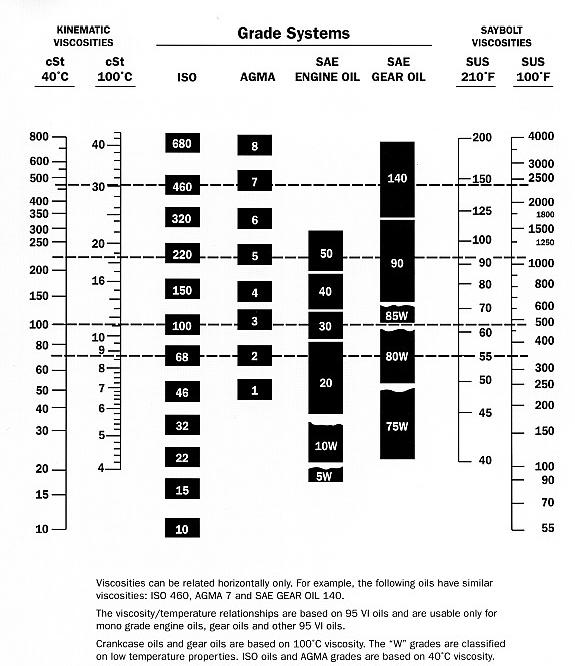
VISCOSITY @ 100deg C | VISCOSITY @ 40deg C |
MOTOR OILS, HYDRAULIC OILS | ISO GRADE |
| SAE GRADE RANGE (cST) | ISO GRADE RANGE (cST) |
5 | 3.80-* | 32 | 28.8-35.2 |
| 10 | 4.10-* | 46 | 41.4-50.6 |
| 20 | 5.60-9.29 | 68 | 61.2-74.8 |
| 30 | 9.30-12.49 | 100 | 90.0-110 |
| 40 | 12.50-16.29 | 150 | 135-165 |
| 50 | 16.30-21.89 | 220 | 198-242 |
| 60 | 21.90-26.09 | 320 | 288-352 |
| 80 | 7.0-11.00 | 460 | 414-506 |
| 90 | 13.50-23.99 | 680 | 612-748 |
| 140 | 24.00-40.99 | 1000 | 900-1100 |
| 250 | 41.00-UP | 1500 | 1350-1650 |
Viscosities can be related horizontally only
Viscosities based on 96 VI single grade oils.
ISO are specified at 40 deg C
AGMA are specified at 40 deg C
SAE 75w, 80w, 85, 5w, & 10w
specified at low temperature.
Equivalent viscosities for 100 & 210 deg F are shown
SAE 90 to 250 and 20 to 50 specified at 100 deg C.
ISO VISCOSITY CLASSIFICATION SYSTEM
Many petroleum products are graded according to the ISO Viscosity Classification System, approved by the international standards organization (ISO). Each ISO viscosity grade number corresponds to the mid-point of a viscosity range expressed in centistokes(cSt) at 40 deg C. For example, a lubricant with an ISO grade of 32 has a viscosity within the range of 28.8-35.2, the midpoint of which is 32.
Rule of Thumb: The comparable ISO grade of a given product whose viscosity in SUS at 100 deg F is known can be determined by using the following conversion formula:
SUS @ 100 deg F/5=cSt @ 40 deg C.
cst= 0.226xSUS-(195/SUS)
