The wheel and tyre Bible - everything you need to know about tyre markings, wheels, tyres (tires), rim sizes, tread depth and wear, aquaplaning, wheel balancing, aftermarket wheels, alloys, TPMS tyre pressure monitoring systems and much more.
 Win free stuffWhat's New?e-Book / Images
![[All you need to know about car tyres (Tires) and Wheels.]](tyre_bible_files/thewheelandtyrebible.gif)
 | I am in no way affiliated with any branch of the motor industry. I am just a pro-car, pro-motorbike petrolhead who is into basic maintenance. This information is the result of information-gathering, research and hands-on experience. By reading these pages, you agree to indemnify, defend and hold harmless Christopher J Longhurst, any sponsors and/or site providers against any and all claims, damages, costs or other expenses that arise directly or indirectly from you fiddling with your car or motorbike as a result of what you read here. In short: the advice here is worth as much as you are paying for it. |
Translated versions of this site:  Русский (Russian)
Page 1 ------ Page 2
 Latest blog entry
| 05/20/2009 02:27 PM |
| Driving with like-minded people |
|
I recently spent 5 days back in my childhood country of Holland,
driving all over the place in a rented Hyundai. It was a joy to be on
roads with like-minded drivers. For the most part, they all obeyed the
road signs, almost always used their indicators, waved people in to
gaps, acknowledged such gestures, and drove like pros. Especially
compared to the UK and my current home drivers in Utah. It was just so
pleasurable to be surrounded by drivers who weren't texting, weren't
talking on cellphones and who were so in tune with actually driving a
vehicle on the road, that the whole traffic stream just works like a
finely choreographed ballet. Now that's not to say they're perfect - I saw the odd idiot move - but it was 90/10 between good drivers and bad, as opposed to 5/95 which is the split back in Utah. And the less said about the UK drivers, the better. The odd thing is, and not being a trained expert, bribed official or trained consultant I could be wrong on this - the driving in Holland is commensurate with their driver education which is long, comprehensive and strict. The driving in Utah is similarly commensurate, with their driver training being essentially that you know what a car is. Could it be, and perish the thoughts, that better driver training results in better drivers? Chris - www.carbibles.com
 |
Are you confused by your car tyres? Don't know your rolling radius from your radial? Then take a good long look through this page where I hope to be able to shift some of the mystery from it all for you. At the very least, you'll be able to sound like you know what you're talking about the next time you go to get some new tyres.
Decoding all those tyre markings on the sidewall
Look at your car tyre. It's confusing isn't it? All numbers, letters, symbols, mysterious codes. Actually, most of that information in a tyre marking is surplus to what you need to know. So here's the important stuff:
![[tyre markings]](tyre_bible_files/tyre_markings.gif) | |
|---|---|
| Key | Tyre Marking Description |
| A | Manufacturers or brand name, and commercial name or identity. |
| B | Tyre size, construction and speed rating designations. Tubeless designates a tyre which requires no inner tube. See tyre sizes and speed ratings below. DIN-type tyre marking also has the load index encoded in it. These go from a load index of 50 (190kg) up to an index of 169 (5800kg). |
| C | Denotes type of car tyre construction. |
| D | M&S denotes a car tyre designed for mud and snow. Reinforced marking only where applicable. |
| E | Pressure marking requirement. |
| F | ECE (not EEC) type approval mark and number. |
| G | North American Dept of Transport compliance symbols and identification numbers. |
| H | Country of manufacture. |
As well as all that, you might also find the following embossed in the rubber tyre marking:
- The temperature rating - an indicator of how well the tyre withstands heat buildup. "A" is the highest rating; "C" is the lowest.
- The traction rating - an indicator of how well the tyre is capable of stopping on wet pavement. "AA" is the highest rating; "C" is the lowest.
- The tread-wear rating - a comparative rating for the useful life of the tyre's tread. A tyre with a tread-wear rating of 200, for example, could be expected to last twice as long as one with a rating of 100. Tread-wear grades typically range between 60 and 600 in 20-point increments. It is important to consider that this is a relative indicator, and the actual life of a tyre's tread will be affected by quality of road surfaces, type of driving, correct tyre inflation, proper wheel alignment and other variable factors. In other words, don't think that a tread-wear rating of 100 means a 30,000 mile tyre.
Encoded in the US DOT information (G in the tyre marking above) is a
two-letter code that identifies where the tyre was manufactured in
detail. In other words, what factory and in some cases, what city it
was manufactured in. It's the first two letters after the 'DOT' - in
this case "FA" denoting Yokohama.
This two-letter identifier is worth knowing in case you see a tyre
recall on the evening news where they tell you a certain factory is
recalling tyres. Armed with the two-letter identifier list, you can
figure out if you are affected. It's a nauseatingly long list, and I've
not put it on this page. But if you click here it will popup a separate window with just those codes in it.
Additional markings
In addition to all of the above, here is a comprehensive list of other markings you can find on your sidewall.
- "Star": Original tyres for BMW
- B: Bias construction, typically for motorcycles. See tyre construction below.
- BSW: Black SideWall
- C: Commercial; tyres for light trucks. Similar to LT (below)
- E4: Tyre approved according to ECE-regulations. See The E Mark below.
- FR: Flange Rib - the area above the bead of the tyre that acts as a protection for the outer lip of your alloy wheel against light contact with kerbs etc.
- LT: Light Truck tyres.
- M0: Original tyres for Mercedes-Benz
- M+S, or M&S: Mud and Snow - see car tyre types
- Made in ...: Country of production
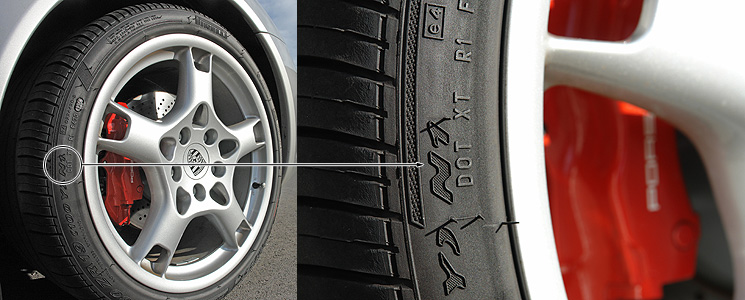
- N(number): Original tyres for Porsche. See Porsche N-rated tyres below.
- OWL: Outline White Lettering
- RF: Reinforced tyres
- SFI, or Inner: Side Facing Inwards; inside of asymmetric tyres. See tyre treads below.
- SFO, or Outer: Side Facing Outwards; outside of asymmetric tyres. See tyre treads below.
- SL: Standard Load; tyre for normal usage and loads
- TL: Tubeless
- TT: Tube-type, tyre must be used with an inner-tube
- TWI: Tread Wear Indicator.
- WSW: White SideWall
- XL: eXtra Load; tyre for vehicles of heavier standard weights
- Arrows: Denotes rotation direction for directional tread. See tyre treads below.
DOT Codes and the 6-year shelf life
 As
part of the DOT code (G in the tyre marking above), there is a tyre
manufacture date stamped on the sidewall. Take a look at yours - there
will be a three- or four-digit code. This code denotes when the tyre
was manufactured, and as a rule-of-thumb, you should never use
tyres more than 6 years old. The rubber in tyres degrades over time,
irrespective of whether the tyre is being used or not. When you get a
tyre change, if you can, see if the tyre place will allow you to
inspect the new tyres first. It's not uncommon for these shops to have
stuff in stock which is more than 6 years old. The tyre might look
brand new, but it will delaminate or have some other failure within
weeks of being put on a vehicle.
As
part of the DOT code (G in the tyre marking above), there is a tyre
manufacture date stamped on the sidewall. Take a look at yours - there
will be a three- or four-digit code. This code denotes when the tyre
was manufactured, and as a rule-of-thumb, you should never use
tyres more than 6 years old. The rubber in tyres degrades over time,
irrespective of whether the tyre is being used or not. When you get a
tyre change, if you can, see if the tyre place will allow you to
inspect the new tyres first. It's not uncommon for these shops to have
stuff in stock which is more than 6 years old. The tyre might look
brand new, but it will delaminate or have some other failure within
weeks of being put on a vehicle.
Reading the code. The code is pretty simple. The three-digit code was used for tyres manufactured before 2000. So for example 1 7 6 means it was manufactured in the 17th week of 6th year of the decade. In this case it means 1986.
For tyres manufactured in the 90's, the same code holds true but there
is a little triangle after the DOT code. So for this example, a tyre
manufactured in the 17th week of 1996 would have the code 176
After 2000, the code was switched to a 4-digit code. Same rules apply, so for example 3 0 0 3 means the tyre was manufactured in the 30th week of 2003.
Check your spare
I
had a reader email me about the age code and he pointed out that it's
wise to check your spare tyre too. In his case, he had an older vehicle
but his running tyres were all nice and fresh. It was his spare that
was the problem - it had a date code on it of 081
meaning it was manufactured in the 8th week of 1991. At the time of
writing, that was a 16 year old tyre. So you've been warned - if you're
driving an older car, check the date code of your spare. If you get a
flat and your spare is gently corroding in the boot (or trunk), it
won't do you much good at all.
DOT Age Code Calculator
The calculation built in to this page is up-to-date based on today's date. If the DOT age code on your tyres is older than this code, change your tyres.
Interesting note : in June 2005, Ford and GM admitted that tyres older than 6 years posed a hazard and from their 2006 model year onwards, started printing warnings to this effect in their drivers handbooks for all their vehicles.
The E-Mark
 Item F in the tyre marking diagram above is the E-mark. All tyres sold
in Europe after July 1997 must carry an E-mark. The mark itself is
either an upper or lower case "E" followed by a number in a circle or
rectangle, followed by a further number.
Item F in the tyre marking diagram above is the E-mark. All tyres sold
in Europe after July 1997 must carry an E-mark. The mark itself is
either an upper or lower case "E" followed by a number in a circle or
rectangle, followed by a further number.
An "E" (upper case) indicates that the tyre is certified to comply with
the dimensional, performance and marking requirements of ECE regulation
30.
An "e" (lower case) indicates that the tyre is certified to comply with
the dimensional, performance and marking requirements of Directive
92/33/EEC.
The number in the circle or rectangle denotes the country code of the
government that granted the type approval. 11 is the UK. The last
number outside the circle or rectangle is the number of the type
approval certificate issued for that particular tyre size and type.
Tyre size notations.
Okay, so you look at your car and discover that it is shod with a nice, but worn set of 185-65HR13's (from the tyre marking). Any tyre mechanic will tell you that he can replace them, and he will. You'll cough up and drive away safe in the knowledge that he's just put some more rubber on each corner of the car that has the same shamanic symbols on it as those he took off. So what does it all mean?
 | ||||
| This is the width in mm of the tyre from sidewall to sidewall when it's unstressed and you're looking at it head on (or top-down). This is known as the section width. | This is the ratio of the height of the tyre sidewall, (section height), expressed as a percentage of the width. It is known as the aspect ratio. In this case, 65% of 185mm is 120.25mm - the section height. | This is the speed rating of the tyre. | This tells you that the tyre is a radial construction. Check out tyre construction if you want to know what that means. | This is the diameter in inches of the rim of the wheel that the tyre has been designed to fit on. Don't ask me why tyre sizes mix imperial and metric measurements. They just do. Okay? |
More recently, there has been a move (especially in Europe) to adjust tyre designations to conform to DIN. This is the German Institute for standardisation - Deutsches Institut fuer Normung, often truncated to Deutsche Industrie Normal. DIN sizing means a slight change in the way the information is presented to the following:
 | |||||
| Section width | Aspect ratio | Radial | Rim diameter | Load index | Speed rating. |
Ultra high speed tyre size notations.
There is a subtle difference in the notation used on ultra high speed tyres, in particular motorcycle tyres. For the most part, the notation is the same as the DIN style described above. The difference is in the way the speed rating is displayed. For these tyres, if the speed rating is above 149mph, then a 'Z' must appear in the dimension part of the notation, as well as the actual speed rating shown elsewhere. The 'Z' is a quick way to see that the tyre is rated for over 149mph.
 | ||||||
| Section width | Aspect ratio | 149+ mph rated | Radial | Rim diameter | Load index | Speed rating. |
Classic / vintage / imperial crossply tyre sizes.
What ho. Fabulous morning for a ride in the Bentley. Problem is your
1955 Bentley is running on 7.6x15 tyres. What, you ask, is 7.6x15? Well
it's for older vehicles with imperial measurements and crossply tyres.
Both measurements are in inches - in this case a 7.6inch tyre designed
to fit a 15inch wheel. There is one piece of information missing though
- aspect ratio. Aspect ratios only began to be reduced at the end of
the 1960s to improve cornering. Previously no aspect ratio was given on
radial or crossply tyres. For crossply tyres, the initial number is
both the tread width and the sidewall height. So in my example, 7.6x15
denotes a tyre 7.6 inches across with a sidewall height which is also
7.6 inches. After conversion to the newer notation, this is the
equivalent to a 195/100 15. If you're plugging numbers into the tyre
size calculator lower down this page, I've included an aspect ratio
value of 100 for imperial calculations.
Note: I put 195/100 15 instead of 195/100R15
because technically the "R" means radial. If you're trying to get
replacement crossply tyres, the "R" won't be in the specification. However if you're trying to replace your old crossply tyres with metric radial bias tyres, then the size does have the "R" in it.
Here is a javascript calculator to turn your imperial tyre size into a radial metric tyre size:
Classic / vintage radial tyre sizes.
Remember above that I said aspect ratios only started to come into play
in the 1960s? Unlike the 100% aspect ratio for crossply tyres, for radial
tyres, it's slightly different - here an aspect ratio of 80% is be
assumed. So for example, if you come across on older tyre with 185R16
stamped on it, this describes a tyre with a tread width of 185mm and a
sidewall height which is assumed to be 80% of that; 148mm.
The
question of the aspect ratio for radial sizes has been the subject of a
lot of email to me. I've had varying figures from 80% up to 85% and
everyone claims they're right. Well one reader took it to heart and did
some in-depth research. It seem there is actually no fixed standard for
aspect ratio when it is not expressly stated in the tyre size.
Different manufacturers use slightly different figures.
The english MOT (road-worthiness test) manual states: Unless
marked otherwise, "standard" car tyres have a nominal aspect ratio of
82%. Some tyres have an aspect ratio of 80%. These have "/80" included
in the size part of the tyre marking e.g. 165/80 R13. Note: Tyres with
aspect ratios of 80% and 82% are almost identical in size and can be
safely mixed in any configuration on a vehicle.
See http://www.motuk.co.uk/manual_410.htm for the online version.
If you're plugging vintage radial numbers into the tyre size
calculator, I've included aspect ratios of 80 and 82 for these
calculations.
Alpha numeric load-based tyre sizes for vintage cars.
On some 60's and 70's era vintage vehicles, (for example the Jensen
Interceptor), the tyre sizes were denoted as ER70VR15. The '70' refers
to the section height as you might expect, and the '15' is the wheel
dimension, but on first inspection there appears to be no section
width. Actually there is, but it's in yet another odd format. In this
case, the first letter is the thing to look at. The letter itself has
no direct equivalent to modern dimensional sizes but instead relates to
load index; the higher the letter the more load it can carry. With
vintage tyres, higher loads translated into bigger tyres, so the close approximations between old load and new size these days are:
C = 185 D = 195 E = 205 F = 215 G = 225 H = 235 etc.
In this example then, ER70VR15 means 205/70 R15 with a 'V' speed
rating. Whilst many of the latter Interceptors were technically capable
of 140mph, the aerodynamic behaviour would have you quickly backing off
to about 120mph so frankly that 'V' rating is a little optimistic. If
you're looking to replace tyres for this type of vehicle, an 'H' speed
rated tyre is the better choice, and it's cheaper.
For
those of you reading this in the colonies, an example vehicle from this
era is the Chevy Nova which had E78-14 tyres. (In this case, there was
no letter 'R' meaning these were cross-ply tyres, not radials). The
equivalent size in modern notation would be 205/78 R14. The following
converter will give you a rough idea of the equivalent metric tyre size
for a given alpha numeric tyre size:
Metric Tyre sizes and the BMW blurb.
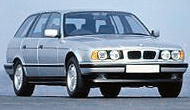 Fab! You've bought a BMW 525TD. Tyres look a bit shoddy so you go to
replace them. What the....? TD230/55ZR390? What the hell does that
mean? Well my friend, you've bought a car with metric tyres. Not that
there's any real difference, but certain manufacturers experiment with
different things. For a while, (mid 1990s) the 525TD came with arguably
experimental 390x180 alloy wheels. These buggers required huge and
non-conformal tyres. I'll break down that classification into chunks
you can understand with your new-found knowledge:
Fab! You've bought a BMW 525TD. Tyres look a bit shoddy so you go to
replace them. What the....? TD230/55ZR390? What the hell does that
mean? Well my friend, you've bought a car with metric tyres. Not that
there's any real difference, but certain manufacturers experiment with
different things. For a while, (mid 1990s) the 525TD came with arguably
experimental 390x180 alloy wheels. These buggers required huge and
non-conformal tyres. I'll break down that classification into chunks
you can understand with your new-found knowledge:
TD - ignore that. 230 = cross section 230mm. 55 = 55% sidewall height.
Z=very high speed rating. R390=390mm diameter wheels. These are the
equivalent of about a 15.5" wheel. There's a nice standard size for
you. And you, my friend, have bought in to the long-raging debate about
those tyres. They are an odd size, 180x390. Very few manufacturers make
them now and if you've been shopping around for them, you'll have had
the odd heart-stopper at the high price. The advice from the BMWcar magazine forum
is to change the wheels to standard sized 16" so there's more choice of
tyres. 215-55R16 for example. The technical reason for the 390s
apparently is that they should run flat in the event of a puncture but
that started a whole debate on their forum and serious doubts were
expressed. You've been warned...
If you're European, you'll know that there's one country bound to throw a spanner in the works of just about anything. To assist BMW in the confusion of buyers everywhere, the French, or more specifically Michelin have decided to go one step further out of line with their Pax tyre system. See the section later on to do with run-flat tyres to find out how they've decided to mark their wheels and tyres.
Land Rovers and other off-road tyre sizes.
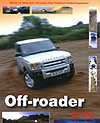 On
older Land Rovers (on the LWB/110 vehicles and many "off-roaders"),
you'll often find tyres with a size like 750x16. This is another weird
notation which defies logic. In this case, the 750 refers to a
decimalised notation of an inch measurement. 750 = 7.50 inches,
referring to the "normal inflated width" of the tyre - i.e. the
external maximum width of the inflated, unladen tyre. (This is
helpfully also not necessarily the width of the tread itself). The 16
still means 16 inch rims. Weird eh? The next question if you came to
this page looking for info on Land Rover tyres will be "What size tyre
is that the equivalent of in modern notation?". Simple. It has no
aspect ratio and the original tyres would likely be cross-ply, so from
what you've learned a couple of paragraphs above, assume 100% aspect
ratio. Convert 7.5inches to be 190mm. That gives you a 190/100 R16
tyre. (You could use the calculator in the section on Classic / vintage / imperial crossply tyre sizes above to get the same result.)
On
older Land Rovers (on the LWB/110 vehicles and many "off-roaders"),
you'll often find tyres with a size like 750x16. This is another weird
notation which defies logic. In this case, the 750 refers to a
decimalised notation of an inch measurement. 750 = 7.50 inches,
referring to the "normal inflated width" of the tyre - i.e. the
external maximum width of the inflated, unladen tyre. (This is
helpfully also not necessarily the width of the tread itself). The 16
still means 16 inch rims. Weird eh? The next question if you came to
this page looking for info on Land Rover tyres will be "What size tyre
is that the equivalent of in modern notation?". Simple. It has no
aspect ratio and the original tyres would likely be cross-ply, so from
what you've learned a couple of paragraphs above, assume 100% aspect
ratio. Convert 7.5inches to be 190mm. That gives you a 190/100 R16
tyre. (You could use the calculator in the section on Classic / vintage / imperial crossply tyre sizes above to get the same result.)
Generally speaking, the Land Rover folks reckon a 265/65R16 is a good
replacement for the "750", although the tread is slightly wider and
might give some fouling problems on full lock. It's also 5% smaller in
rolling radius so your speed will over-read by about 4mph at 70mph. If
you can't fit those, then the other size that is recommended by
Landrover anoraks is 235/85R16.
On Discoveries, Range Rovers, or the SWB Defenders/Series land rovers
you'll find "205" tyres, denoting 205mm x 16 inches. The 205 type tyres
can generally be replaced with 235/70R16 or 225/75R16. The 235 is a
wider tyre and the general consensus in Land Rover circles is that it
holds the road better when being pushed.
If you're really into this stuff, you ought to read Tom Sheppard's Off Roader Driving
(ISBN 0953232425). It's a Land Rover publication first published in
1993 as "The Land Rover Experience". It's been steadily revised and you
can now get the current edition from Amazon. I've even helpfully
provided you with this link so you can go straight to it....
LT (Light Truck) imperial tyre sizes.
Confused yet? Okay how about this: 30x9.5 R15 LT or LT30x9.5/15. Yet another mix-and-match notation, this time for (amongst other things) light truck classification tyres. All the information you need to figure out a standard size is in there, but in the usual weird order. In this case the 30 refers to a 30 inch overall diamter. The 9.5 refers to a 9.5 inch wide tread. The R15 refers to a 15 inch diameter wheel. In order to figure out the closest standard notation, you know the tread width which (in this example) is 9.5 inches or 240mm. The sidewall height is the overall height minus the wheel diameter all divided by 2. So 30 inches minus 15 inches, which gives you 15 inches. Half that to get 7.5 inches and that's the sidewall height - 190mm. Remember the section value is a percentage of the tread width - in this case 190mm/240mm gives us a section of 80% (near enough). So the standard size for 30x9.5R15 works out to be 240/80R15. In truth you can barely find a tyre that size so most off-roaders with that sort of tyre size go for 245/70R15 which is more common. For your convenience, another calculator then.
Porsche N-rated tyres.
 Porsche
designs and manufacturers some of the highest performance cars in the
world (with the exception of the butt-ugly Cayenne). All this design
and performance is worth nothing if you put cheap Korean tyres on your
Porsche though, and because of that prospect, Porsche introduced the N
rating or N specification system. In order for a manufacturer to be an
OE (original equipment) supplier of tyres for Porsches, they must work
with the Porsche engineers at the development and testing stage. They
concentrate on supreme dry-weather handling but they also spend a
considerable amount of time working on wet-weather handling. Porsches
are typically very tail-heavy because of the position of the engine
relative to the rear wheels, and with traction control off, it's
extremely easy to spin one in the wet. Because of this, Porsche specify
a set of wet-grip properties which is way above and beyond the
requirements of any other car manufacturer.
Porsche
designs and manufacturers some of the highest performance cars in the
world (with the exception of the butt-ugly Cayenne). All this design
and performance is worth nothing if you put cheap Korean tyres on your
Porsche though, and because of that prospect, Porsche introduced the N
rating or N specification system. In order for a manufacturer to be an
OE (original equipment) supplier of tyres for Porsches, they must work
with the Porsche engineers at the development and testing stage. They
concentrate on supreme dry-weather handling but they also spend a
considerable amount of time working on wet-weather handling. Porsches
are typically very tail-heavy because of the position of the engine
relative to the rear wheels, and with traction control off, it's
extremely easy to spin one in the wet. Because of this, Porsche specify
a set of wet-grip properties which is way above and beyond the
requirements of any other car manufacturer.
OE tyres for Porsches
must successfully pass lab tests to prove that they would be capable of
adequately supporting a Porsche at top speed on a German Autobahn. Once
the lab tests are done, they must go on to track and race tests where
prototypes are evaluated by Porsche engineers for their high-speed
durability, uniformity and serviceability. If they pass all the tests,
Porsche give the manufacturer the go-ahead to put the car tyres into
production and then they can proudly claim they are an N-rated Porsche
OEM (Original Equipment Modifier).
The N-ratings go from 0 (zero)
to 4, marked as N-0, N-1 etc. This N-rating, stamped into a tyre
sidewall, clearly identifies these tyres as having gone through all the
nauseating R&D and testing required by Porsche as described above.
The number designates the revision of the design. So for a totally new
design, the first approved version of it will be N-0. When the design
is improved in some way, it will be re-rated as an N-1. If the design
changes completely so as to become a totally new tyre, it will be
re-rated at N-0.
If
you've got a Porsche, then you ought to be aware that as well as using
N-rated tyres, you ought to use matching tyres all around because many
Porsches have different sizes tyres front and rear. So for example if
you have a Porsche with N-3 rated tyres and the rear ones need
replacing but the model has been discontinued, you should not get N-0's and put them on the back leaving the old N-3's on the front. You should replace all of them with the newer-designed re-rated N-0 tyres. But then you own a Porsche so you can certainly afford four new tyres....
One final point. You may go into a tyre warehouse and find two tyres
with all identical markings, sizes and speed ratings, but one set has
an N-rating. Despite everything else being the same, the non-N-rated
tyres have not
been certified for use on a Porsche. You can buy them, and you can put
them on your car, but if you stuff it into the armco at 150mph, Porsche
will just look at you and with a very teutonic expression ask why you
didn't use N-rated tyres.
| Like the site? Help Chris buy a bike. The page you're reading is free, but if you like what you see and feel you've learned something, throw me a $5 bone as a token of your appreciation. Help me buy the object of my desire. |
Lies, Damn Lies and Speed ratings.
All tyres are rated with a speed letter. This indicates the maximum speed that the tyre can sustain for a ten minute endurance without coming to pieces and destroying itself, your car, the car next to you and anyone else within a suitable radius at the time.
| Speed Symbol | Max Speed Capability | Speed Symbol | Max Speed Capability | ||
|---|---|---|---|---|---|
| Km/h | MPH | Km/h | MPH | ||
| L | 120 | 75 | S | 180 | 113 |
| M | 130 | 81 | T | 190 | 118 |
| N | 140 | 87 | U | 200 | 125 |
| P | 150 | 95 | H | 210 | 130 |
| Q | 160 | 100 | V | 240 | 150 |
| R | 170 | 105 | W | 270 | 168 |
| Y | 300 | 186 | |||
| Z | 240+ | 150+ | |||
'H' rated tyres are becoming the most commonplace and widely used tyres, replacing 'S' and 'T' ratings. Percentage-wise, the current split is something like this: S/T=67%, H=23%, V=8%. Certain performance cars come with 'V' or 'Z' rated tyres as standard. This is good because it matches the performance capability of the car, but bad because you need to re-mortgage your house to buy a new set of tyres.
UTQG Ratings
The UTQG - Uniform Tyre Quality Grade - test is required of all dry-weather tyres ("snow" tyres are exempt) before they may be sold in the United States. This is a rather simple-minded test that produces three index numbers : Tread life, Traction and Temperature.
- The tread life index measures the relative tread life of the tyre compared to a "government reference". An index of 100 is equivalent to an estimated tread life of 30,000 miles of highway driving.
- The traction test is a measure of wet braking performance of a new tyre. There is no minimum stopping distance, therefore a grade "C" tyre can be very poor in the wet.
- The temperature test is run at high speeds and high ambient temperatures until the tyre fails. To achieve a minimum grade of "C" the tyre must safely run at 85mph for 30 minutes, higher grades are indicative of surviving higher speeds (a rating of "B" is, for some reason, roughly equivalent to a European "S" rating, a rating of "A" is equivalent to an "H" rating.)
There are some exceptions: Yokohama A008's are temperature rated "C" yet are sold as "H" speed rated tyres. These UTQC tests should be used only as a rough guide for stopping. If you drive in the snow, seriously consider a pair of (if not four "Snow Tyres" Like life, this tyre test is entirely subjective.
Load indices.
The load index on a tyre is a numerical code associated with the
maximum load the tyre can carry. These are generally valid for speed
under 210km/h (130mph). Once you get above these speeds, the
load-carrying capacity of tyres decreases and you're in highly
technical territory the likes of which I'm not going into on this page.
The table below gives you most of the Load Index (LI) values you're
likely to come across. For the sake of simplicity, if you know your car
weighs 2 tons - 2000kg - then assume an even weight on each wheel. 4
wheels at 2000kg = 500kg per wheel. This is a load index of 84. The
engineer in you should add 10% or more for safety's sake. For this
example, I'd probably add 20% for a weight capacity of 600kg - a load
index of 90. Generally speaking, the average car tyre is going to have
a much higher load index than you'd ever need. It's better to have
something that will fail at speeds and stress levels you physically
can't achieve, than have something that will fail if you nudge over
60mph with a six pack in the trunk.
|
|
|
|
|
|
|
|
|
|
|
A Word on "guaranteed" tyres
When I moved to America, I noticed a lot of car tyre shops offering
tyres with x,000 mile guarantees. It's not unusual to see 60,000 mile
guarantees on tyres. It amazed me that anyone would be foolish enough
to put a guarantee on a consumable product given that the life of the
tyre is entirely dependent on the suspension geometry of the car it is
being used on, the style of driving, the types of road, and the
weather. Yet many manufacturers and dealers offer an unconditional*
guarantee. There's the catch though. The '*' after the word
"unconditional" takes you elsewhere on their information flyer, to the
conditions attached to the unconditional guarantee. If you want to
claim on that guarantee, typically you'll have to prove the tyres were
inflated to the correct pressure all the time, prove they were rotated
every 3000 miles, prove the suspension geometry of your car has always
been 100%, prove you never drove over 80mph, prove you never left them
parked in the baking hot sun or freezing cold ice, and prove you never
drove on the freeways. Wording in the guarantee will be similar to:
"used in normal
service on the vehicle on which they were originally fitted and in
accordance with the maintenance recommendations and safety warnings
contained in the attached owner's manual"
and
"The
tyres have been rotated and inspected by a participating (tyre brand)
tyre retailer every 7,500 miles, and the attached Mounting and Rotation
Service Record has been fully completed and signed"
There will typically also be a long list of what isn't covered. For example:
Road
hazard injury (e.g., a cut, snag, bruise, impact damage, or puncture),
incorrect mounting of the tire, tire/wheel imbalance, or improper
repair, misapplication, improper maintenance, racing, underinflation,
overinflation or other abuse, uneven or rapid wear which is caused by
mechanical irregularity in the vehicle such as wheel misalignment,
accident, fire, chemical corrosion, tire alteration, or vandalism,
ozone or exposure to weather.
Given that you really
can't prove any of this, the guarantee is, therefore, worthless because
it is left wide open to interpretation by the dealer and/or
manufacturer. For a good example, check out the Michelin warranty or
guarantee, available on their website (PDF file).
Don't be taken in by this - it's a sales ploy and nothing more. Nobody - not even the manufacturers - can guarantee that their tyre won't de-laminate or catch a puncture the moment you leave the tyre shop. Buy your tyres based on reviews, recommendations, previous experience and the recommendation of friends. Do not buy one simply because of the guarantee.
Big-chain dealers vs. manufacturer warranties.
A reader pointed out to me that the dealer he worked for honoured tyre warranties in a no-fuss manner requiring simply the original receipt for when they were purchased and one small form to be filled out. They then typically used a pro-rated refund applied to the new tyre. For example if someone paid $100 for a tyre guaranteed for 60,000 miles and it was dead after 40,000, pro-rata the customer had 34% of the warranty mileage left in the tyre. They would either refund $34 (34% of $100) or apply it against the cost of a replacement. I suspect this no-fuss attitude is down to buying power. Large chain stores like CostCo or Sears will have far more clout with the manufacturers than you or I with our 4 tyres. After all they buy bulk in he hundreds if not thousands. For the consumer, it makes them look good because you get a fair trade. They can argue the toss with the manufacturers later, leveraging their position as a bulk buyer in the market to get the guarantees honoured.
Car tyre types.
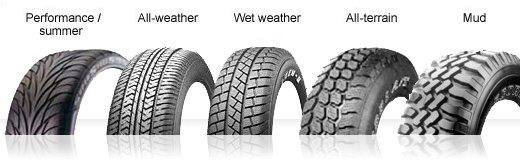 There
are several different types of car tyre that you, the humble consumer,
can buy for your car. What you choose depends on how you use your car,
where you live, how you like the ride of your car and a variety of
other factors. The different classifications are as follows, and some
representative examples are shown in the image on the right.
There
are several different types of car tyre that you, the humble consumer,
can buy for your car. What you choose depends on how you use your car,
where you live, how you like the ride of your car and a variety of
other factors. The different classifications are as follows, and some
representative examples are shown in the image on the right.
Performance tyres or summer tyres
Performance tyres are designed for faster cars or for people who prefer
to drive harder than the average consumer. They typically put
performance and grip ahead of longevity by using a softer rubber
compound. Tread block design is normally biased towards outright grip
rather than the ability to pump water out of the way on a wet road. The
extreme example of performance tyres are "slicks" used in motor racing,
so-called because they have no tread at all.
All-round or all-season tyres
These tyres are what you'll typically find on every production car that
comes out of a factory. They're designed to be a compromise between
grip, performance, longevity, noise and wet-weather safety. For
increased tyre life, they are made with a harder rubber compound, which
sacrifices outright grip and cornering performance. For 90% of the
world's drivers, this isn't an issue. The tread block design is
normally a compromise between quiet running and water dispersion - the
tyre should not be too noisy in normal use but should work fairly well
in downpours and on wet roads. All-season tyres are neither excellent
dry-weather, nor excellent wet-weather tyres, but are, at best, a
compromise.
Wet-weather tyres
Rather than use an even harder rubber compound than all-season tyres,
wet weather tyres actually use a softer compound than performance
tyres. The rubber needs to heat up quicker in cold or wet conditions
and needs to have as much mechanical grip as possible. They'll normally
also have a lot more siping to try to disperse water from the contact
patch. Aquachannel tyres are a subset of winter or wet-weather tyres
and I have a little section on them further down the page.
Snow & mud or ice : special winter tyres
Winter tyres come at the other end of the spectrum to performance
tyres, obviously. They're designed to work well in wintery conditions
with snow and ice on the roads. Winter tyres typically have larger, and
thus noiser tread block patterns. In extreme climates, true snow tyres
have tiny metal studs fabricated into the tread for biting into the
snow and ice. The downside of this is that they are incredibly noisy on
dry roads and wear out both the tyre and the road surface extremely
quickly if driven in the dry. Mud & snow tyres typically either
have 'M&S' stamped on the tyre sidewall. Snow & Ice tyres have
a snowflake symbol.
All-terrain tyres
All-terrain tyres are typically used on SUVs and light trucks. They are
larger tyres with stiffer sidewalls and bigger tread block patterns.
The larger tread block means the tyres are very noisy on normal roads
but grip loose sand and dirt very well when you take the car or truck
off-road. As well as the noise, the larger tread block pattern means
less tyre surface in contact with the road. The rubber compound used in
these tyres is normally middle-of-the-road - neither soft nor hard.
Mud tyres
At the extreme end of the all-terrain tyre classification are mud
tyres. These have massive, super-chunky tread blocks and really
shouldn't ever be driven anywhere other than loose mud and dirt. The
tread sometimes doesn't even come in blocks any more but looks more
like paddles built in to the tyre carcass.
Tyre constructions.
Simply put, if you bought a car in the last 20 years or so, you should be riding on radial tyres. If you're not, then it's a small miracle you're still alive to be reading this. Radial tyres wear much better and have a far greater rigidity for when cars are cornering and the tyres are deforming.
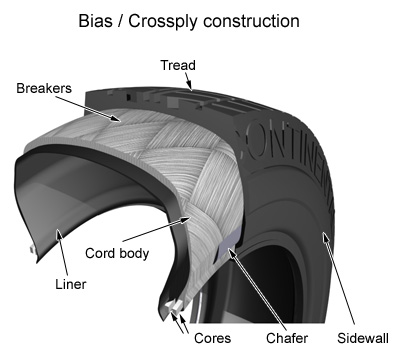
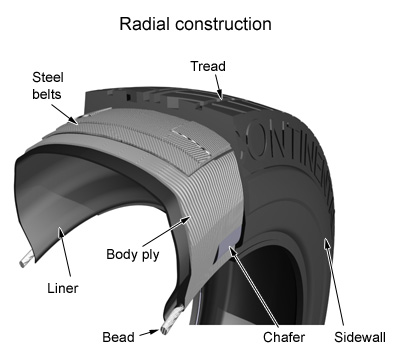
| Cross-ply components | Radial components |
|---|---|
| The tread consists of specially compounded/vulcanised rubber which can have unique characteristics ranging from wear resistance, cut resistance, heat resistance, low rolling resistance, or any combination of these. The purpose of the tread is to transmit the forces between the rest of the tyre and the ground. | |
| The sidewall is a protective rubber coating on the outer sides of the tyre. It is designed to resist cutting, scuffing, weather checking, and cracking. | |
| The chafer protects the bead and body from chafing (wear from rubbing) where the tyre is in contact with the rim. | The chafer of a radial tyre acts as a reinforcement. It increases the overall stiffness of the bead area, which in turn restricts deflection and deformation and increases the durability of the bead area. It also assists the bead in transforming the torque forces from the rim to the radial ply. |
| The liner is an integral part of all tubeless pneumatic tyres. It covers the inside of the tyre from bead to bead and prevents the air from escaping through the tyre. | |
| The bead of a cross-ply tyre consists of bundles of bronze coated high tensile strength steel wire strands which are insulated with rubber. A cross-ply tyre designed for off-road use typically has two or three bundles. A radial on-road tyre normally only has one. The bead is considered the foundation of the tyre. It anchors the bead on the rim. | |
| The cord body is also known as the tyre carcass. It consists of layers of nylon plies. The cord body confines the pressure, which supports the tyre load and absorbs shocks encountered during driving. Each cord in each ply is completely surrounded by resilient rubber. These cords run diagonally to the direction of motion and transmit the forces from the tread down to the bead. | The body ply of a radial tyre is made up of a single layer of steel cord wire. The wire runs from bead to bead laterally to the direction of motion (hence the term "radial plies"). The body ply is a primary component restricting the pressure which ultimately carries the load. The body ply also transmits the forces (torque, torsion, etc.) from the belts to the bead and eventually to the rim. |
| The breakers are also know as belts. They provide protection for the cord body from cutting. They also increase tread stability which resists cutting. Breakers can be made of nylon, aralon, or steel wire. | The belts are layers of steel cord wires located between the tread and the body ply. Off-road tyres can have up to five belts. Road tyres typically have one or two. The steel wire of the belts run diagonally to the direction of motion. The belts increase the rigidity of the tread which increases the cut resistance of the tyre. They also transmit the torque forces to the radial ply and restrict tyre growth which prevents cutting, cut growth and cracking. |
Comparison of Radial vs. Cross-ply performance
This little table gives you some idea of the advantages and disadvantages of the two types of tyre construction. You can see the primary reasons why radial tyres are almost used on almost all the world's passenger vehicles now, including their resistance to tearing and cutting in the tread, as well as the better overall performance and fuel economy.
| Cross-ply | Radial | |
|---|---|---|
| Vehicle Steadiness |  |  |
| Cut Resistance - Tread | | |
| Cut Resistance - Sidewall | | |
| Repairability | | |
| Self Cleaning | | |
| Traction | | |
| Heat Resistance | | |
| Wear Resistance | | |
| Flotation | | |
| Fuel Economy | | |
A subset of tyre construction : tyre tread.
You thought tread was the shape of the rubber blocks around the outside
of your tyre didn't you? Well it is, but it's also so much more. The
proper choice of tread design for a specific application can mean the
difference between a comfortable, quiet ride, and a piss poor excuse
for a tyre that leaves you feeling exhausted whenever you get out of
your car.
A proper tread design improves traction, improves handling and
increases Durability. It also has a direct effect on ride comfort,
noise level and fuel efficiency. Believe it or not, each part of the
tread of your tyre has a different name, and a different function and
effect on the overall tyre. Your tyres might not have all these
features, but here's a rundown of what they look like, what they're
called and why the tyre manufacturers spend millions each year fiddling
with all this stuff.
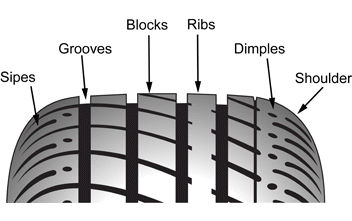
Sipes
are the small, slit-like grooves in the tread blocks that allow the
blocks to flex. This added flexibility increases traction by creating
an additional biting edge. Sipes are especially helpful on ice, light
snow and loose dirt.
Grooves create voids for better water
channeling on wet road surfaces (like the Aquachannel tyres below).
Grooves are the most efficient way of channeling water from in front of
the tyres to behind it. By designing grooves circumferentially, water
has less distance to be channeled.
Blocks are the segments that make up the majority of a tyre's tread. Their primary function is to provide traction.
Ribs are the straight-lined row of blocks that create a circumferential contact "band."
Dimples are the indentations in the tread, normally towards the outer edge of the tyre. They improve cooling.
Shoulders
provide continuous contact with the road while maneuvering. The
shoulders wrap slightly over the inner and outer sidewall of a tyre.
The Void Ratio
is the amount of open space in the tread. A low void ratio means a tyre
has more rubber is in contact with the road. A high void ratio
increases the ability to drain water. Sports, dry-weather and high
performance tyres have a low void ratio for grip and traction.
Wet-weather and snow tyres have high void ratios.
Tread patterns
There are hundreds if not thousands of car tyre tread patterns available. The actual pattern itself is a mix of functionality and aesthetics. Companies like Yokohama specialise in high performance tyres with good-looking tread patterns. Believe it or not, the look of the pattern is very important. People want to be safe with their new tyres, but there's a vanity element to them too. For example, in the following comparison, which would you prefer to have on your car?
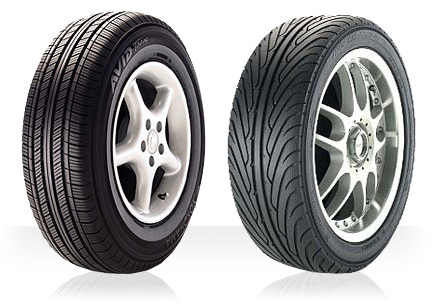
The thought process you're going through whilst looking at those two
tyres is an example of the sort of thing the tyre manufacturers are
interested in. Sometimes they have focus groups and public
show-and-tells for new designs to gauge public reaction. For example,
given the choice, I'd prefer the tread pattern on the right. The
challenge for the manufacturers is to make functionally safe tyres
without making them look like a random assortment of rubber that's just
been glued to a wheel in a random fashion.
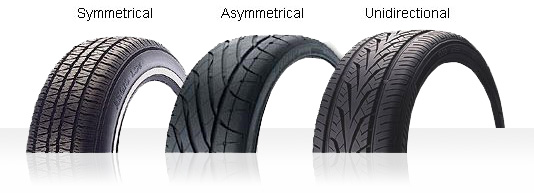
In amongst all this, there are three basic types of tread pattern that the manufacturers can choose to go with:
Symmetrical: consistent across the tyre's face. Both halves of the treadface are the same design.
Asymmetrical:
the tread pattern changes across the face of the tyre. These designs
normally incorporates larger tread blocks on the outer portion for
increased stability during cornering. The smaller inner blocks and
greater use of grooves help to disperse water and heat. Asymmetrical
tyres tend to also be unidirectional tyres.
Unidirectional:
designed to rotate in only one direction, these tyres enhance
straight-line acceleration by reducing rolling resistance. They also
provide shorter stopping distance. Unidirectional tyres must be
dedicated to a specific side of the vehicle, so the information on the
sidewall will always include a rotational direction arrow. Make sure
the tyres rotate in this direction or you'll get into all sorts of
trouble.
Tread depth and tread wear indicators
 For
the most part, motoring law in most countries determines that your
tyres need a minimum tread depth to be legal. This varies from country
to country but is normally around 1.6mm. To assist you in figuring out
when you're getting close to that value, most tyres have tread wear
indicators built into them. If you look around the tread carefully, at
some point you'll see a bar of rubber which goes across the tread and
isn't part of the regular pattern (see the picture here for an
example). This is the wear indicator. It's really basic, but it's also
pretty foolproof. The tread wear indicator is moulded into the rubber
at a depth of about 2mm normally. As the rubber in your tyres wears
away due to everyday use, the tread wears down. At some point, the tyre
tread will become flush with the wear indicator (which is normally
recessed into the tread). At this point you have about 2mm of tread
left - in other words it is time to change tyres.
For
the most part, motoring law in most countries determines that your
tyres need a minimum tread depth to be legal. This varies from country
to country but is normally around 1.6mm. To assist you in figuring out
when you're getting close to that value, most tyres have tread wear
indicators built into them. If you look around the tread carefully, at
some point you'll see a bar of rubber which goes across the tread and
isn't part of the regular pattern (see the picture here for an
example). This is the wear indicator. It's really basic, but it's also
pretty foolproof. The tread wear indicator is moulded into the rubber
at a depth of about 2mm normally. As the rubber in your tyres wears
away due to everyday use, the tread wears down. At some point, the tyre
tread will become flush with the wear indicator (which is normally
recessed into the tread). At this point you have about 2mm of tread
left - in other words it is time to change tyres.
Minimum legal tread depth does not mean "safe".
Actually it's wise to change your tyres before you get to the wear indicator, as by this point, the effectiveness of the tyre in the wet is pretty limited, and its grip in the dry won't be as sharp as it was when new. In 2006, Auto Express magazine in the UK did some pretty rigorous testing on "legal" tyres. They are campaigning to have the legal minimum in England increased from 1.6mm up to 3mm. Their reasons are backed up by testing : at 1.6mm, despite still being perfectly legal, the stopping distance is increased by 40% in the wet over tyres that have 3mm of tread left. They performed the test using the same car, under the same conditions with the same driver. The only thing that changed was the tyres. The Fifth Gear TV program performed a graphic demonstration of the problem by equipping two cars with different tyres. The lead car had 3mm of tread left, the trailing car had 1.6mm. The cars were driven at 50mph at a distance of 3 car lengths apart - not safe, but representative of the real-world. When the lead driver performed an emergency stop, the trailing driver reacted nearly instantly, but despite years of training and an ABS-equipped car, he slammed into the lead vehicle still doing 35mph. This was the result:
I've sliced up the video into a short clip so you can see what happened. Download the clip here. You'll need the DiVX codec installed to play it. The clip is, of course, ©2006 Channel Five in the UK.
Despite knowledge like this, there are always going to be people who
ignore their tyres and at the point where the tread is gone completely,
they are within a couple of hundred miles of driving on the metal
overbanding in the tyre carcass itself. There's really no excuse for
not changing your tyres when the tread gets low. Sure, when you go to
get them done, the price will seem steep - it always does with tyres.
But it will seem like a wise investment next time you find yourself
pirouetting across three lanes of wet motorway traffic towards the
crash barrier. Which leads us nicely on to the subject of.....
Aquaplaning / hydroplaning.
By this point you probably understand that one of the functions of your car's tyres is to pump water out of the tread on wet road surfaces. As the tyre spins, the tread blocks force water into the sipes and grooves and those channel water out and away from the contact patch where the tyre meets the road. As your tread wears down, the depth of the grooves and sipes gets less, which in turn reduces the tyre's ability to remove water. At some point, the tread will get down to a point where all but the lightest of showers will turn any road into a skating rink for you. This is called aquaplaning and how it happens is really simple: as you drive in the wet, your tyres form a natural but slight bow wave on the road surface. Some of the water escapes around the side of the tyre as spray whilst the rest goes under the tyre. The tyre tread pumps the water out to the sides and the contact patch remains in good contact with the road. As the amount of water becomes more or deeper (heavier rain, or travelling faster for example), you end up with the tyre riding on a cushion of water as the volume of water in the 'bow wave' overcomes the tyre's ability to disperse it. At this point, it doesn't matter what you do - braking, accelerating and steering have no effect because the tyre is actually making no contact with the road surface any more. In fact, the worst thing you can do is to brake, because stopping the rotation of the wheels removes any last chance the tyres have at removing the water. If you let off the accelerator instead, as wind resistance and other factors begin to slow you down, at some point you'll go back through the critical depth of water and the tyres will begin to grip again.
 | ||
| Under good conditions, with adequate tread, light water buildup and good road drainage, the tyre tread is able to disperse the water from the road surface so that the tyre's contact patch remains in good contact with the road. | As conditions worsen - less drainage, higher speed or more rain, the amount of water on the road surface increases. The tread is only able to disperse so much water, and begins to become innundated. | At this point, the tread is overwhelmed with water and is no longer effective. Water is incompressible so the tyre is lifted off the road and skates across the surface of the water. |
Aquaplaning doesn't just happen because of dodgy tyre tread depth. You can get into just as much trouble with brand new tyres if you go careening through a deep puddle. The new tyres may have their full complement of tread depth with nice deep grooves and sipes, but the depth of the water in the puddle might be so much that the volume of water can't be removed quickly enough. Every tyre has a finite limit to the amount of water it can pump out of the way. Exceed that limit and you're aquaplaning.
Road surface design
It's worth
spending a moment whilst we're on the subject of aquaplaning to talk
about road surface design. I know your morning commute along pot-holed
roads full of cracks might lead you to believe otherwise, but for the
most part, roads, especially motorways, are designed to lessen the risk
of aquaplaning in the first place. Most roads are built with a slope to
one side or the other, or are crowned in the middle (ie. the road
surface is higher in the middle than at the sides). The idea being that
any water buildup is encouraged to run off the road surface to drainage
ditches at the sides. Some newer designs of asphalt are more porous
than the old stuff, and when laid on top of a subsurface drainage
system, will allow a certain amount of water to run down through the
road surface as well as off to the sides.
Slip sliding in a summer downpour.
If you've driven for any length of time and ever been caught in a
downpour on a hot summer day, you'll have seen how a super-glue sticky
surface can turn into a teflon ice rink at the drop of a hat. This
unusual phenomenon occurs because of the way most road surfaces are
manufactured and put down. There's a lot of oil and tar involved in
laying asphalt and over the course of its lifetime, a road surface will
naturally leech out these products. During normal dry-weather driving
or a light rain storm, they get dispersed gradually by the action of
trucks, cars and motorbikes driving on the road. However, in a
downpour, the road surface cools off extremely quickly. As it contracts
slightly, the oils and tars are squeezed out at a quicker rate than
normal and because oil is less dense than water, any residue floats to
the top of the layer of rain water on the road. The result is
oil-on-water which has zero grip. Next time you drive through a sudden
summer downpour, look at the road surface once it has stopped raining -
you'll see it covered in rainbow artifacts where the sunlight is
reflecting off the wet, oily layer.
| Like the site? Help Chris buy a bike. The page you're reading is free, but if you like what you see and feel you've learned something, throw me a $5 bone as a token of your appreciation. Help me buy the object of my desire. |
Aquachannel tyres.
![[aquatread]](tyre_bible_files/aquatread.gif) Towards the end of the 90's, there was a gradually increasing trend for
manufacturers to design and build so-called aquachannel tyres. Brand
names you might recognise are Goodyear Aquatread and Continental Aquacontact.
These differ noticeably from the normal type of tyre you would expect
to see on a car in that the have a central groove running around the
tread pattern. This, combined with the new tread patterns themselves
lead the manufacturers to startling water-removal figures. According to
Goodyear, their versions of these tyres can expel up to two gallons of
water a second from under the tyre when travelling at motorway speeds.
My personal experience of these tyres is that they work. Very well in
fact - they grip like superglue in the wet. The downside is that they
are generally made of a very soft compound rubber which leads to
greatly reduced tyre life. You've got to weigh it up - if you spend
most of the year driving around in the wet, then they're possibly worth
the extra expense. If you drive around over 50% of the time in the dry,
then you should think carefully about these tyres because it's a lot of
money to spend for tyres which will need replacing every 10,000 miles
in the dry.
Towards the end of the 90's, there was a gradually increasing trend for
manufacturers to design and build so-called aquachannel tyres. Brand
names you might recognise are Goodyear Aquatread and Continental Aquacontact.
These differ noticeably from the normal type of tyre you would expect
to see on a car in that the have a central groove running around the
tread pattern. This, combined with the new tread patterns themselves
lead the manufacturers to startling water-removal figures. According to
Goodyear, their versions of these tyres can expel up to two gallons of
water a second from under the tyre when travelling at motorway speeds.
My personal experience of these tyres is that they work. Very well in
fact - they grip like superglue in the wet. The downside is that they
are generally made of a very soft compound rubber which leads to
greatly reduced tyre life. You've got to weigh it up - if you spend
most of the year driving around in the wet, then they're possibly worth
the extra expense. If you drive around over 50% of the time in the dry,
then you should think carefully about these tyres because it's a lot of
money to spend for tyres which will need replacing every 10,000 miles
in the dry.
TwinTire™
![[twintyre2]](tyre_bible_files/twintyre2.jpg)
![[twintyre1]](tyre_bible_files/twintyre1.gif) This
was an idea from the USA based on the twin tyres used in Western
Australia on their police vehicles. It's long been the practice for
closed-wheel racing cars, such as NASCAR vehicles, to use two inner
tubes inside each tyre, allowing for different pressures inside the
same tyre. They also allow for proper run-flat puncture capability.
TwinTires tried putting the same principle into effect for those of us
with road-going cars. Their system used specially designed wheel rims
to go with their own unique type of tyres. Each wheel rim was actually
molded as two half-width rims joined together. The TwinTires tyres then
fitted those double rims. Effectively, you got two independent tyres
per wheel, each with their own inner tube or tubeless pressure. The
most obvious advantage of this system was that it was an almost
failsafe puncture proof tyre. As most punctures are caused by single
objects entering the tyre at a single point, with this system, only one
tyre would deflate, leaving the other untouched so that your vehicle
was still controllable. TwinTires claimed a reduction in braking
distance too, typically from 150ft down to 120ft when braking from a
fixed 70mph. The other advantage was that the system was effectively an
evolution of the Aquatread type single tyres that can be bought over
the counter. In the dry, you had more or less the same contact area as
a normal tyre. In the wet, most of the water was channeled into the gap
between the two tyres leaving (supposedly) a much more efficient wet
contact patch. History is cruel to those who buck the trend, and as it
turned out this system was just a passing fad. Their products
disappeared around 2001 and the website vanished shortly thereafter.
I've not seen any trace of them since. Daunltess Motor Corp are the last remaining suppliers and they have all the remaining stock.
This
was an idea from the USA based on the twin tyres used in Western
Australia on their police vehicles. It's long been the practice for
closed-wheel racing cars, such as NASCAR vehicles, to use two inner
tubes inside each tyre, allowing for different pressures inside the
same tyre. They also allow for proper run-flat puncture capability.
TwinTires tried putting the same principle into effect for those of us
with road-going cars. Their system used specially designed wheel rims
to go with their own unique type of tyres. Each wheel rim was actually
molded as two half-width rims joined together. The TwinTires tyres then
fitted those double rims. Effectively, you got two independent tyres
per wheel, each with their own inner tube or tubeless pressure. The
most obvious advantage of this system was that it was an almost
failsafe puncture proof tyre. As most punctures are caused by single
objects entering the tyre at a single point, with this system, only one
tyre would deflate, leaving the other untouched so that your vehicle
was still controllable. TwinTires claimed a reduction in braking
distance too, typically from 150ft down to 120ft when braking from a
fixed 70mph. The other advantage was that the system was effectively an
evolution of the Aquatread type single tyres that can be bought over
the counter. In the dry, you had more or less the same contact area as
a normal tyre. In the wet, most of the water was channeled into the gap
between the two tyres leaving (supposedly) a much more efficient wet
contact patch. History is cruel to those who buck the trend, and as it
turned out this system was just a passing fad. Their products
disappeared around 2001 and the website vanished shortly thereafter.
I've not seen any trace of them since. Daunltess Motor Corp are the last remaining suppliers and they have all the remaining stock.
For an independent opinion on TwinTyre systems from someone who used them avidly, have a read of his e-mail to me which has a lot of information in it.
Run-Flat Tyres.
![[runflat]](tyre_bible_files/runflat.gif) Yikes!
Tyres for the accident-prone. As it's name implies, it's a tyre
designed to run when flat. ie. when you've driven over a cunningly
placed plank full of nails, you can blow out the tyre and still drive
for miles without needing to repair or re-inflate it. I should just put
one thing straight here - this doesn't mean you can drive on forever
with a deflated tyre. It means you won't careen out of control across
the motorway and nail some innocent wildlife when you blowout a tyre.
It's more of a safety thing - it's designed to allow you to continue
driving to a point where you can safely get the tyre changed (or
fixed). The way it works is to have a reinforced sidewall on the tyre.
When a normal tyre deflates, the sidewalls squash outwards and are
sliced off by the wheel rims, wrecking the whole show. With run-flat
tyres, the reinforced sidewall maintains some height in the tyre
allowing you to drive on. Most run-flat tyres come with a TPMS to alert
that you've got a puncture (see TPMS later in the page)
Yikes!
Tyres for the accident-prone. As it's name implies, it's a tyre
designed to run when flat. ie. when you've driven over a cunningly
placed plank full of nails, you can blow out the tyre and still drive
for miles without needing to repair or re-inflate it. I should just put
one thing straight here - this doesn't mean you can drive on forever
with a deflated tyre. It means you won't careen out of control across
the motorway and nail some innocent wildlife when you blowout a tyre.
It's more of a safety thing - it's designed to allow you to continue
driving to a point where you can safely get the tyre changed (or
fixed). The way it works is to have a reinforced sidewall on the tyre.
When a normal tyre deflates, the sidewalls squash outwards and are
sliced off by the wheel rims, wrecking the whole show. With run-flat
tyres, the reinforced sidewall maintains some height in the tyre
allowing you to drive on. Most run-flat tyres come with a TPMS to alert
that you've got a puncture (see TPMS later in the page)
Both Goodyear (Run-flat Radials) and Michelin (Zero Pressure System) introduced run-flat tyres to their ranges in 2000. Goodyear named their technology "EMT", meaning Extended Mobility Tyre.
![[pax system]](tyre_bible_files/paxsystem.gif)
Not content with their Zero Pressure System, Michelin developed the PAX system
too in late 2000 which is a variation on a theme. Rather than
super-supportive sidewalls, the PAX system relies on a wheel-rim and
tyre combination to provide a derivative run-flat capability. As well
as the usual air-filled tyre, there is now a reinforced polymer support
ring inside. This solid ring clips the air-filled tyre by it's bead to
the wheel rim which is the first bonus - it prevents the air-filled
tyre from coming off the rim. The second bonus, of course, is that if
you get a puncture, the air-filled tyre deflates, and the support ring
takes the strain. Michelin say this system is good for over 100 miles
at 80km/h (50mph). The downside is that I believe the PAX system is
just that - a system. ie. you can't use PAX tyres on standard rims and
you can't use standard tyres on PAX rims. This is because PAX tyres
have asymmetric beads. In English this means that the inside bead and
outside bead are a different diameter. Typically a 410 PAX tyre will
have bead diameters of 400mm on the outside and 420mm on the inside.
Remember up the top of this page where I was talking about tyre sizes and mentioned that Michelin had come up with a new 'standard' ? Imagine you're used to seeing tyre sizes written like this : 205/60 R16. If you've read my page this far, you ought to know what that means. But for the PAX system, that same tyres size now becomes : 205-650 R410 A. Decoding this, the 205 is the same as it always was - tyre width in mm. The 650 now means 650mm in overall diameter, rather than a sidewall height of 65% of 205mm. The 410 is the metric equivalent of a 16inch wheel rim. Finally, the 'A' means "This is a PAX system wheel or tyre with an asymmetric bead".
The Michelin PAX tyre size converter
You can use this little script to convert Michelin PAX sizes into the closest conventional tyre size. ie. it's not going to be exact, but the resulting size is as close as you can get in standard tyre sizes. Remember though that the PAX system uses asymmetric beads so this typically means you can't fit a standard tyre to a PAX rim.
What about the criminals?
My immediate thought when I heard about run-flat tyres was "so now
criminals can outfit their cars with these, and not be prone to the
police stinger devices used to slow down getaway cars." I e-mailed all
the major tyre companies for their response on this matter, and so far
have only had one reply - from Michelin. Here's what they have to say
on the matter:
![[michelin]](tyre_bible_files/michelin.gif)
"Michelin's
aim is to propose products allowing people to drive in enhanced
conditions of security. From this point of view, run-flat tyres and PAX
System represent great progress in the history of the automotive
industry. Indeed, these two developments allow drivers to go on driving
even after a puncture, if, for instance, they do not feel safe to stop
on the hard shoulder of a highway to repair their tyre, or they are in
a hazardous area. Michelin is of course aware that such inventions,
like any other innovations can be used in a distorted way : cheques for
example are meant to facilitate transactions, however the signature on
a cheque can be falsified and money can go into the wrong hands ; run
flat tyres are designed to provide better security to a driver, but
could be used for other purposes by somebody having other intentions.
Michelin is very sorry that it is unable to control any abuses made of
its tyres by individuals intent on breaking the law."
Michelin Tweels.
![[michelintweel]](tyre_bible_files/michelintweel.jpg) In 2005, Michelin unveiled their "Tweel" concept - a word made up of the combination of Tyre and Wheel.
After decades of riding around on air-filled tyres, Michelin would like
to convince us that there is a better way. They're working on a totally
air-less tyre. Airless = puncture proof. The Tweel is the creation of
Michelin's American technology centre - no doubt working with the sound
of the Ford Explorer / Bridgestone Firestone lawsuit still ringing in
their ears.
In 2005, Michelin unveiled their "Tweel" concept - a word made up of the combination of Tyre and Wheel.
After decades of riding around on air-filled tyres, Michelin would like
to convince us that there is a better way. They're working on a totally
air-less tyre. Airless = puncture proof. The Tweel is the creation of
Michelin's American technology centre - no doubt working with the sound
of the Ford Explorer / Bridgestone Firestone lawsuit still ringing in
their ears.
The Tweel is a combined single-piece tyre and wheel
combination, hence the name, though it actually begins as an assembly
of four pieces bonded together: the hub, a polyurethane spoke section,
a "shear band" surrounding the spokes, and the tread band - the rubber
layer that wraps around the circumference and touches the road. The
Tweel's hub functions just like your everyday wheel right now - a rigid
attachment point to the axle. The polyurethane spokes are flexible to
help absorb road impacts. These act sort of like the sidewall in a
current tyre. But turn a tweel side-on and you can see right through
it. The shear band surrounding the spokes effectively takes the place
of the air pressure, distributing the load. Finally, the tread is
similar in appearance to a conventional tyre. The
image on the right is my own rendering based on the teeny tiny images I
found from the Michelin press release. It gives you some idea what the
new Tweel could look like.
One of the basic shortcomings of a
tyre filled with air is that the inflation pressure is distributed
equally around the tyre, both up and down (vertically) as well as
side-to side (laterally). That property keeps the tyre round, but it
also means that raising the pressure to improve cornering - increasing
lateral stiffness - also adds up-down stiffness, making the ride
harsher. With the Tweel's injection-molded spokes, those
characteristics are no longer linked. Only the spokes toward the bottom
of the tyre at any point in its rotation are determining the grip /
ride quality. Those spokes rotating around the top of the tyre are free
to flex to full extension without affecting the grip or ride quality.
The Tweel offers a number of benefits beyond the obvious attraction of
being impervious to nails in the road. The tread will last two to three
times as long as today's radial tyres, Michelin says, and when it does
wear thin it can be retreaded. For manufacturers, the Tweel offers an
opportunity to reduce the number of parts, eliminating most of the 23
components of a typical new tyre as well as the costly air-pressure
monitors now required on all new vehicles in the United States. (See TPMS below).
Another benefit? No spare wheels. That leaves more room for boot/trunk space, and reduces the carried weight in the vehicle.
Reporters who took the change to drive an Audi A4 sedan equipped with
Tweels early in 2005 complained of harsh vibration and an overly noisy
ride. Michelin are well aware of these shortfalls - mostly due to
vibration in the spoke system. (They admit they're in
extremely-alpha-test mode.) Another problem is that the wheels transmit
a lot more force and vibration into the cabin than regular tyres. A
plus point though is cornering ability. Because of the rigidity of the
spokes and the lack of a flexing sidewall, cornering grip, response and
feel is excellent.
There are other negatives: the flexibility, at this early stage,
contributes to greater friction, though it is within 5% of that
generated by a conventional radial tyre. And so far, the Tweel is no
lighter than the tyre and wheel it replaces. Almost everything else
about the Tweel is undetermined at this early stage of development,
including serious matters like cost and frivolous questions like the
possibilities of chrome-plating. Either way, it's a promising look into
the future.
Tweels are being tested out on the iBot - Dean Kamen's (the Segway
inventor) new prototype wheelchair, and by the military. The military
are interested because the Tweel is incredibly resistant to damage,
even caused by explosions. Michelin hope to bring this technology to
everyday road car use, construction equipment, and potentially even
aircraft tyres.
Stiffened sidewalls - Goodyear Eagle with ResponsEdge.
|
In 2007, Goodyear added a new tyre to their Eagle range, called the
Eagle Responsedge. The tyre has the same basic construction as all
modern tyres but Goodyear added a carbon-fibre insert to the outer
sidewall. If you've seen footage of cars cornering hard in racing,
you'll have seen how the sidewalls deform under extreme cornering
loads. The idea of putting a carbon fibre insert in the outer sidewall
is that it stiffens the sidewall to help prevent compression and
sideways shearing. That in turn helps to keep more of the contact patch
on the road during cornering as the tyre isn't trying to roll out of
the corner so much. Ultimately the idea is improved cornering speed and
handling characteristics. It's another of the trickle-down technologies
from Formula 1 motor racing that has finally hit the streets for the
consumer. From the Goodyear markering blurb:"Featuring a dual-compound asymmetric tread design, the tire sports a sound- and shock-absorbing InsuLayer made with DuPont KEVLAR, to help provide a smooth, quiet ride and to promote even treadwear. On the inboard side of the tread, an All Season Zone offers an open tread pattern, Aquachutes and lateral grooves for water dispersion, and a high number of TredLock technology microgrooves. All of these tread features are supported by a new silica tread compound. Combined, the All Season Zone provides all-season traction and handling confidence in wet and wintery conditions." |
Kevlar puncture resistence - Goodyear Wrangler 'SilentArmor'.
In 2007, Goodyear added another new tyre to their range which they
advertised as having 'SilentArmor' (note the spelling - this is a tyre
for the American market). This is a truck and SUV tyre that is
essentially constructed identically to a normal radial except that one
of the steel belts has been replaced with a Kevlar® belt. Kevlar® is a
particularly light but very strong synthetic fiber that doesn't rust or
corrode and is five times stronger than steel for the equivalent
weight. (It's one of the many things found in bulletproof jackets). The
idea here is that the Kevlar® belt helps absorb some of the road noise
of the tyre as well as making the tread more resistent to punctures.
It's interesting to note that Kevlar® is being advertised in this way
as if its something new. In fact, DuPont originally intended their
ballistic fabric to replace the steel belts in car tyres but it never
quite made it that far.
In
addition to the Kevlar® belt, the tyre also has strengthened sidewalls
as well as an extended rubber lip around the sidewall to try to help
prevent kerbing from damaging your wheels. Goodyear site
Coloured dots and stripes - whats that all about?
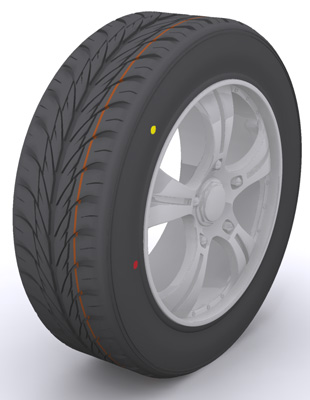 When you're looking for new tyres, you'll often see some coloured dots
on the tyre sidewall, and bands of colour in the tread. These are all
here for a reason, but it's more for the tyre fitter than for your
benefit.
When you're looking for new tyres, you'll often see some coloured dots
on the tyre sidewall, and bands of colour in the tread. These are all
here for a reason, but it's more for the tyre fitter than for your
benefit.
The dots on the sidewall typically denote unformity and weight. It's
impossible to manufacture a tyre which is perfectly balanced and
perfectly manufactured in the belts. As a result, all tyres have a
point on the tread which is lighter than the rest of the tyre - a thin
spot if you like. It's fractional - you'd never notice it unless you
used tyre manufacturing equipment to find it, but its there. When the
tyre is manufactured, this point is found and a coloured dot is put on
the sidewall of the tyre corresponding to the light spot. Typically
this is a yellow dot (although some manufacturers use different colours
just to confuse us) and is known as the weight mark.
Typically the yellow dot should end up aligned to the valve stem on
your wheel and tyre combo. This is because you can help minimize the
amount of weight needed to balance the tyre and wheel combo by mounting
the tyre so that its light point is matched up with the wheel's heavy
balance point. Every wheel has a valve stem which cannot be moved so
that is considered to be the heavy balance point for the wheel. (Trivia
side note : wheels also have light and heavy spots. Typically the
lightest spot on the wheel is found during manufacture and the heavier
valve stem is then located diametrically opposite that light spot to
help balance the wheel out).
As well as not being able to
manufacture perfectly weighted tyres, it's also nearly impossible to
make a tyre which is perfectly circular. By perfectly circular, I mean
down to some nauseating number of decimal places. Again, you'd be hard
pushed to actually be able to tell that a tyre wasn't round without
specialist equipment. Every tyre has a high and a low spot, the
difference of which is called radial runout. Using sophisticated
computer analysis, tyre manufacturers spin each tyre and look for the
'wobble' in the tyre at certain RPMs. It's all about harmonic frequency
(you know - the frequency at which something vibrates, like the Tacoma
Narrows bridge collapse). Where the first harmonic curve from the tyre
wobble hits its high point, that's where the tyre's high spot is.
Manufacturers typically mark this point with a red dot on the tyre
sidewall, although again, some tyres have no marks, and others use
different colours. This is called the uniformity mark.
Correspondingly, most wheel rims are also not 100% circular, and will
have a notch or a dimple stamped into the wheel rim somewhere
indicating their low point. It makes sense then, that the high point of
the tyre should be matched with the low point of the wheel rim to
balance out the radial runout.
What if both dots are present?
Generally speaking, if you get a tyre with both a red and a yellow dot on it, it should be mounted according to the red dot - ie. the uniformity mark should line up with the dimple on the wheel rim, and the yellow mark should be ignored.
What about the coloured stripes in the tread?
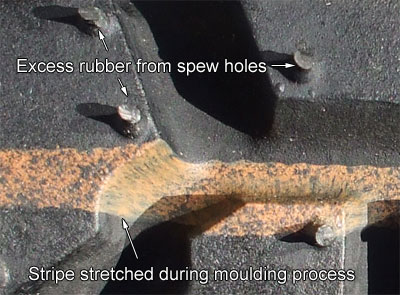 Often
when you buy tyres, there will be a coloured band or stripe running
around the tyre inside the tread. These can be any colour and can be
placed laterally almost anyhwere across the tread. For ages I thought
they were either a uniformity check - a painted mark used to check the
"roundness" of the tyre - or and indication of the tyre runout. Turns
out the answer is far simpler and much more disappointing. The lines
are sprayed on to the rubber tread stock after it has been extruded
during the manufacturing process. The problem is that the tread stock
can be manufactured hours or days before it's actually used to make the
tyres. So the lines serve one main purpose - they're an in-factory
identification for the tyre builders to make sure they're using the
correct tread stock for the carcass of the tyre they're assembling.
Think of them like a barcode. They can sometimes indicate the rubber
compound or the intended tyre size and often you'll find other
information printed on to the tread as well as the stripes (see the
example below of a number code).
Often
when you buy tyres, there will be a coloured band or stripe running
around the tyre inside the tread. These can be any colour and can be
placed laterally almost anyhwere across the tread. For ages I thought
they were either a uniformity check - a painted mark used to check the
"roundness" of the tyre - or and indication of the tyre runout. Turns
out the answer is far simpler and much more disappointing. The lines
are sprayed on to the rubber tread stock after it has been extruded
during the manufacturing process. The problem is that the tread stock
can be manufactured hours or days before it's actually used to make the
tyres. So the lines serve one main purpose - they're an in-factory
identification for the tyre builders to make sure they're using the
correct tread stock for the carcass of the tyre they're assembling.
Think of them like a barcode. They can sometimes indicate the rubber
compound or the intended tyre size and often you'll find other
information printed on to the tread as well as the stripes (see the
example below of a number code).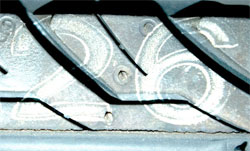
When
a tyre is being assembled, all the components are put together
(carcass, beads, belts etc) inside a tyre mould and the stripes help
the technician to align the tread stock properly. The inside of the
mould has the inverse pattern of the tyre tread in it so that when heat
and pressure are applied, the rubber in the tread stock is forced into
the mould. Excess rubber is allowed to escape through little holes
(called spew holes) which is why you'll often find what look like
rubber hairs on a new tyre - they're excess rubber from the spew holes
that was never trimmed. If you look closely at where one of the
sprayed-on lines crosses a tread block, you'll be able to see where
it's been stretched during the moulding process. The picture above is a
good example.
All this is well and good if the manufacturing plant
uses an 8-segment petal-type tyre machine (where the mould is on the
inside of a bunch of metal 'petals' that close to form the finished
shape), but on older 2-part moulds, the tread stock can be pushed
off-centre as the mould closes so the lines also serve one other
function - a visual inspection post-assembly to make sure the tyre
tread remained in the correct place. As the tyre is being spun during
inspection, the lines will wander across the tread if something became
misaligned during the manufacturing process.
Running in your new tyres
It may sound like an odd concept, but if you buy brand new tyres and slap them on your car, then try to drive the nuts off it, you're going to come a cropper. The reason, believe it or not, is that all tyres need a running-in (or scrubbing-in) period. When tyres are made, the inside of the tyre mould is first lined with a non-stick coating. When the tyres pop out, some of that releasing agent sticks to the tyres themselves. What you get is a nice shiny new tyre, with 'shiny' being the operative word. The releasing agent can take as much as 500 miles to scrub off. Now for the everyday Joe, this isn't really so much of an issue, but for people who are fast drivers, or think they're fast drivers, this can lead to a distressing loss-of-grip mid-corner and a visit to something large and solid. It's doubly important for motorcyclists because they have half the number of tyres and a much smaller contact patch per tyre to boot.
Getting the same results with tyre-black polish or dress-up polish
If you're proud of your car (or vain) you might have been tempted at one point or another to use a Back-to-Black type substance on them to blacken up the sidewalls of the tyres. These things are over-the-counter items that you can buy in just about any car parts store and they're designed to remove the dirt and muck from your sidewalls whilst (allegedly) conditioning the rubber and restoring that factory-fresh look to your tyres. This is all very good until you use a little too much and/or park the car in the sun. When that happens, this stuff starts to run down your tyres and into the tread. Worse, I've seen people using tyre-black on the tread on purpose. This stuff is basically teflon mixed with WD-40 and if you get it on the tyre tread, your car is going to take on the handling dynamics of a drunk ice skater. Not in a "ha ha that was funny" sort of way but in a "holy snot that's gonna hurt!" sort of way. You've been warned.
Learning from others - tyre reviews
With the sheer number of tyres available to you, you might wonder how to choose the one that's going to suit your driving style. Most tyre websites will have a section for customer reviews but you need to be careful because the big-name sites (like TyreRack etc) typically attract people with an axe to grind or those who can never review anything other than positively. As a result, you'll find the same tyre being given 5-star ratings and 1-star ratings and nothing in between, and the reviews will not be especially objective. Tyrereviews.co.uk is a new independent site which seems pretty good - it has a broad spectrum of comments and their reviews are sorted by tyre type as well as by vehicle. If you can't get what you want from the web, go all old-fashioned and use your mouth - ask your friends. I know it's an out-of-date concept, but you'd be surprised what talking to people can reveal, instead of emailing them or worse, txtng yr bff 4 hlp. They will likely have an opinion one way or another and any opinion is worth listening to when you're trying to gather information.
So Chris - what do you like?
My personal favourite tyre brand is Yokohama. I've had them on every vehicle I've owned since 1993. That doesn't necessarily mean they're fabulous tyres, it just means I like them, I like the way they handle, how they wear and how they make the car feel. That's the crux of the matter though. Essentially you're never going to know whether a tyre will suit your needs until you've got them on your car and are driving it the way you normally drive. My advice: if you find a good brand and style that you like, stick with it. It might take a few tyre changes to find one but eventually you'll likely find something that makes you think "hey - this isn't a bad tyre". Just stick with big name brands. Anything that costs less than about $80 or £50 a tyre will be junk. Trust me.
The eBay problem
This paragraph may seem a little out of place but I have had a lot of problems with a couple of eBay members (megamanuals and lowhondaprelude) stealing my work, turning it into PDF files and selling it on eBay. Generally, idiots like this do a copy/paste job so they won't notice this paragraph here. If you're reading this and you bought this page anywhere other than from my website at www.carbibles.com, then you have a pirated, copyright-infringing copy. Please send me an email as I am building a case file against the people doing this. Go to www.carbibles.com to see the full site and find my contact details. And now, back to the meat of the subject....
Page 1 ------ Page 2
 | These pages were last updated on 22nd April 2009. Copyright © Chris Longhurst 1994 - 2009 unless otherwise noted. The author will respond expeditiously to any intellectual property infringement. Reproduction in whole or in part in any form or medium without express written permission of Chris Longhurst is prohibited. Important Copyright info. |  |