The wheel and tyre Bible - everything you need to know about tyre markings, wheels, tyres (tires), rim sizes, tread depth and wear, aquaplaning, wheel balancing, aftermarket wheels, alloy wheels, TPMS tire pressure monitoring systems and much more.
 Win free stuffWhat's New?e-Book / Images
![[All you need to know about car tyres (Tires) and Wheels.]](tyre_bible_pg2_files/thewheelandtyrebible.gif)
 | I am in no way affiliated with any branch of the motor industry. I am just a pro-car, pro-motorbike petrolhead who is into basic maintenance. This information is the result of information-gathering, research and hands-on experience. By reading these pages, you agree to indemnify, defend and hold harmless Christopher J Longhurst, any sponsors and/or site providers against any and all claims, damages, costs or other expenses that arise directly or indirectly from you fiddling with your car or motorbike as a result of what you read here. In short: the advice here is worth as much as you are paying for it. |
Translated versions of this site:  Русский (Russian)
Page 1 ------ Page 2
Moving on - Wheel measurements.
Okay. If you want to change the wheels on your car, you need to take some things into consideration.
- Number of bolts or studs
It goes without saying that you can't fit a 4-bolt wheel onto a 5-bolt wheel hub. Sounds obvious, but people have been known to fork out for an expensive set of alloy wheels only to find they've got the wrong number of mounting holes. - Pitch Circle Diameter
Right. So you know how many holes there are. Now you need to know the PCD, or Pitch Circle Diameter. This is the diameter of the invisible circle formed by scribing a circle that passes through the centre point of each mounting hole. If you've got the right number of holes, but they're the wrong spacing, again the wheel just won't fit. - PCD notation
Stud patterns and PCD values are typically listed in this notation : 5x114.42. This means a 5-bolt pattern on an imaginary circle of 114.42mm diameter. - Centre spigot size
This is a tricky one. The wheel bolts or studs are there to hold the wheel laterally on to the axle, but they're not really designed to take vertical load - ie. they're not designed to take the weight of the car. That's the job of the centre spigot - the part of the axle that sticks out and pokes through the hole in the middle of the wheel. It's the load-bearing part of the axle and the wheel, as well as being the assembly that centres the wheel on the axle. For the most part, the centre spigot on aftermarket alloy wheels is much larger than that of the car you want to put them on to. When this happens, the best solution is a spigot locating ring (also called a hub-centric ring) which is essentially a steel or hard plastic doughnut designed to fit snugly on to your axle spigot and into the wheel spigot.
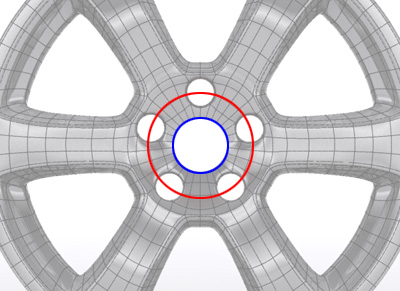
The image below shows the PCD (the red ring and mounting hole centrelines) and the spigot size (the blue ring). The spigot hole on an alloy wheel is normally covered up with a centre cap or cover.
- Inset or outset
This is very important. Ignore this and you can end up with all manner of nasty problems. This is the distance in mm between the centre line of the wheel rim, and the line through the fixing face. You can have inset, outset or neither. This determines how the suspension and self-centring steering behave. The most obvious problem that will occur if you get it wrong is that the steering will either become so heavy that you can't turn the car, or so light that you need to spend all your time keeping the bugger in a straight line. More mundane problems through ignoring this measurement can range from wheels that foul parts of the bodywork or suspension, to high-speed judder in the steering because the suspension setup can't handle that particular type of wheel. This figure will be stamped on the wheel somewhere as an ET figure.
Inset and outset are subsets of offset and the relationship is this : positive offset = inset. Negative offset = outset. Typically you can get away with 5mm-7mm difference from the vehicle manufacturer specification before you'll run into trouble with the wheels fouling the suspension or bodywork. So for example if your stock wheels have an offset of 42mm and you can only find replacements with a 40mm offset, that 2mm difference ought to OK.
| No offset | Inset wheel | Outset wheel |
|---|---|---|
![[none]](tyre_bible_pg2_files/no_offset.gif) |
![[inset]](tyre_bible_pg2_files/inset_wheel.gif) |
![[outset]](tyre_bible_pg2_files/outset_wheel.gif) |
- More inset = closer to the suspension?
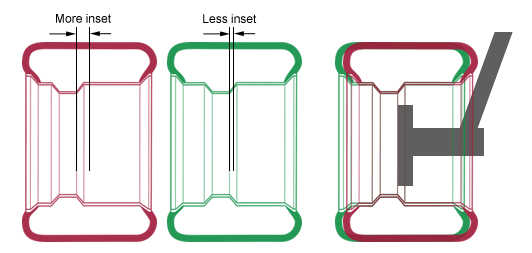
It may sound counterintuitive, but when you increase the inset of a wheel, you decrease the clearance between the inner edge of the wheel and the suspension components. In the example below, the red wheel has a larger inset - ie. the distance from the mounting face to the centreline of the wheel is larger than that of the green wheel. The grey blocks indicate a stylised mounting hub, axle and suspension component. You can see that by increasing the inset (positive offset) of the wheel, it pushes the inner edge of the wheel and tyre closer to the suspension. Conversely, decreasing the inset moves the wheel and tyre closer to the outside of the vehicle where it might scrub and rub against the bodywork and wheel arches. It might help to think of this more in terms of overall offset rather than inset and outset. The most positive the offset, the more the wheel is tucked into the car. The more negative the offset, the more the wheel sticks out.
- A real example
![[arealwheel]](tyre_bible_pg2_files/arealwheel.jpg) They say a picture is equivalent to a thousand words, so study this one
carefully. It's one of the alloy wheels off one of my old cars.
Enlarged so you can read it is the wheel information described above.
You'll notice it reads "6J x 14 H2 ET45". The "6J x 14" part of that is
the size of the wheel rim - in this case it has a depth of 6 inches and
a diameter of 14 inches (see the section directly below here on wheel
sizes for a more in-depth explanation). The "J" symbolises the shape of
the tyre bead profile. (see rim contours below)
They say a picture is equivalent to a thousand words, so study this one
carefully. It's one of the alloy wheels off one of my old cars.
Enlarged so you can read it is the wheel information described above.
You'll notice it reads "6J x 14 H2 ET45". The "6J x 14" part of that is
the size of the wheel rim - in this case it has a depth of 6 inches and
a diameter of 14 inches (see the section directly below here on wheel
sizes for a more in-depth explanation). The "J" symbolises the shape of
the tyre bead profile. (see rim contours below)
The "H2" means that this wheel rim is a double hump design (see hump profiles, below). The "ET45" figure below that though symbolises that these wheels have a positive offset of 45mm. In other words, they have an inset of 45mm. In my case, the info is all stamped on the outside face of the wheel which made it nice and easy to photograph and explain for you. On most aftermarket wheels, they don't want to pollute the lines and style of the outside of the wheel with stamped-on information - it's more likely to be found inside the rim, or on one of the inner mounting surfaces.
The wheel offset calculator
This little javascript will help you to understand the different between your old and new wheel and tyre combination in terms of the offset and how it's going to affect the overall lateral position of the wheel and tyre.
Matching your tyres to your wheels.
Okay. This is a biggie so take a break, get a hot cup of Java, relax and then when you think you're ready to handle the complexities of tyre matching, carry on. This diagram should help you to figure out what's going on.
![[xsection]](tyre_bible_pg2_files/xsection.gif)
Wheel sizes
Wheel sizes are expressed as WWWxDDD sizes. For example 7x14. A 7x14 wheel is has a rim width of 7 inches, and a rim diameter of 14 inches. The width is usually below the width of the tyre for a good match. So a 185mm tyre would usually be matched to a wheel which is 6 inches wide. (185mm is more like 7 inches, but that's across the entire tyre width, not the bead area where the tyre fits the rim.)
Rolling Radius
The important thing that you need to keep in consideration is rolling radius. This is so devastatingly important that I'll mention it in bold again:rolling radius!.
This is the distance in mm from the centre of the wheel to the edge of
the tread when it's unladen. If this changes because you've mismatched
your new wheels and tyres, then your speedo will lose accuracy and the
fuel consumption might go up. The latter reason is because the
manufacturer built the engine/gearbox combo for a specific rolling
radius. Mess with this and the whole thing could start to fall down
around you.
It's worth pointing out that the actual radius the
manufacturers use for speedo calculation is the 'dynamic' or the
'laden' radius of the wheel at the recommended inflation pressure and
'normal' loading. Obviously though, this value is entirely dependent on
the unladen rolling radius.
J, JJ, K, JK, B, P and D : Tyre bead profiles / rim contour designations.
![[beadprofile]](tyre_bible_pg2_files/beadprofile.gif) No, my keyboard letters weren't stuck down when I typed this. The
letter that typically sits between the rim width and diameter figures
stamped on the wheel, and indicates the physical shape of the wheel
where the tyre bead meets it. In the cross-section on the left you can
see the area highlighted in red.
No, my keyboard letters weren't stuck down when I typed this. The
letter that typically sits between the rim width and diameter figures
stamped on the wheel, and indicates the physical shape of the wheel
where the tyre bead meets it. In the cross-section on the left you can
see the area highlighted in red.
Like so many topics, the answer as to which letter represents which
profile is a long and complicated one. Common wisdom has it that the
letter represents the shape. ie. "J" means the bead profile is the
shape of the letter "J". Not so, although "J" is the most common
profile identifier. 4x4 vehicles often have "JJ" wheels. Jaguar
vehicles (especially older ones) have "K" profile wheels. Some of the
very old VW Beetles had "P" and "B" profile wheels.
Anyway the reason it is an "awkward topic to find definitive data on"
is very apparent if you've ever looked at Standards Manual of the
European Tyre and Rim Technical Organisation. It is extremely
hard to follow! There are pages and pages (64 in total) on wheel
contours and bead profiles alone, including dimensions for every type
of wheel you can think of (and many you can't) with at least a dozen
tabled dimensions for each. Casually looking through the manual is
enough to send you to sleep. Looking at it with some concentration is
enough to make your brain run out of your ears. To try to boil it all
down for you, it seems that they divide up the rim into different
sections and have various codes to describe the geometry of each area.
For example, the "J" code makes up the "Rim Contour" and specifies rim
contour dimensions in a single category of rims called "Code 10 to 26
on 5deg. Drop-Centre Rims". To give you some idea of just how complex /
anal this process is, I've recreated one such diagram with Photoshop
below to try to put you off the scent.
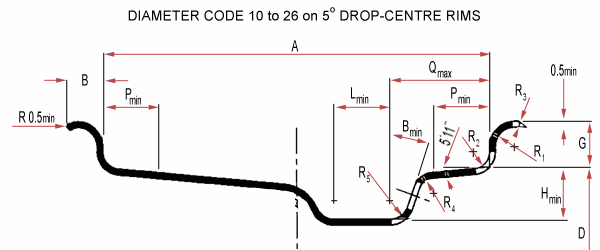
From the tables present in this manual, the difference in dimensions
between "J" and "B" rims is mainly due to the shape of the rim flange.
This is the part in the above diagram defined by the R radius and B and
Pmin parameters. Hence my somewhat simpler description : tyre bead profiles.
Note
that in my example, the difference between "J" and "B" rims is small
but not negligible. This area of rim-to-tyre interface is very
critical. Very small changes in a tyre's bead profile make large
differences in mounting pressures and rim slip.
"A" and "D" contour
designations come under the category of "Cycles, Motorcycles, and
Scooters" but also show up in the "Industrial Vehicles and Lift Trucks"
category. Naturally, the contours have completely different geometry
for the same designation in two different categories.
The "S", "T", "V" and "W" contour designation codes fall into the
"Commercial Vehicles, Flat Base Rims" category. The "E", "F", "G" and
"H" codes fall into the "Commercial Vehicles, Semi-Drop Centre Rims"
category. Are you beginning to see just how complex this all is?
I think the best thing for you, dear reader, is a general rule-of-thumb, and it is this : if your wheels are stamped 5J15 and you buy 5K15 tyres, rest assured they absolutely won't fit.
H, H2, FH, CH, EH and EH2 : Hump profiles.
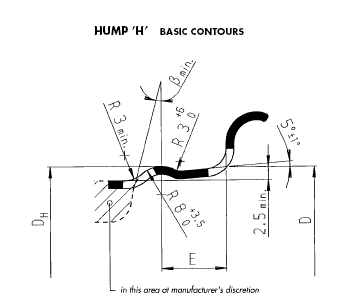
More alphabet soup. So you might have just about understood the bit about bead profiles, but there's another design feature of wheel rims. The 'hump' is actually a bump put on the bead seat (for the bead) to prevent the tyre from sliding off the rim while the vehicle is moving. As with rim contours, there are several different designations of hump design and configuration, depending on the number and shape of the humps. For the inquisitive reader, here's a table of the hump designations, and a diagram similar to the one above which displays in nauseating detail just what a hump really is. The eagle-eyed amongst you (or those paying attention) will notice that this diagram is an enlarged view of the area around Pmin in the other ETRTO diagram above, because that's typically where the hump is.
| Designation | Bead Seat Contour | Marking | |
|---|---|---|---|
| Outside | Inside | ||
| Hump | Hump | Normal | H |
| Double Hump | Hump | Hump | H2 |
| Flat Hump | Flat Hump | Normal | FH |
| Double Flat Hump | Flat Hump | Flat Hump | FH2 |
| Combination Hump | Flat Hump | Hump | CH |
| Extended Hump | Extended Hump | Extended Hump | EH2 |
| Extended Hump 2+ | Extended Hump 2+ | Extended Hump 2+ | EH2 + |
If you're obsessive-compulsive and absolutely must know everything there is to know about bead profiles, humps and rim flanges, you can check out the ETRTO (European Tyre and Rim Technical Organisation website from where you can purchase their manuals and documents. Go nuts. Meanwhile, the rest of us will move on to the next topic.
Why would I want to change to alloy wheels and new tyres anyway?
A good question. Styling and performance are the only two reasons. Most cars come with horrible narrow little tyres and 13 inch rims. More recently the manufacturers have come to their senses and started putting decent combinations on factory cars so that's not so much of a problem any more. The first reason is performance. Speed in corners more specifically. If you have larger rims, you get smaller sidewalls on the tyres. And if you have smaller sidewalls, the tyre deforms less under the immense sideways forces involved in cornering.
So how does it all figure out?
Point to note: 1 inch = 25.4mm. You need to know that because tyre/wheel manufacturers insist on mixing mm and inches in their ratings.
Also note that a certain amount of artistic licence is required when
calculating these values. The tyre's rolling radius will change the
instant you put load on it, and calculating values to fractions of a
millimetre just isn't worth it - tyre tread wear will more than see off
that sort of accuracy.
Lets take an average example: a car with factory fitted 6x14 wheels and 185/65 R14's on them.
- Radius of wheel = 7 inches (half the diameter) = 177.8mm
- Section height = 65% of 185mm = 120.25mm
- So the rolling radius for this car to maintain is 177.8+120.25=298.05mm
With me so far? Good. Now lets assume I want 15 inch rims which are slightly wider to give me that nice fat look. I'm after a set of 7x15's
First we need to determine the ideal width of tyre for my new wider
wheels. 7 inches = 177.8mm. The closest standard tyre width to that is
actually 205mm so that's what we'll use. (remember the tyre width is
larger than the width of the bead fitting.)
- Radius of wheel = 7.5 inches (half of 15) = 190.5mm
- We know that the overall rolling radius must be as close to 298.05mm as possible
- So the section height must be 298.05mm-190.5mm = 107.55mm
- Figure out what percentage of 205mm is 107.55mm. In this case it's 52.5%
- So combine the figures - the new tyre must be 205/50 R15
- ....giving a new rolling radius of 293mm - more than close enough.
A tyre size calculator.
Well if all that maths seems a little beyond you, and judging by the volume of e-mails I get on this subject, it might well be, I've made a little Javascript application below to help you out. Select the tyre size you currently have, and then the size you're interested in. Calculate each tyre size and then click on the click to calculate the difference button. It will show you all the rolling radii, circumferences, percentage differences and even speedometer error. Enjoy.
A Speedometer error means an odometer error too.
It stands to reason that if you change the rolling radius of your wheels and tyres, and the speedometer no longer reads correctly, that your odometer will also gradually become inaccurate. Assume for example that you bought a car brand new and changed the wheels and tyres on day one from 195.65R14 to 205/50R15 - not an uncommon change. By the calculator above, that makes your speedometer over read by 1.7%. Consequently, the registered odometer reading will also be out by the same value. So for example, when you get to 10,000km of driving (in the real world), your odometer will actually read 10,170km. OK so that's not a huge difference but it is one of the reasons why most car dealers have a disclaimer on their secondhand vehicles telling you that they won't guarantee the displayed mileage. ("Clocking" the odometer is the other reason). Odometer errors due to mis-matched tyres and wheels will happen on regular odometers as well as the newer digital ones.
A quick word about motorcycle speedometers.
Veering off-topic for a moment, it's worth pointing out that without exception, all motorbike speedometers are designed to inflate the ego of the rider by at least 5%. In some cases, they are are much as 10% optimistic. ie. the speedometer on a motorbike will always over-read. 100mph? Not likely - you're actually doing closer to 90mph.
Aspect Ratio and Rim / Pan Width.
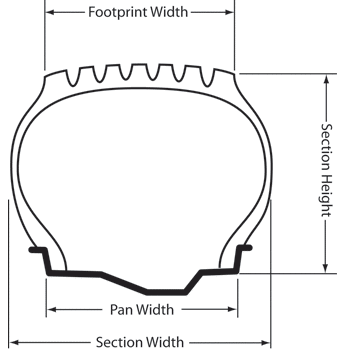 Aspect ratio is, as you know if you read the bit above, the ratio of
the tyre's section height to its section width. The aspect ratio is
sometimes referred to as the tyre 'series'. So a 50-series tyre means
one with an aspect ratio of 50%. The maths is pretty simple and the
resulting figure is stamped on all tyres as part of the sizing
information:
Aspect ratio is, as you know if you read the bit above, the ratio of
the tyre's section height to its section width. The aspect ratio is
sometimes referred to as the tyre 'series'. So a 50-series tyre means
one with an aspect ratio of 50%. The maths is pretty simple and the
resulting figure is stamped on all tyres as part of the sizing
information:
| Aspect ratio = | Section height |
 | |
| Section width |
The actual dimensions of a tyre depend on the rim on which it is
mounted. The biggest variable is the tyre's section width; a change of
about 0.2" for every 0.5" change in rim width.
The ratio between the section width and the rim width is pretty
important. If the rim width is too narrow, you pinch the tyre in and
cause it to balloon more in cross-section. If the rim width is too
wide, you run the risk of the tyre ripping away at high speed.
For 50-series tyres and above, the rim width is 70% of the tyre's section width, rounded off to the nearest 0.5.
For example, a 255/50R16 tyre, has a design section width of 10.04"
(255mm = 10.04 inches). 70% of 10.04" is 7.028", which rounded to the
nearest half inch, is 7". Ideally then, a 255/50R16 tyres should be
mounted on a 7x16 rim.
For 45-series tyres and below, the rim width is 85% of the tyre's section width, rounded off to the nearest 0.5.
For example, a 255/45R17 tyre, still has a design section width of
10.04" (255mm = 10.04 inches). But 85% of 10.04" is 8.534", which
rounded to the nearest half inch, is 8.5". Ideally then, a 255/45R17
tyre should be mounted on an 8½x17 rim.
Sources: ETRTO Design manual. Yokohama Tyres
An ideal rim-width calculator
Blimey I'm good to you. Can't figure that maths out either? Click away my friend and Chris's Rimwidthulatortm will tell you what you need to know. Obvious disclaimer : the results should be verified with the tyre dealership/manufacturer.
Too wide or too narrow - does it make a difference?
Given all the information above, you ought to know one last thing.
A rim that is too narrow in relation to the tyre width will allow the
tyre to distort excessively sideways under fast cornering. On the other
hand, unduly wide rims on an ordinary car tend to give rather a harsh
ride because the sidewalls have not got enough curvature to make them
flex over bumps and potholes. That's why there is a range of rim sizes
for each tyre size in my Rimwidthulator above. Put a 185/65R14 tyre on
a rim narrower than 5inches or wider than 6.5inches and suffer the
consequences.
The Plus One concept
The plus one concept describes the proper sizing up of a wheel and tyre combo without all that spiel I've gone through above. Basically, each time you add 1 inch to the wheel diameter, add 20mm to the tyre width and subtract 10% from the aspect ratio. This compensates nicely for the increases in rim width that generally accompany increases in diameter too. By using a larger diameter wheel with a lower profile tyre it's possible to properly maintain the overall rolling radius, keeping odometer and speedometer changes negligible. By using a tyre with a shorter sidewall, you gain quickness in steering response and better lateral stability. The visual appeal is obvious, most wheels look better than the sidewall of the tyre, so the more wheel and less sidewall there is, the better it looks.
![[plusone]](tyre_bible_pg2_files/plusone.gif)
Tyre size table up to 17" wheels
Here, for those of you who can't or won't calculate your tyre size, is a table of equivalent tyres. These all give rolling radii within a few mm of each other and would mostly be acceptable, depending on the wheel rim size you're after.
| 80 SERIES | 75 SERIES | 70 SERIES | 65 SERIES | 60 SERIES | 55 SERIES | 50 SERIES |
|---|---|---|---|---|---|---|
| 135/80 R 13 | - | 145/70 R 13 | - | 175/60 R 13 | - | - |
| - | - | 155/70 R 13 | 165/65 R 13 | - | - | - |
| - | - | - | 175/65 R 13 | - | - | - |
| 145/80 R 13 | - | 155/70 R 13 | 175/65 R 13 | 185/60 R 13 | 185/55 R 14 | - |
| - | - | 165/70 R 13 | 165/65 R 14 | 175/60 R 14 | - | - |
| - | - | 175/70 R 13 | - | - | - | - |
| 155/80 R 13 | 165/75 R 13 | 175/70 R 13 | 165/65 R 14 | 175/60 R 14 | 195/55 R 14 | 195/50 R 15 |
| - | - | 185/70 R 13 | 175/65 R 14 | 185/60 R 14 | 185/55 R 15 | - |
| - | - | 165/70 R 14 | - | 195/60 R 14 | - | - |
| 165/80 R 13 | - | 185/70 R 13 | 175/65 R 14 | 195/60 R 14 | 205/55 R 14 | 205/50 R 15 |
| - | - | 165/70 R 13 | 185/65 R 14 | 205/60 R 14 | 185/55 R 15 | 195/50 R 16 |
| - | - | 175/70 R14 | - | - | 195/55 R 15 | - |
| - | - | - | - | - | 205/55 R15 | - |
| 175/80 R 13 | 175/75 R 14 | 175/70 R 14 | 185/65 R 14 | 205/60 R 14 | 195/55 R 15 | 215/50 R 16 |
| - | - | 185/70 R 14 | 195/65 R 14 | 215/60 R 14 | 205/55 R 15 | 195/50 R 16 |
| - | - | - | 185/65 R 15 | 195/60 R 15 | - | 205/50 R 16 |
| 185/80 R 13 | 185/75 R 14 | 185/70 R 14 | 195/65 R 14 | 215/60 R 14 | 205/55 R 16 | 205/50 R 16 |
| - | - | 195/70 R 14 | 185/65 R 15 | 225/60 R 14 | - | 225/50 R 16 |
| - | - | - | 195/65 R 15 | 195/60 R 15 | - | 205/50 R 17 |
| - | - | - | - | 205/60 R 15 | - | - |
| - | - | - | - | 215/60 R 15 | - | - |
So that's it then?
Yes - that's it. A little time with a calculator, a pen and some paper will enable to you confidently stride into your local tyre/wheel supplier and state exactly what you want.
A Case study to help you out
Lead by example - that's a good motto. My Case Study will walk you through the entire process of selecting a new set of wheels and tyres so you can get an idea of what is involved.
Oversizing tyres
If you want the fat look but don't want to go bonkers with new wheels, you can oversize the tyres on the rims usually by about 20mm (to be safe). So if your standard tyres are 185/60 R14s, you can oversize them to about 205mm. But make sure you recalculate the percentage value to keep the sidewall height the same.
Fitment guides
 Rochford Tyres
has an excellent fitment guide page where they list a ton of
combinations and permutations of wheels and tyres for all the popular
makes and models. The guide is designed to give you an idea of wheel
and tyre sizes that will keep you close to spec for rolling radius. Use
the 'Alloy Wheel Search' box at the top-left of their site. As an added
bonus, if you decide to buy anything from them, use the
Rochford Tyres
has an excellent fitment guide page where they list a ton of
combinations and permutations of wheels and tyres for all the popular
makes and models. The guide is designed to give you an idea of wheel
and tyre sizes that will keep you close to spec for rolling radius. Use
the 'Alloy Wheel Search' box at the top-left of their site. As an added
bonus, if you decide to buy anything from them, use the  at the checkout to get 5% off! Sweet!
And finally, you might like to check out this little program written by Brian Cassidy,which helps with tyre size calculation.
| Like the site? Help Chris buy a bike. The page you're reading is free, but if you like what you see and feel you've learned something, throw me a $5 bone as a token of your appreciation. Help me buy the object of my desire. |
Fat or thin? The question of contact patches and grip.
If there's one question guaranteed to promote argument and counter argument, it's this : do wide tyres give me better grip?
Fat tyres look good. In fact they look stonkingly good. In the dry they
are mercilessly full of grip. In the wet, you might want to make sure
your insurance is paid up, especially if you're in a rear-wheel-drive
car. Contrary to what you might think (and to what I used to think),
bigger contact patch does not necessarily mean increased grip. Better yet, fatter tyres do not mean bigger contact patch. Confused? Check it out:
Pressure=weight/area.
That's about as simple a physics equation as you can get. For the
general case of most car tyres travelling on a road, it works pretty
well. Let me explain. Let's say you've got some regular tyres, as
supplied with your car. They're inflated to 30psi and your car weighs
1500Kg. Roughly speaking, each tyre is taking about a quarter of your
car's weight - in this case 375Kg. In metric, 30psi is about 2.11Kg/cm².
By that formula, the area of your contact patch is going to be roughly 375 / 2.11 = 177.7cm² (weight divided by pressure)
Let's say your standard tyres are 185/65R14 - a good middle-ground,
factory-fit tyre. That means the tread width is 18.5cm side to side. So
your contact patch with all these variables is going to be about
177.7cm² / 18.5, which is 9.8cm. Your contact patch is a rectangle
18.5cm across the width of the tyre by 9.8cm front-to-back where it
sits 'flat' on the road.
Still with me? Great. You've taken your car to the tyre dealer and with
the help of my tyre calculator, figured out that you can get some
swanky 225/50R15 tyres. You polish up the 15inch rims, get the tyres
fitted and drive off. Let's look at the equation again. The weight of
your car bearing down on the wheels hasn't changed. The PSI in the
tyres is going to be about the same. If those two variables haven't
changed, then your contact patch is still going to be the same :
177.7cm²
However
you now have wider tyres - the tread width is now 22.5cm instead of
18.5cm. The same contact patch but with wider tyres means a narrower
contact area front-to-back. In this example, it becomes 177.7cm² /
22.5, which is 7.8cm.
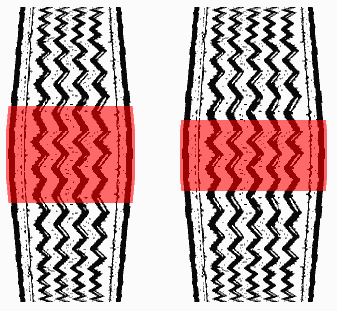 |
| Imagine driving on to a glass road and looking up underneath your tyres. This is the example contact patch (in red) for the situation I explained above. The narrower tyre has a longer, thinner contact patch. The fatter tyre has a shorter, wider contact patch, but the area is the same on both. |
And there is your 'eureka' moment. Overall, the area of your contact patch has remained more or less the same. But by putting wider tyres on, the shape of the contact patch has changed. Actually, the contact patch is really a squashed oval rather than a rectangle, but for the sake of simplicity on this site, I've illustrated it as a rectangle - it makes the concept a little easier to understand. So has the penny dropped? I'll assume it has. So now you understand that it makes no difference to the contact patch, this leads us on nicely to the sticky topic of grip.
The area of the contact patch does not affect the actual grip of the tyre. The things that do
affect grip are the coefficient of friction of the rubber compound and
the load on the tyre. As far as friction is concerned, the formula is
relatively simple - F=uN, where F is the frictional force, N is the
Normal force for the surfaces being pressed together and u is the
coefficient of friction. In the case of a tyre, the Normal force
basically stays the same - mass of the car multiplied by gravity. The
coefficient of friction also remains unchanged because it's dependent
on the two surfaces - in this case the road and the tyre's rubber.
The coefficient of friction is in part determined by the rubber
compound's ability to 'key' with the road surface at a microscopic
level.
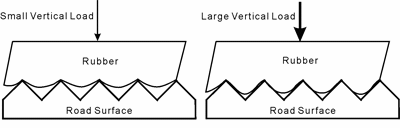
This explains why you can slide in a corner if you change road surface - for example going from a rough road to a smooth road, or a road surface covered in rain and diesel (a motorcyclist's pet peeve). The slide happens because the coefficient of friction has changed.
So do wider tyres give better grip?
If the contact patch remains the same size and the coefficient of friction and frictional force remain the same, then surely there is no difference in performance between narrow and wide tyres? Well there is but it has a lot to do with heat transfer. With a narrow tyre, the contact patch takes up more of the circumference of the tyre so for any given rotation, the sidewall has to compress more to get the contact patch on to the road. Deforming the tyre creates heat. With a longer contact patch and more sidewall deformation, the tyre spends proportionately less time cooling off than a wider tyre which has a shorter contact patch and less sidewall deformation. Why does this matter? Well because the narrower tyre has less capacity for cooling off, it needs to be made of a harder rubber compound in order to better resist heating in the first place. The harder compound has less mechanical keying and a lower coefficient of friction. The wider tyres are typically made of softer compounds with greater mechanical keying and a higher coefficient of friction. And voila - wider tyres = better grip. But not for the reasons we all thought.
What about lateral force in cornering?
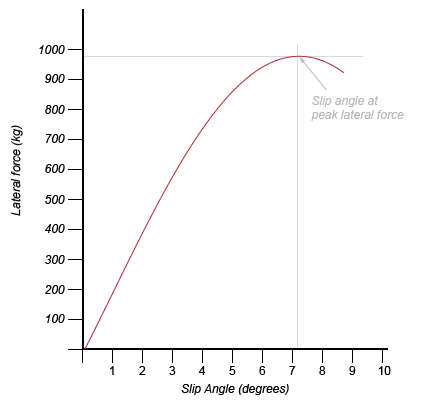
In terms of the lateral force applied to a tyre during cornering, you eventually come to a point where slip angle becomes important. The plot below shows an example of normalised lateral force (in Kg) versus slip angle (in degrees). Slip angle is best described as the difference between the angle of the tyres that you've set by steering, and the direction in which the tyres actually want to travel. As you corner the lateral force increases on your tyres, and at some point, the lateral force is going to overcome the mechanical grip of the tyres and that point is defined by the peak slip angle, as shown in the graph. ie. there comes a point at which no matter how much vertical load is applied to the tyre (from the vehicle weight), it's going to be overcome by the lateral force and 'break away' and slip. So why do wider tyres perform better when cornering? Well apart from the softer rubber compound giving better mechanical keying and a higher coefficient of friction, they have lower profile sidewalls. This makes them more resistant to deforming under lateral load, resulting in a more predictable and stable contact patch. In other words, you can get to a higher lateral load before reaching the peak slip angle.
In reality, trying to figure this out using static examples and reading some internet hack's website is all but impossible because what's really important here is dynamic setup. In reality the contact patch is effectively spinning around your tyre at some horrendous speed. When you brake or corner, load-transfer happens and all the tyres start to behave differently to each other. This is why weight transfer makes such a difference the handling dynamics of the car. Braking for instance; weight moves forward, so load on the front tyres increases. The reverse happens to the rear at the same time, creating a car which can oversteer at the drop of a hat. The Mercedes A-class had this problem when it came out. The load-transfer was all wrong, and a rapid left-right-left on the steering wheel would upset the load so much that the vehicle lost grip in the rear, went sideways, re-acquired grip and rolled over. (That's since been changed.) The Audi TT had a problem too because the load on it's rear wheels wasn't enough to prevent oversteer which is why all the new models have that daft little spoiler on the back.
If your brain isn't running out of your ears already, then here's a link to where you can find many raging debates that go on in the Subaru forums about this very subject. If you decide to read this, you should bear in mind that Simon de Banke, webmaster of ScoobyNet, is a highly respected expert in vehicle dynamics and handling, and is also an extremely talented rally driver. It's also worth noting that he holds the World Record for driving sideways...........
If you decide to fatten up the tyres on your car, another consideration should be clearance with bits of your car. There's no point in getting super-fat tyres if they're going to rub against the inside of your wheel arches. Also, on cars with McPherson strut front suspension, there's a very real possibility that the tyre will foul the steering linkage on the suspension. Check it first!
Holy crap that's complicated. Isn't there a shorter answer?
Yes.
Choose
the dimensions of your tyre according to the 'comfort/cornering speed'
ratio that suits you. Lower profile/series = more precise cornering.
Higher profile/series = more comfort. To increase the contact patch,
lower the tyre pressure a little.
Caster, camber, alignment and other voodoo.
Alignment
This is the general term used to gloss over the next three points:
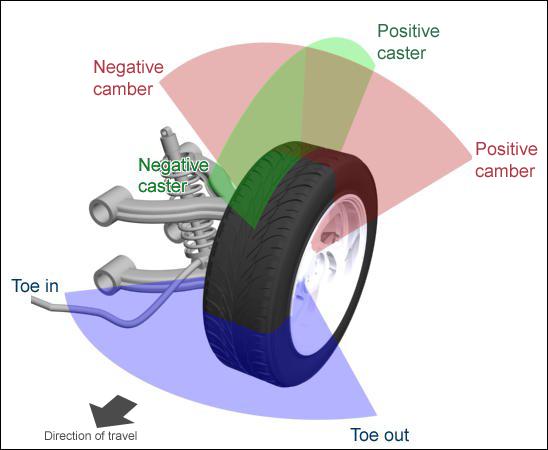
Caster
This is the forward (negative) or backwards (positive) tilt of the spindle steering axis. It is what causes your steering to 'self-centre'. Correct caster is almost always positive. Look at a bicycle - the front forks have a quite obvious rearward tilt to the handlebars, and so are giving positive caster. The whole point of it is to give the car (or bike) a noticeable centre point of the steering - a point where it's obvious the car will be going in straight line.
Camber
Camber is the tilt of
the top of a wheel inwards or outwards (negative or positive). Proper
camber (along with toe and caster) make sure that the tyre tread
surface is as flat as possible on the road surface. If your camber is
out, you'll get tyre wear. Too much negative camber (wheels tilt
inwards) causes tread and tyre wear on the inside edge of the tyre.
Consequently, too much positive camber causes wear on the outside edge.
Negative camber is what counteracts the tendency of the inside wheel during a turn
to lean out from the centre of the vehicle. 0 or Negative camber is almost always desired.
Positive camber would create handling problems.
The technical reason for this is because when the tyres on the inside
of the turn have negative camber, they will tend to go toward 0 camber,
using the contact patch more efficiently during the turn. If the tyres
had positive camber, during a turn, the inside wheels would tend to
even more positive camber, compromising the efficiency of the contact
patch because the tyre would effectively only be riding on its outer
edge.
Toe in & out
'Toe' is the
term given to the left-right alignment of the front wheels relative to
each other. Toe-in is where the front edge of the wheels are closer
together than the rear, and toe-out is the opposite. Toe-in counteracts
the tendency for the wheels to toe-out under power, like hard
acceleration or at motorway speeds (where toe-in disappears). Toe-out
counteracts the tendency for the front wheels to toe-in when turning at
motorway speeds. It's all a bit bizarre and contradictory, but it does
make a difference. A typical symptom of too much toe-in will be
excessive wear and feathering on the outer edges of the tyre tread
section. Similarly, too much toe-out will cause the same feathering
wear patterns on the inner edges of the tread pattern.
A reader of my site emailed me this which is a nice description of toe-in and toe-out.
As
a front-wheel-drive car pulls itself forwards, the wheels will tend to
pivot arount the king-pins, and thus towards the center of the car. To
ensure they end up straight ahead, they should sit with a slight
toe-out when at rest.
A rear-wheel-drive car pushes itself forward,
and the front wheels are rotated by friction... thus they will tend to
want to trail the king-pins, and therefor will want to splay apart. To
ensure that they run parallel when rolling, they should be given some
toe-in when at rest.
The perfect 4WD car will have neutral pressure
on the front wheels, so have neither toe-in or toe-out... however very
few companies make the perfect 4WD, so some will have a small amount to
toe-in/out, depending on the dominant axle.
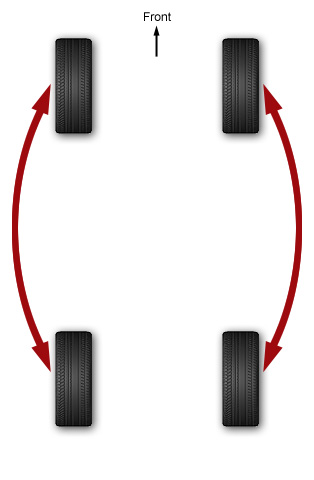
Rotating your tyres.
This is the practice of swapping the front and back tyres to even out
the wear, not the practice of literally spinning your tyres around
(you'd be surprised how often people seem to get confused by this). I
used to believe that this wasn't a good idea. Think about it: the tyres
begin to wear in a pattern, however good or bad, that matches their
position on the car. If you now change them all around, you end up with
tyres worn for the rear being placed on the front and vice versa.
However, having had this done a few times both on front-wheel drive and
all-wheel-drive vehicles during manufacturer services, I' a bit of a
convert. I now reckon it actually is A Good Thing. It results in even overall
tyre wear. By this, I mean wear in the tread depth. This is a valid
point, but if you can't be bothered to buy a new pair of tyres when the
old pair wear too much, then you shouldn't be on the road, let alone
kidding yourself that putting worn front tyres on the back and partly
worn back tyres on the front will cure your problem.
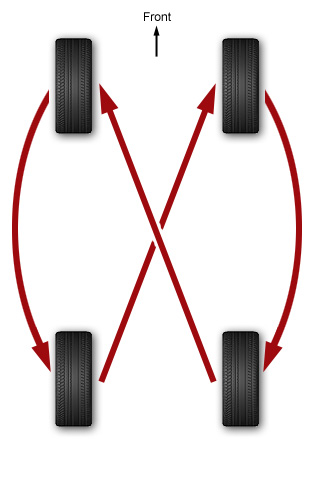
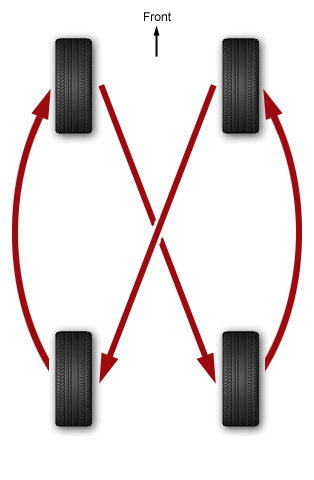
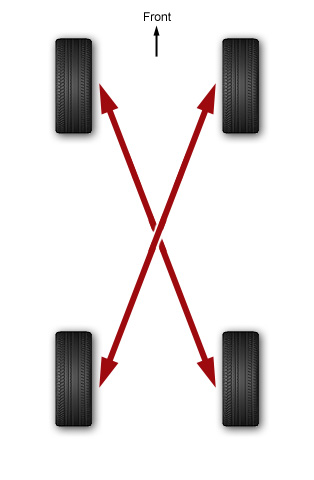
So how should
you rotate your tyres? It depends on whether you have 2-, 4-, front- or
rear-wheel drive, and whether or not you have unidirectional tyres
(meaning, those with tread designed only to spin in one direction).
With unidirectional tyres, you can swap the front and rear per-side,
but not swap them side-to-side. If you do, they'll all end up spinning
the wrong way for the tread. Generally speaking you ought to rotate
your tyres every 5,000 miles (8,000km) or so, even if they're showing
no signs of wear. The following table shows the correct way to rotate
your tyres.
| Front-wheel drive, non-unidirectional tyres | Rear-wheel drive, non unidirectional tyres |
 |  |
| 4-wheel drive, non-unidirectional tyres | Any unidirectional tyres |
 |  |
Diagnosing problems from tyre wear.
Your tyre wear pattern can tell you a lot about any problems you might be having with the wheel/tyre/suspension geometry setup. The first two signs to look for are over- and under-inflation. These are relatively easy to spot:
![[wear]](tyre_bible_pg2_files/wear_patterns.jpg)
Here's a generic fault-finding table for most types of tyre wear:
| Problem | Cause |
|---|---|
| Shoulder Wear Both Shoulders wearing faster than the centre of the tread | |
| Under-inflation | |
| Repeated high-speed cornering | |
| Improper matching of rims and tyres | |
| Tyres haven't been rotated recently | |
| Centre Wear The centre of the tread is wearing faster than the shoulders | |
| Over-inflation | |
| Improper matching of rims and tyres | |
| Tyres haven't been rotated recently | |
| One-sided wear One side of the tyre wearing unusually fast | |
| Improper wheel alignment (especially camber) | |
| Tyres haven't been rotated recently | |
| Spot wear A part (or a few parts) of the circumference of the tread are wearing faster than other parts. | |
| Faulty suspension, rotating parts or brake parts | |
| Dynamic imbalance of tyre/rim assembly | |
| Excessive runout of tyre and rim assembly | |
| Sudden braking and rapid starting | |
| Under inflation | |
| Diagonal wear A part (or a few parts) of the tread are wearing diagonally faster than other parts. | |
| Faulty suspension, rotating parts or brake parts | |
| Improper wheel alignment | |
| Dynamic imbalance of tyre/rim assembly | |
| Tyres haven't been rotated recently | |
| Under inflation | |
| Feather-edged wear The blocks or ribs of the tread are wearing in a feather-edge pattern | |
| Improper wheel alignment (faulty toe-in) | |
| Bent axle beam |
Checking your tyres.
It's amazing that so many people pay such scant attention to their tyres. If you're travelling at 70mph on the motorway, four little 20-square-centimetre pads of rubber are all that sits between you and a potential accident. If you don't take care of your tyres, those contact patches will not be doing their job properly. If you're happy with riding around on worn tyres, that's fine, but don't expect them to be of any help if you get into a sticky situation. The key of course, is to check your tyres regularly. If you're a motorcyclist, do it every night before you lock the bike up. For a car, maybe once a week. You're looking for signs of adverse tyres wear (see the section above). You're looking for splits in the tyre sidewall, or chunks of missing rubber gouged out from when you failed to negotiate that kerb last week. More obvious things to look for are nails sticking out of the tread. Although if you do find something like this, don't pull it out. As long as it's in there, it's sealing the hole. When you pull it out, then you'll get the puncture. That doesn't mean I'm recommending you drive around with a nail in your tyre, but it does mean you can at least get the car to a tyre place to get it pulled out and have the resulting hole plugged. The more you look after your tyres, the more they'll look after you.
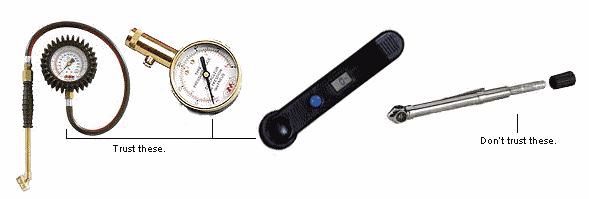
Lies, damn lies, and tyre pressure gauges.
Whilst on the subject of checking your tyres, you really ought to check
the pressures once every couple of weeks too. Doing this does rather
rely on you having, or having access to a working, accurate tyre
pressure gauge. If you've got one of those free pencil-type gauges that
car dealerships give away free, then I'll pop your bubble right now and
tell you it's worth nothing. Same goes for the ones you find on a
garage forecourt. Sure they'll fill the tyre with air, but they can be
up to 20% out either way. Don't trust them. Only recently - since about
2003 - have I been able to trust digital gauges. Before that they were
just junk - I had one which told me that the air in my garage was at
18psi with nothing attached to the valve. That's improved now and
current-generation digital gauges are a lot more reliable. One thing to
remember with digital gauges is to give them enough time to sample the
pressure. If you pop it on and off, the reading will be low. Hold it on
the valve cap for a few seconds and watch the display (if you can).
Generally speaking you should only trust a decent, branded pressure
gauge that you can buy for a small outlay - $30 maybe - and keep it in
your glove box. The best types are the ones housed in a brass casing
with a radial display on the front and a pressure relief valve. I keep
one in the car all the time and it's interesting to see how badly out
the other cheaper or free ones are. My local garage forecourt has an
in-line pressure gauge which over-reads by about 1.5psi. This means
that if you rely on their gauge, your tyres are all 1.5psi short of
their recommended inflation pressure. That's pretty bad. My local
garage in England used to have one that under-read by nearly 6 psi,
meaning everyone's tyres were rock-hard because they were 6psi
over-inflated. I've yet to find one that matches my little calibrated
gauge.
One reader pointed something else out to me. Realistically even a cheap
pressure gauge is OK provided it is consistent. This is easy to check
by taking three to five readings of the same tyre and confirming they
are all the same, then confirming it reads (consistently) more for
higher pressure and less for lower pressure.
One last note : if you're a motorcyclist, don't carry your pressure
gauge in your pocket - if you come off, it will tear great chunks of
flesh out of you as you careen down the road....
Tyre pressure and gas-mileage.
For the first two years of our new life in America, I'd take our Subaru
for its service, and it would come back with the tyres pumped up to
40psi. Each time, I'd check the door pillar sticker which informed me
that they should be 32psi front and 28psi rear, and let the air out to
get to those values. Eventually, seeing odd tyre wear and getting fed
up of doing this, I asked one of the mechanics "why do you always
over-inflate the tyres?" I got a very long and technical response which
basically indicated that Subaru are one of the manufacturers who've
never really adjusted their recommended tyre pressures in line with new
technology. It seems that the numbers they put in their manuals and
door stickers are a little out of date. I'm a bit of a skeptic so I
researched this on the Internet in some of the Impreza forums and chat
rooms and it turns out to be true. So I pumped up the tyres to 40psi
front and rear, as the garage had been doing, and as my research
indicated. The result, of course, is a much stiffer ride. But the odd
tyre wear has gone, and my gas-mileage has changed from a meagre
15.7mpg (U.S) to a slightly more respectable 20.32 mpg (U.S). That's
with mostly stop-start in-town driving. Compare that to the official
quoted Subaru figures of 21mpg (city) and 27mpg (freeway) and you'll
see that by changing the tyre pressures to not match the manual and
door sticker, I've basically achieved their quoted figures.
So what does this prove? Well for one it proves that tyre pressure is
absolutely linked to your car's economy. I can get an extra 50 miles
between fill-ups now. It also proves that it's worth researching things
if you think something is a little odd. It does also add weight to the
above motto about not trusting forecourt pressure gauges. Imagine if
you're underfilling your tyres because of a dodgy pressure gauge - not
only is it dangerous, but it's costing you at the pump too.
What's the "correct" tyre pressure?
How long is a piece of string?
Seriously though, you'll be more likely to get a sensible answer to the
length of a piece of string than you will to the question of tyres
pressures. Lets just say a good starting point is the pressure
indicated in the owner's manual, or the sticker inside the driver's
side door pillar. I say 'starting point' because on every car I've
owned, I've ended up deviating from those figures for one reason or
another. On my Subaru Impreza, as outlined above, I got much better gas
mileage and no difference in tyre wear by increasing my pressures to
40psi. On my Honda Element, I cured the vague handling and
outer-tyre-edge wear by increasing the pressures from the
manufacturer-recommended 32/34psi front and rear respectively, to 37psi
all round. On my Audi Coupe I cured some squirrelly braking problems by
increasing the pressure at the front from 32psi to 36psi. On my really
old VW Golf, I cured bad fuel economy and vague steering by increasing
the pressures all-round to 33psi.
So what can you, dear reader, learn from my anecdotes? Not much really.
It's pub-science. Ask ten Subaru Impreza owners what they run their
tyres at and you'll get ten different answers. It depends on how they
drive, what size wheels they have, what type of tyres they have, the
required comfort vs. handling levels and so on and so forth. That's why
I said the sticker in the door pillar is a good starting point. It's really up to you to search the internet and ask around for information specific to your car.
The Max. Pressure -10% theory.
Every tyre has a maximum inflation pressure stamped on the side
somewhere. This is the maximum pressure the tyre can safely achieve
under load. It is not the pressure you should inflate them to.
Having said this, I've given up using the door pillar sticker as my
starting point and instead use the max.pressure-10% theory. According
to the wags on many internet forums you can get the best performance by
inflating them to 10% less than their recommended maximum pressure (the
tyres, not the wags - they already haves inflated egos). It's a vague
rule of thumb, and given that every car is different in weight and
handling, it's a bit of a sledgehammer approach. But from my experience
it does seem to provide a better starting point for adjusting
tyre pressures. So to go back to my Subaru Impreza example, the maximum
pressure on my Yokohama tyres was 44psi. 10% of that is 4.4, so
44-4.4=39.6psi which is about where I ended up. On my Element, the
maximum pressure is 40psi so the 10% rule started me out at 36psi. I
added one more to see what happened and it got better. Going up to
38psi and it definitely went off the boil, so for my vehicle and my
driving style, 37psi on the Element was the sweet spot.
The other alternative - don't mess with your pressures at all
So - raising the pressure can extend a tyre's life because there is now less rubber contact with the road, the tyre is stiffer and therefore heats up less so lasts longer and less friction with the road gives greater MPG. Also, less sidewall flex will give a more positive feeling of steering accuracy but it can result in less ultimate grip and sudden unexpected loss of grip at the limit of adhesion. Raising or lowering tyre pressures too much either side of manufacturers recommendations could be at the expense of a less safe, more uncomfortable vehicle. So should we take all vehicle manufacturers recommendations as being absolutely correct? Remember that thousands of hours go into the development and testing of a car. If you've dicked around with your tyre pressures and still don't think it's right, go back to the door pillar sticker and try that again - you could be surprised.
| Like the site? Help Chris buy a bike. The page you're reading is free, but if you like what you see and feel you've learned something, throw me a $5 bone as a token of your appreciation. Help me buy the object of my desire. |
Nitrogen inflation
 Nitrogen
inflation (nitrogen filled tyres) is one of those topics that gets
discussed in car circles a lot. Some people swear by it, whilst others
consider it to be an expensive rip off. So what's the big idea? Well
there are two common theories on this.
Nitrogen
inflation (nitrogen filled tyres) is one of those topics that gets
discussed in car circles a lot. Some people swear by it, whilst others
consider it to be an expensive rip off. So what's the big idea? Well
there are two common theories on this.
Theory 1: nitrogen molecules are larger than oxygen molecules
so they won't permeate through the rubber of the tyre like oxygen will,
and thus you'll never lose pressure over time due to leakage. The fact
is any gas will leak out of a tyre if its at a higher pressure
than the ambient pressure outside. The only way to stop it is a
non-gas-permeable membrane lining the inside of the tyre.
The science bit:
Water is about half the size of either nitrogen or oxygen, so it might
diffuse out of the tyre faster, but it would have to be much, much
faster to make a difference. Tyres can leak 1-2 psi a month at the
extreme end of the scale although it's not clear how much of that is by
permeation through the rubber, and how much is through microscopic
leaks of various sorts. For a racing tyre to lose significant water
during its racing lifetime (maybe an hour or so for Formula 1), the
permeation rate would have to be hundreds of times faster than
oxygen or nitrogen, so that pretty much cancels out the idea that it's
the molecule size that makes the difference.
Theory 2: Nitrogen means less water vapour.
This is more to do with the thermal properties than anything else.
Nitrogen is an inert gas; it doesn't combust or oxidise. The process
used to compress nitrogen eliminates water vapor and that's the key to
this particular theory. When a tyre heats up under normal use, any
water vapour inside it also heats up which causes an increase in tyre
pressure. By removing water vapor with a pure nitrogen fill, you're
basically going to allow the tyre to stay at a more constant pressure
irrespective of temperature over the life of the tyre. In other words,
your tyre pressures won't change as you drive.
The science bit: The van der Waals gas equation
provides a good estimate for comparing the expansions of oxygen and
nitrogen to water. If you compare moist air (20°C, 80% RH) to nitrogen,
you'll find that going up as far as 80°C results in the moist air
increasing in pressure by about 0.01 psi less per litre volume than
nitrogen. Moist air will increase in pressure by 7.253psi whereas
nitrogen will increase in pressure by 7.263psi. Even humid air has only
a small amount of water in it (about 2 mole % which means about 2% by
volume), so that all puts a bit of a blunt tip on the theory that it's
the differences in thermal expansion rates that give nitrogen an
advantage. In fact it would seem to suggest that damp air is marginally
better than nitrogen. Go figure.
So which option is right - smaller molecules, or less water vapour? It would seem neither. A reader of this site had a good thought on the whole nitrogen inflation thing. He wrote: Some racer who did not know the details of chemistry and physics thought that nitrogen would be better because (insert plausible but incorrect science here) and he started using nitrogen. He won some races and word got out that he was using nitrogen in his tyres. Well, it is not expensive to use nitrogen in place of air, so pretty soon everyone was doing it. Hey, until I hear a reason that makes good scientific sense, this explanation seems just as good.
Nitrogen inflation is
nothing new - the aerospace world has been doing it for years in
aircraft tyres. Racing teams will also often use nitrogen inflation,
but largely out of conveience rather than due to any specific
performance benefit, which would tend to fit with the armchair science
outlined above. Nitrogen is supplied in pressurised tanks, so no other
equipment is needed to inflate the tyres - no compressors or generators
or anything.
So does it make a difference to drivers in the
real world? Well consider this; The air you breathe is already made up
of 78% nitrogen. The composition is completed by 21% oxygen and tiny
percentages of argon, carbon dioxide, neon, methane, helium, krypton,
hydrogen and xenon. The kit that is used to generate nitrogen for road
tyres typically only gets to about 95% purity. To get close to that in
your tyres, you'd need to inflate and deflate them several times to
purge any remaining oxygen and even then you're only likely to get
about 90% pure nitrogen. So under ideal conditions, you're increasing
the nitrogen content of the gas in the tyre from 78% to 90%. Given that
nitrogen inflation from the average tyre workshop is a one-shot deal
(no purging involved) you're more likely to be driving around with 80%
pure nitrogen than 90%. That's a 2% difference from bog standard air.
On top of that, nitrogen inflation doesn't make your tyres any less
prone to damage from road debris and punctures and such. It doesn't
make them any stronger, and if you need to top them up and use a
regular garage air-line to do it, you've diluted whatever purity of
nitrogen was in the tyres right there. For $30 a tyre for nitrogen
inflation, do you
think that's worth it? For all the alleged benefits of a nitrogen fill,
you'd be far better off finding a tyre change place that has a
vapour-elimination system in their air compressor. If they can pump up
your tyres with dry air, you'll get about the same benefits as you would with a nitrogen inflation but for free.
TPMS - Tyre Pressure Monitor Systems.
For those of you who live in America and are in to cars, you'll no doubt remember the Ford Explorer / Firestone Bridgestone lawsuits of the early 21st century. A particular variety of Firestone tyre, sold as standard on Ford Explorers, had a nasty knack of de-laminating at speed causing high-speed blowouts, which, because the Explorer was an S.U.V, resulted in high-speed rollover accidents. After the smoke cleared, it turned out that the tyres were particularly susceptible to running at low-pressure. Where most tyres could handle this, the Firestones could not, heated up, delaminated and blammo - instant lawsuit.
The NHTSA ruling.
The American
National Highways and Transport Safety Association made some sweeping
regulatory changes in 2002 because of the Ford Explorer case. Section
13 of the Transportation Recall Enhancement, Accountability and
Documentation (TREAD) Act, required the Secretary of Transportation to
mandate a warning system in all new vehicles to alert operators when
their tyres are under inflated.
After extensive study, NHTSA determined that a direct tyre pressure
monitoring system should be installed in all new vehicles. In a "return
letter" issued after meetings with the auto industry, the Office of
Management and Budget (OMB) demurred, claiming its cost-benefit
calculations provided a basis for delaying a requirement for direct
systems. The final rule, issued May 2002, would have allowed auto
makers to install ineffective TPMS and would have left too many drivers
and passengers unaware of dangerously underinflated tyres. The full
text of the various rulings and judgments, along with a lot more NHTSA
information on the subject can be found at this NHSA link.
Indirect TPMS
Indirect TPMS works without actually changing anything in the wheel or tyre. It relies on a component of the ABS system on some cars - the wheel speed sensors. Indirect TPMS reads the wheel speeds from all 4 ABS sensors and compares them. If one wheel is rotating at a different rate to the other three, it means the tyre pressure is different and the onboard computer can warn you that one tyre is low. Indirect systems don't work if you're losing pressure in all four tyres at the same rate because there is no differential between the rotations. Typically losing pressure in all tyres at once is a result of either incredibly bad luck or driving over a police spike strip.
Current / First / Second generation Direct TPMS.
The current generation of direct tyre pressure monitoring systems all
work on the same basic principle, but have two distinctly different
designs. The idea is that a small sensor/transmitter unit is placed in
each wheel, in the airspace inside the tyre. The unit monitors tyre
pressure and air temperature, and sends information back to some sort
of central console for the driver to see. This is a prime example of
trickle-down technology from motor racing. Formula 1 teams have been
using this technology for years and now it's coming to consumer
vehicles.
At its most basic, the system has one or more lights in the cabin
and/or a buzzer or some other sound. When one of the tyre pressure
monitors registers over-temperature or under-inflation, the driver is
alerted by a sound and a light indicating the problem. On more
up-market systems, the indicator will show which tyre has the problem.
Strap-on sensors.
The first type of sensor is a strap-on type. It's about the size of
your thumb and it clamped to the inside of the wheel rim with a steel
radial belt. SmarTire
manufacture an aftermarket kit that can be fitted to most vehicles.
Typically these sensors weigh in at about 42g (about 1½ ounces) and the
load is centred on the wheel rim. Normal wheel-balancing procedures can
compensate for these devices. The downside is that you have the
potential for the steel strap to fail and start flailing about inside
your tyre, and if you do get a flat, the location of the sensor means
it will be crushed and destroyed within the first wheel rotation of
your tyre going flat. Then again, these devices are there to warn you
of weird operating conditions. They cannot predict a blowout.
Valve-stem sensors.
The second type of sensor is a small block which forms part of the
inside of the tyre valve stem. It's a little smaller than the strap-on
type and doesn't have the associated steel band to go with it.
Manufacturers include Autodax
TRW Automotive and Pacific Industrial Corp. You'll find these on GM,
Subaru, Honda and Toyota vehicles amongst others. These sensors are
lighter and weigh about 28g (an ounce). Because they are smaller and
are part of the valve stem itself, they are mounted to one side of the
wheel rim. Again, regular wheel-balancing can account for this weight.
The disadvantage of this system is that because of its
proximity to the side of the wheel, a ham-fisted tyre-changer can
easily destroy the sensor with the machine that is used to take tyres
off the rims. Also, when re-fitting the tyres, the tyre bead itself, if
not correctly located, can crush the sensor. Finally, because the valve
passes through the TPMS unit, you can't use quick-seal aerosol type
flat tyre remedies because the gunk screws up the transmitters.
Dust-cap sensors.
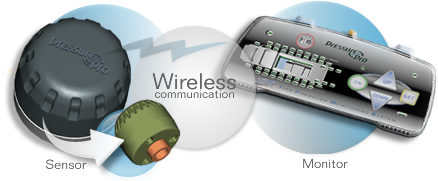
 The third type of sensor is perhaps the easiest to use as an add-on item. PressurePro
sell a system where the sensors are actually built in to the dust caps
that you screw on to your tyre valves. In their system, the in-car
monitor ($199 at the time of writing) plugs into the 12v accessory
socket so it requires no in-vehicle wiring. The PressurePro sensors
send readings to the in-car unit every 7 seconds via wireless RF. The
system alerts you if the pressure in any tyre drops 12.5% below its
baseline pressure - the pressure the tyre was at when the sensor cap
was first screwed on. 12.5% is actually quite a lot. For a passenger
car tyre running at 34psi, 12.5% represents a drop of 4.25; psi. Whilst
that's definitely into the danger zone - the reason for TPMS in the
first place - a drop of 1psi is enough to begin to affect tyre
temperature and gas mileage. Note: the PressurePro system doesn't
monitor tyre temperature.
The third type of sensor is perhaps the easiest to use as an add-on item. PressurePro
sell a system where the sensors are actually built in to the dust caps
that you screw on to your tyre valves. In their system, the in-car
monitor ($199 at the time of writing) plugs into the 12v accessory
socket so it requires no in-vehicle wiring. The PressurePro sensors
send readings to the in-car unit every 7 seconds via wireless RF. The
system alerts you if the pressure in any tyre drops 12.5% below its
baseline pressure - the pressure the tyre was at when the sensor cap
was first screwed on. 12.5% is actually quite a lot. For a passenger
car tyre running at 34psi, 12.5% represents a drop of 4.25; psi. Whilst
that's definitely into the danger zone - the reason for TPMS in the
first place - a drop of 1psi is enough to begin to affect tyre
temperature and gas mileage. Note: the PressurePro system doesn't
monitor tyre temperature.
I've been in contact with one of the
engineering types at PressurePro and will be reviewing their system for
these pages in August 2006.
One concern I had about this system was
the construction of their dustcaps themselves. Built wrong, they could
cause the one thing they're designed to prevent - tyre deflation. How?
In order for the dustcap-monitor to work, it has to hold the valve stem
open once it is screwed on (see also The Low Tech Approach
below). If the unit should crack or break under duress whilst it is
holding the valve stem open, it could lead to tyre deflation. After
speaking to a PressurePro rep, he informed me that there are three
failsafes built into the dustcap to prevent this from happening, even
if the cap itself begins to distort. The caps are tested up to 300°F
(148°C) and down to -40°F (-40°c) for distortion and brittle fracture.
Each cap costs $50 retail at the time of writing, so judge for yourself
if they're likely to be built better than the low tech approach which
cost $19 for four. See the product review page for my test of the PressurePro system.
Driver displays.
As I mentioned above, the driver displays range from the über simple
buzzer and light, to items which would look at home on the bridge of
the starship Enterprise. In the SmarTire picture above, you can see
their sensor has 4 lights on it to the right of the box - an example of
the basic system. The Autodax image shows a more complex system which
shows actual pressures and temperatures as well. SmarTire have a second
generation display available now which shows a graphic representation
of the vehicle along with the problem tyre. Their new system can be set
to trigger at specific temperatures and inflation pressures. For
example it can go off when the tyre gets too hot, when the pressure
goes below a set threshold, or the pressure gets a specified amount
below the "starting" pressure (eg if it loses 1psi of pressure). This
is SmarTire's second-generation display showing some of their operating
modes:
The limits of what TPMS can do.
All TPMS systems have limits. These are usually around ±1.5 PSI/.1 BAR
in pressure accuracy, and ±5.4°F/3°C temperature accuracy. They cannot warn you of an impending blowout. Tyre blowouts are caused by instantaneous failure of the tyre. However
they can tell you about the symptoms that lead to blowouts, and that is
the primary reason for having TPMS. Tyre failures are usually preceded
by long periods of running at lower-than-acceptable pressures - TPMS
would warn you about that. When the tyre pressure is low, the sidewall
flexes a lot more, generating more heat - TPMS can tell you about that
too.
Typically, tyre pressure is transmitted as soon as your
vehicle starts moving. Pressure data is then transmitted every 4-6
minutes randomly, although the sensors read tyre pressure every 7
seconds or so. If the new pressure reading differs from the last
transmitted pressure by more than 3 PSI/.21 BAR, then the data is
transmitted immediately to alert you of a problem. In some systems, the
car's onboard computer has preset limits so rather than measuring a
change, the system simply alerts you when one of the tyres drops below
the preset limit.
Tyre temperature is also normally transmitted as soon as the vehicle
starts moving. As with pressure data, temperature data is then
transmitted every 4-6 minutes randomly. Again the sensors will read the
temperature more frequently, however the system will only alert you if
the temperature exceeds 80°C/176°F.
The down-side of current TPMS.
TPMS sensors need power to work. All the current sensors use batteries.
Whilst these are rated for about 5 years use, or 250,000 miles, the
batteries are not replaceable
in any system. The manufacturers don't want a battery cover to come
loose and start zipping around inside your tyre. For one it is
dangerous to the inside of the tyre and for another, if the battery
compartment opened, the battery would come out and you'd lose all
sensor data for that wheel. As a result, the batteries are built-in to
the sealed unit during manufacture. If you get a dead sensor, you need
to buy a whole new one. Also, you know what batteries are like in
extreme cold and extreme hot - bear that in mind if you regularly park
in snow and ice....
Currently, there are no laws mandating
manufacture dates to be put on these third-party systems. So if you buy
one from a store, it could be brand new, or it could have been sitting
on the shelf for a year. You've been warned.
Rotating your tyres or using snow tyres - what you need to know when using TPMS.
All factory-fit TPMS systems are registered at the factory to the
vehicle. The onboard computer stores a unique transponder ID for each
unit along with its position on the car - front left or right, rear
left or right for example. If you change wheels in the winter to wheels
with snow tyres on them, you either need to move the TPMS sensors to
the corresponding new wheels, or have a duplicate set. Same goes for
rotating your tyres - if you do front to back rotation for example, the
car's computer still reads the TPMS signals but the sensors it believes
are on the front are now on the rear and vice versa. For vehicles with
even tyre pressures all around, this makes no difference unless you
have a system which can tell you which
tyre is deflating. If you have a vehicle where the front pressures are
supposed to be lower than the rear, the onboard pressure limits will be
set accordingly and the underinflation alarms will be skewed.
Particularly at the front - the sensors will be expecting higher
pressure because they're registered as being on the rear wheels. You
could end up with a constant TPMS alarm.
So how to get around this?
There is no easy way. Some vehicles have onboard re-learning
capabilities, where you can get the vehicle into a mode where you can
teach it the location of the sensors in a particular order. Others
require reprogramming through the OBDII port. Either way you need
specialist equipment (such as those sold by Bartec)
to stimulate the TPMS transponders in order and then reprogram the
vehicle accordingly. The general procedure starts at the front left
tyre once the vehicle is in 'learn' mode and then works clockwise
around it. For wireless type reprogramming, the vehicle waits for the
first transponder code, which it receives when you stimulate the sensor
using the special tool, then waits for the second code and so on. For
wired-type reprogramming, the tool stores the 4 transponder codes in
order then uploads them to the car's computer once connected through
the OBD II port.
It's something to bear in mind if you have TPMS on
your vehicle - winter wheels, tyre rotations - anything that moves a
sensor from it's pre-registered location on the vehicle - can cause
problems.
Next-generation TPMS.
Several
companies are working on the battery problem for the sensor modules. As
I mentioned above, the basic pitfall of all existing systems is that at
some point, the battery will wear out, and you'll need a new sensor.
There are a few competing, emerging technologies right now trying to
tackle the problem of perfecting transmitter-sensors that don't require
a battery..
The Pera Piezotag
system relies on the inherent properties of piezoelectric materials -
that is a material which generates current when pressure is applied to
it. The inside of a tyre is constantly at pressure so it seems
reasonable that a correctly-manufactured piezoelectric wafer could
generate enough current to operate the sensor just from the pressure
inside the tyre.
The ALPS Batteryless TPMS system (licenced from IQ Mobil,
a small German R&D company) is similar to an RFID chip in that it
gets its power from the radio signal which interrogates it. Current
systems, (including the Pera proposal) are classified as "active"
transmitter / receiver systems. The sensors transmit signals of their
own accord and the in-car receiver picks them up. The ALPS system is a
"passive" RFID transceiver system. The sensors remain dormant and
un-powered until the in-car transceiver sends a high-power short-range
radio signal out which basically carries a "tell me your status"
command. The RF power in the radio signal is enough to cause the RFID
unit in the sensor to power up, take a reading, transmit it and power
down. Clever eh? The downside of this system is that it's likely to be
pricey compared to others coming to the market. There are 9 pcbs in
their system; one in each wheel, one in each wheel arch and one in the
console.
Transense Technologies
in England are licensing their technology to SmarTire, Michelin and
Honeywell. Unlike the Alps system, Transense's system has only one PCB
and employs passive surface acoustic wave sensors (piezo-based again)
at the inner end of each tyre valve. Their sensors monitor both
pressure and temperature. It's worth noting that Transense hold the
patent for resonant SAW technology which expires in 2019. Pera were
exposed to this technology in the early 90's and have since come out
with their own Piezotag system (see above). Coincidence?
Michelin has an inductive (125kHz) system for trucks developed for them by TI, Goodyear and Siemens have a similar technology system for passenger cars. Qinetic (formerly DERA / RAE Farnborough) also have an offering.
The low-tech approach.
If all
this electronic wizardry seems too much for you, you can always go to
the low-tech approach. Valve-cap pressure sensors. These are available
over-the-counter at just about any car parts store and are about as
simple a device as you can get. You inflate your tyre, and replace the
dust cap on the valve with one of these. If it shows green, you're OK.
If it shows yellow, your tyres have lost some pressure. If it shows
red, your tyres are dangerously underinflated. This system does of
course require you to walk around the car and check each time you want
to drive off.
There are some drawbacks to this system which you should be aware of.
For the pressure sensor to read the tyre pressure, it has to depress
the valve stem when its screwed on. This means that the tyre valve is
no longer the thing keeping the air in your tyre - it's now the seal
between this pressure cap and the screw threads. If it's not snug, it
will leak slowly and let air out of your tyre. Secondly, there's the
question of balance. If you use these screw-on caps, you should get
your wheels re-balanced afterwards because it's adding weight to the
rim. Third there's the question of durability - it's better for one of
these things to come off completely if you hit a pothole because then
the valve stem will re-seal. If you crack the pressure cap, you'll let
all the air out of the tyre very quickly. And finally, the question of
accuracy. Typically these things are very coarse in their readings. A
"yellow" signal might not appear until you're 4psi down, and it might
not show red until you're as much as 8psi down. Even 1psi can be a
problem so 4psi or 8psi is dangerously underinflated.
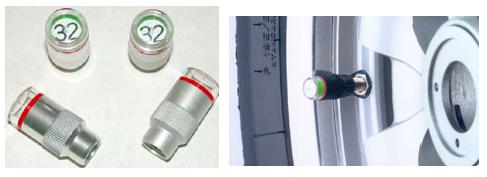
The ultra-low-tech approach, and why all this money is being spent in the first place.
Drivers are lazy. That is the very simple reason that all these companies are burning off millions in R&D budgets, sales and marketing. If we all checked our tyre pressures once a week using one of the tyre pressure gauges mentioned above, we'd know if there was a problem brewing. That is the ultra-low-tech approach. The problem is that 90% of drivers don't ever bother to check their tyres. They either rely on their servicing mechanic or garage to do it for them, or they rely on blind dumb luck. For as long as uneducated people drive around blissfully unaware of the latent danger in their tyres, governments and safety regulators will mandate TPMS. The real question is this : given how unaware some drivers are of their surroundings and their instruments (think of the number of people you see driving with their indicators on on the motorway, or with their fog lights on in bright sunshine) do we really believe that an extra warning light in the vehicle is going to make any difference? Probably not. The key is that if the system was installed, and it worked, and the driver ignored it, then the car, wheel and tyre manufacturers can no longer be held accountable for blowouts and rollovers.
Some TPMS links.
Google Search.
Subaru / GM valve-stem info (PDF file).
TyreAlert. A US manufacturer of TPMS products.
TyreAlert-UK. A UK manufacturer of TPMS products.
Action Imports of Australia, dealing with TPMS products.
Page 1 ------ Page 2
 | These pages were last updated on 22nd April 2009. Copyright © Chris Longhurst 1994 - 2009 unless otherwise noted. The author will respond expeditiously to any intellectual property infringement. Reproduction in whole or in part in any form or medium without express written permission of Chris Longhurst is prohibited. Important Copyright info. |  |