Features:
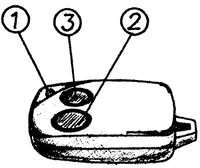
You can arm the System in two ways:
NOTE:
When the system is armed, you will observe the followings;
The System can be disarmed by pressing the First Button on the Remote Control. If you have the Valet Switch connected to the System, it also can disarm the System, as when you leave the vehicle with a mechanic or for a valet parking:
NOTE:
If you want the System back in operation again, you should turn the Switch back to "Normal" position with the Ignition Key at "On" position.
If a door is opened when the System is armed, the Siren will activate immediately, scaring away the intruder. This is done by the Built-in Current Sensor that detects the vehicle's dome light coming on. If the vehicle is not equipped with a dome light or the dome light's power consumption is not big enough, you can have the same Door Entry Protection by connecting the Door Pin Input Wire to the vehicle's door pin.
The Door Pin Input Wire can, also, be used to protect the vehicle's hood or trunk by connecting it to one pin switch of the Hood or Trunk.
The Shock Sensor detects an impact applied to the vehicle. Shepherd-L's most sophisticated Shock Sensor system works in two ways: a. When a light impact is placed, the System sends out the warning voice message first, saying " THIS CAR IS ARMED. BACK OFF !". b. When a heavier impact is applied, then the high power Siren goes off immediately.
When the System is armed, this feature will prevent the vehicle's engine from being started.
To scare off an intruder or call for a help in an emergency, press the First Button on the Remote Control for about 2 seconds to activate the Siren, whether the System is armed or not. To deactivate the Panic Siren, simply press the First Button again.
When the Passive Arming Mode is selected, the System automatically arms itself after the ignition is turned off, the door is opened and then closed.
This mode continues in operation before the ignition is turned on again and the System is armed by the Remote Control, or Non-Passive Arming Mode is selected.
The Status/Warning LED can be mounted on the dash board or some other visual location. It will flash when the System is armed and warn a potential thief that the vehicle is protected with a security system, along with Hana's Window Warning Decal.
Optional Sensors can be purchased separately and connected to the System for more protection;
Hana's extremely stable and reliable perimeter sensor, good for an open area. It transmitts microwave signals to form an area of protection, and detects objects getting into the area. Ideal for convertiables, cars, trucks and boats.
Economic and reliable volumetric sensor that fills the inside of the vehicle to detect movements within it.
The microphone picks up high pitch sound coming from the window breakage.
The Shepherd-L provides the user with many convenience features which can also add up to the protection of the user as well as the vehicle.
Pressing the First Button on the Remote Control arms the System and locks the door at the same time, if the vehicle has a power door-lock system and it is connected to the System.
Likewise, when the System is disarmed by the Remote Control, the door unlocks automatically.
When the System is on Valet Mode, however, pressing the Button only locks and unlocks the doors, not arming or disarming the System.
The Second Button on the Remote Control provides a pulse signal that can release the vehicle's power-activated trunk, hatch or fuel tank door, if it is connected to the System.
When pressing the First Button to disarm the System, the parking lamps of the vehicle will flash two times, enabling you to find your vehicle easily in a dark or crowded parking structure.
When the System is disarmed, the vehicle's courtesy light(dome light) comes on automatically, allowing you to check the inside of the vehicle. The light stays on for 20 seconds or until the ignition key is turned on.
If the System has been triggered during your absence, the parking lights of the vehicle will flash four times to give you warning, when you disarm the System.
If the installation has not been done correctly or a sensor malfunctions, the Self-Diagnosis System of the Shepherd-L will tell you with number of chirp sounds and red LED blinking as to which area dose not function properly, when you first power the System.
* 1 Chirp and LED blinking - Impact Sensor
* 2 Chirps and blmkmgs - Current Sensor
* 3 Chirps and blmkmgs - Passive Arming
* 4 Chirps and blmkmgs - Optional Sensor
The System is equipped with the voice warning message pre-recorded in two different languages- English and Spanish. It is set in English at the factory. In order to change it to Spanish version, the loop wire on the Control Module marked " Spanish" must be cut.
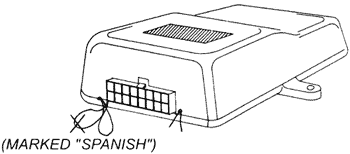
The System comes with the Passive Arming mode set on at the factory.
To set the System back on the Passive Arming Mode,
The System has the built-in Current Sensor which detects a sudden drop in the battery power voltage as when a door is opened and the courtesy light comes on. This is a very useful sensor for protecting the door entry. However, because of the characteristic, it might detect operation of other legitimate electric devices in your vehicle thus activating the Siren. If such false alarm occurs, disabling the Current Sensor becomes required. To do this, cut off the Current Sensor Bypass Loop Wire attached on the Control Module.
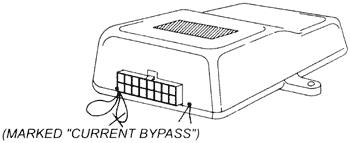
Note:
When the Current Sensor is bypassed, Door Pin Input Wire must be installed to have the door entry protection.
The System has the most advanced and conveneient way of adjusting the sensitivity of the built-in Shock Sensor, from a Remote Control. The Shock Sensor is set at Level 3 at the factory. You can increase, decrease or even turn it off from the Remote Control, without having to go to the Alarm unit;
| LEVEL # | SENSITIVITY | CONFIRMATION CHIRP |
|---|---|---|
| 0 | 0 Sensitivity (Off) | 1 Chirp Sound |
| 1 | 30-40% Lower than Level 3 | 2 Chirp Sounds |
| 2 | 10-25% Lower than Level 3 | 3 Chirp Sounds |
| 3 | Factory-set Optimum Level 4 | Chirp Sounds |
| 4 | 10-25% Higher than Level 3 | 5 Chirp Sounds |
| 5 | Maximum Sensitivity | 6 Chirp Sounds |
The Remote Control of the System is powered by a mini size 12V battery that will last approximately one year under normal use. When the red LED on the Remote Control becomes dim and you are starting to lose the Remote Control range, that indicates the battery needs to be replaced. To replace the battery, follow the below procedures;
| 1. Operating Power Voltage | (NORMINAL) 12 Volt DC |
| 2. Exit Delay Time | 5 Seconds |
| 3. Siren Cycle | 60 Seconds |
| 4. Reset Delay | 2 Seconds |
| 5. Entry Delay Time | 0 Second |
| 6. Passive Arming Entry Time | 30 Seconds |
| 7. Door Lock Pulse Output - Locking | 700m Seconds |
| Unlocking | 700m Seconds |
| 8. Siren Level measured at 1 Meter | 120 dB |
| 9. Current Sensing Sensitivity | 3 Watts |
| 10. Current Drain - Armed | 6mW |
| Disarmed | 5mW |
| 11. Operating Temperature | -30 С to +85C (-22Fto+185F) |
| 12. Remote Control Battery Type | 12V Alkaline |
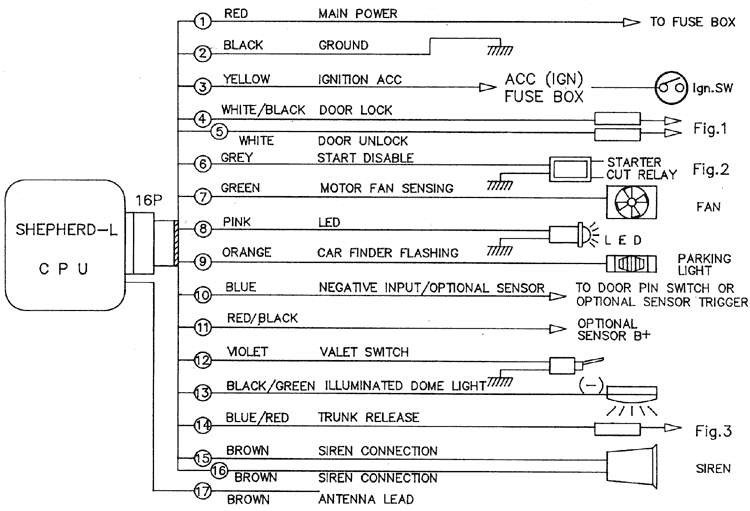
| NO. | WIRE COLOR | FUNCTION | WIRING DESCRIPTION |
|---|---|---|---|
| 1 | Red | Main Power | Connect to a constant 12V (+) Power Source. Dome Light Fuse Box is most recommended. |
| 2 | Black | Ground | Connect to a good Chassis Ground. |
| 3 | Yellow | Ignition ACC | Connect to "true" Ignition SW wire where 12V (+) Power is supplied when the Ignition Key is "On". |
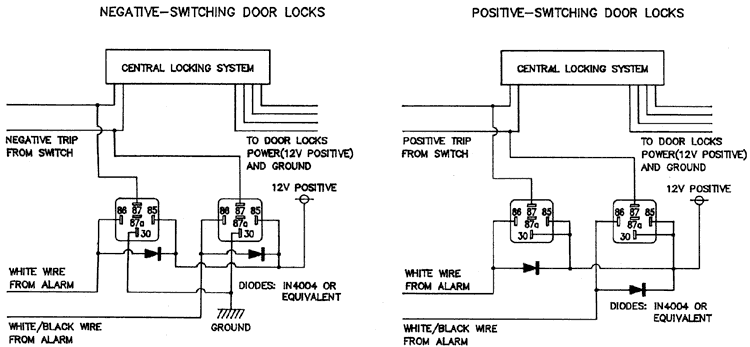
| 4 | White/Black* | Door Lock | Connect to a Relay used for Door Lock control. Refer to [Fig. 1] |
| 5 | White* | Door Unlock | Connect to a Relay used for Door Unlock control. Refer to [Fig. 1] |
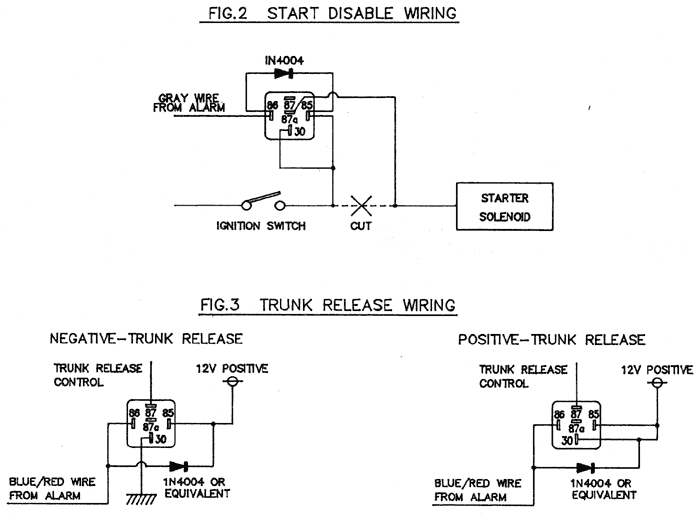
| 6 | Gray* | Start Disable | Connect to the Start Disable Relay circuit. Refer to [Fig. 2] |
| 7 | Green | Motor Fan Sensing | Connect to a Motor Fan switch wire, Negative (-) side for a Negative Motor Fan System, and Positive (+) side for a Positive Motor Fan System. |
| 8 | Pink | Status/Warning LED | Connect to the Pink wire of the LED. |
| 9 | Orange | Car Finder Flashing | Connect to vehicle's Parking Light wire. |
| 10 | Blue | Negative (-) Input Wire | For Door/Hood/Trunk Protection, connect to the wires coming from the Pin Switches (Negative Ground Car only). For Optional Sensor, connect to Trigger wire. |
| 11 | Red/Black | Option B+ | Connect to B+ Power Lead of Optional Sensor |
| 12 | Violet | Valet Switch | Connect to the Violet wire of the Valet Switch supplied. |
| 13 | Black/Green | Illuminated Dome Light Entry | Connect to the Dome (Courtesy) Light circuit (Negative wire). |
| 14 | Blue/Red* | Trunk Release | Connect to the Relay used for Trunk Release Control. Refer to [Fig. 3.] |
| 15 16 |
Brown Brown |
Siren Connection Siren Connection |
Connect to the Siren. Connect to the Siren. |
| 17 | Brown | Antenna Lead | Place this Antenna Wire as high and straight as possible under hood, away from metals. Do not connect, but tie or tape it to plastic parts. |
NOTE: Connection of the wires marked* may require Relays.