Rear Brake Disc Inspection (5D)
Rear Brake Disc Inspection
Runout
| 1. | Raise the rear of the vehicle, and support it with safety stands in the proper locations. Remove the rear wheels. |
| 2. | Remove the brake pads. |
| 3. | Inspect the brake disc surface for damage and cracks. Clean the disc thoroughly, and remove all rust. |
| 4. | Install suitable flat washers (A) and wheel nuts, and tighten the nuts to the specified torque to hold the brake disc securely against the hub.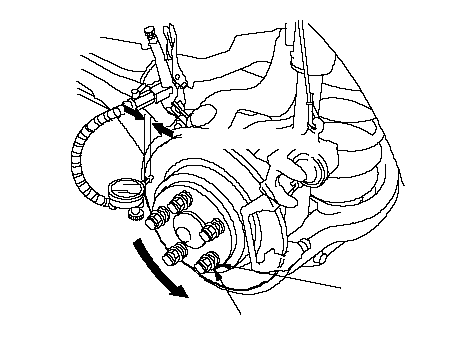 A108 N·m A108 N·m(11.0 kgf·m, 80 lbf·ft)10 mm (0.4 in.) |
| 5. | Set up the dial gauge against the brake disc as shown, and measure the runout at 10 mm (0.4 in.) from the outer edge of the disc.
| ||||||
| 6. | If the brake disc is beyond the service limit, refinish the disc.
NOTE:
|
Thickness and Parallelism
| 1. | Raise the rear of the vehicle, and support it with safety stands in the proper locations. Remove the rear wheels. |
| 2. | Remove the brake pads. |
| 3. | Using a micrometer, measure disc thickness at eight points, approximately 45° apart and 10 mm (0.4 in.) in from the outer edge of the disc.
NOTE: This is the maximum allowable difference between the thickness measurements. 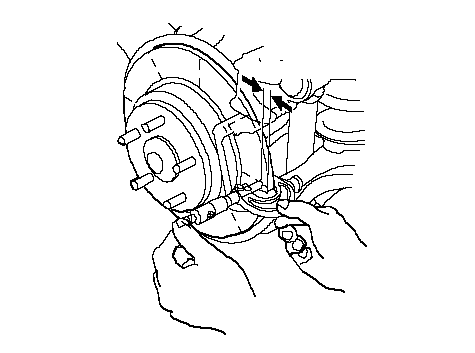 10 mm (0.4 in.) 10 mm (0.4 in.) | ||||||||||||||
| 4. | If the smallest measurement is less than the max. refinishing limit, replace the brake disc. |
| 5. | If the brake disc is beyond the service limit for parallelism, refinish the disc with an on-car brake lathe. |