DTC    P0115    Engine Coolant Temperature Circuit Malfunction

DTC    P0117    Engine Coolant Temperature Circuit Low Input

DTC    P0118    Engine Coolant Temperature Circuit High Input

for Preparation Click here


DESCRIPTION

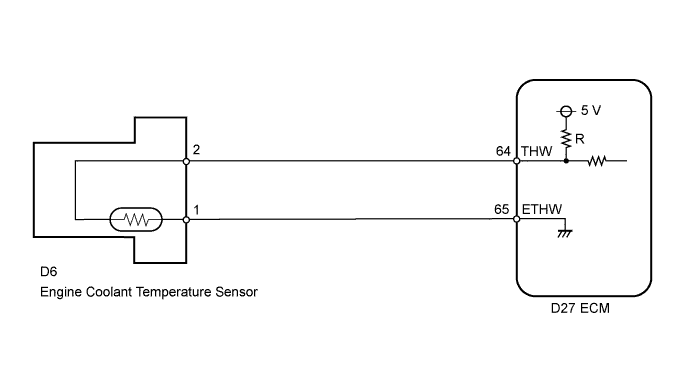
A thermistor, whose resistance value varies according to the engine coolant temperature, is built into the engine coolant temperature sensor.
The structure of the sensor and its connection to the ECM are the same as those of the intake air temperature sensor.

HINT:
When any of DTCs P0115, P0117 and P0118 are set, the ECM enters fail-safe mode. During fail-safe mode, the engine coolant temperature is estimated to be 80°C (176°F) by the ECM. Fail-safe mode continues until a pass condition is detected.


DTC No.
DTC Detection Condition
Trouble Area
P0115
Open or short in engine coolant temperature sensor circuit for 0.5 seconds (1 trip detection logic).
  1. Open or short in engine coolant temperature sensor circuit
  2. Engine coolant temperature sensor
  3. ECM
P0117
Short in engine coolant temperature sensor circuit for 0.5 seconds (1 trip detection logic).
  1. Short in engine coolant temperature sensor circuit
  2. Engine coolant temperature sensor
  3. ECM
P0118
Open in engine coolant temperature sensor circuit for 0.5 seconds (1 trip detection logic).
  1. Open in engine coolant temperature sensor circuit
  2. Engine coolant temperature sensor
  3. ECM

HINT:
When any of these DTCs are set, check the engine coolant temperature by entering the following menus: Powertrain / Engine and ECT / Data List / Coolant Temp.


Temperature Displayed
Malfunction
-40°C (-40°F)
Open circuit
140°C (284°F)
Short circuit

MONITOR DESCRIPTION

The engine coolant temperature sensor is used to monitor the engine coolant temperature. The engine coolant temperature sensor has a thermistor with a resistance that varies according to the temperature of the engine coolant. When the coolant temperature becomes low, the resistance in the thermistor increases. When the temperature becomes high, the resistance drops. These variations in resistance are reflected in the output voltage from the sensor. The ECM monitors the sensor voltage and uses this value to calculate the engine coolant temperature. When the sensor output voltage deviates from the normal operating range, the ECM interprets this as a fault in the engine coolant temperature sensor circuit and sets a DTC.

MONITOR STRATEGY


Frequency of Operation
Continuous

CONFIRMATION DRIVING PATTERN

  1. Turn the power switch on (IG) and wait for 0.5 seconds or more.

WIRING DIAGRAM


A220564E06


INSPECTION PROCEDURE

HINT:
Read freeze frame data using the intelligent tester. The ECM records vehicle and driving condition information as freeze frame data the moment a DTC is stored. When troubleshooting, freeze frame data can be helpful in determining whether the vehicle was running or stopped, whether the engine was warmed up or not, whether the air fuel ratio was lean or rich, as well as other data recorded at the time of a malfunction.

1.READ VALUE USING INTELLIGENT TESTER (ENGINE COOLANT TEMPERATURE)
  1. Connect the intelligent tester to the DLC3.

  1. Turn the power switch on (IG).

  1. Turn the tester on.

  1. Enter the following menus: Powertrain / Engine and ECT / Data List / Coolant Temp.

  1. Read the value displayed on the tester.

    Standard Value:
    Between 75°C and 100°C (167°F and 212°F) with warm engine.


    Result 
    Result
    Proceed to
    -40°C (-40°F)
    A
    140°C (284°F)
    B
    Between 75°C and 100°C (167°F and 212°F)
    C

    HINT:
    1. If there is an open circuit, the tester indicates -40°C (-40°F).
    1. If there is a short circuit, the tester indicates 140°C (284°F).


B
Go to step 4

C
CHECK FOR INTERMITTENT PROBLEMS (Click here)
A


2.READ VALUE USING INTELLIGENT TESTER (CHECK FOR OPEN IN WIRE HARNESS)


  1. Disconnect the engine coolant temperature sensor connector.
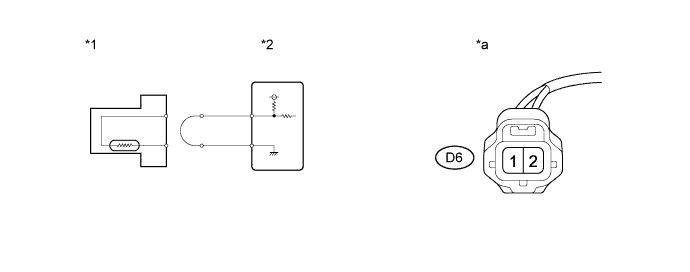

    A207455E34


    Text in Illustration 
    *1
    Engine Coolant Temperature Sensor
    *2
    ECM
    *a
    Front view of wire harness connector
    (to Engine Coolant Temperature Sensor)
    -
    -

  1. Connect terminals 1 and 2 of the engine coolant temperature sensor connector on the wire harness side.

  1. Connect the intelligent tester to the DLC3.

  1. Turn the power switch on (IG).

  1. Turn the tester on.

  1. Enter the following menus: Powertrain / Engine and ECT / Data List / Coolant Temp.

  1. Read the value displayed on the tester.

    Standard Value:
    140°C (284°F)


NG
Go to step 3
OK

REPLACE ENGINE COOLANT TEMPERATURE SENSOR (Click here)  

3.CHECK HARNESS AND CONNECTOR (ENGINE COOLANT TEMPERATURE SENSOR - ECM)
  1. Disconnect the engine coolant temperature sensor connector.

  1. Disconnect the ECM connector.

  1. Measure the resistance according to the value(s) in the table below.

    Standard Resistance:

    Tester Connection
    Condition
    Specified Condition
    D6-2 - D27-64 (THW)
    Always
    Below 1 Ω
    D6-1 - D27-65 (ETHW)
    Always
    Below 1 Ω


NG
REPAIR OR REPLACE HARNESS OR CONNECTOR
OK

REPLACE ECM (Click here)  

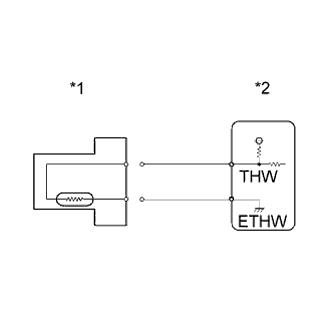
4.READ VALUE USING INTELLIGENT TESTER (CHECK FOR SHORT IN WIRE HARNESS)


    A188268E09
  1. Disconnect the engine coolant temperature sensor connector.
    Text in Illustration 
    *1
    Engine Coolant Temperature Sensor
    *2
    ECM

  1. Connect the intelligent tester to the DLC3.

  1. Turn the power switch on (IG).

  1. Turn the tester on.

  1. Enter the following menus: Powertrain / Engine and ECT / Data List / Coolant Temp.

  1. Read the value displayed on the tester.

    Standard value:
    -40°C (-40°F)


NG
Go to step 5
OK

REPLACE ENGINE COOLANT TEMPERATURE SENSOR (Click here)  

5.CHECK HARNESS AND CONNECTOR (ENGINE COOLANT TEMPERATURE SENSOR - ECM)
  1. Disconnect the engine coolant temperature sensor connector.

  1. Disconnect the ECM connector.

  1. Measure the resistance according to the value(s) in the table below.

    Standard Resistance:

    Tester Connection
    Condition
    Specified Condition
    D6-2 or D27-64 (THW) - Body ground
    Always
    10 kΩ or higher


NG
REPAIR OR REPLACE HARNESS OR CONNECTOR
OK

REPLACE ECM (Click here)