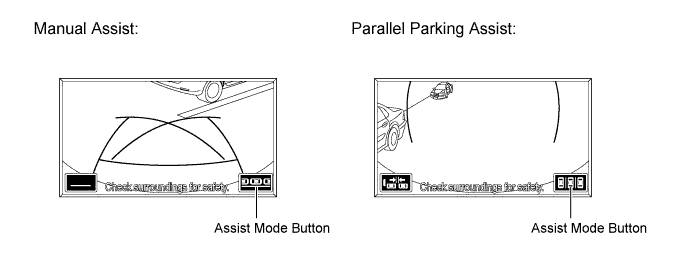
Do not rely entirely on the parking assist monitor system. Use caution, just as you would when driving any vehicle.
Never drive while looking only at the screen. The image on the screen may differ from actual conditions. If you drive while looking only at the screen, you may hit an object or have an accident. Be sure to confirm the safety of your surroundings when driving the vehicle.
The camera uses a wide-angle lens. The perceived distance from images that appear on the screen differs from the actual distance.
In the following cases, it may become difficult to see the images on the screen, but this is not a malfunction:
In the dark (for example, at night).
When the temperature near the lens is very high or low.
When water droplets are adhering to the camera, or when humidity is high (for example, when it rains).
When the camera has scratches or dirt on it.
When foreign matter (for example, mud) is adhering to the camera lens.
When the sun or the beam of headlights is shining directly into the camera lens
When the camera is used under fluorescent lights, sodium lights, or mercury lights etc., the lights and the illuminated area may appear to flicker.
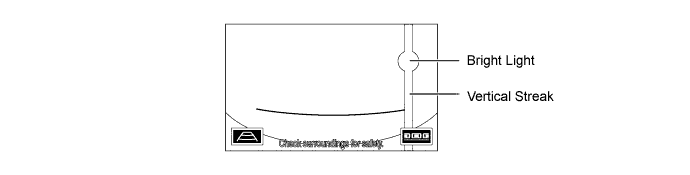
If a bright light (for example, sunlight reflected off the vehicle body) is picked up by the camera, the smear effect*, peculiar to the CCD camera, may occur.
- HINT:
- *: Smear effect: A phenomenon that occurs when a bright light (for example, sunlight reflected off the vehicle body) is received up by the camera and transmitted to the screen, the light source will appear to have a vertical streak above and below it.