HIGH PRESSURE SIDE FUEL PUMP > REMOVAL |
| 1. DISCHARGE FUEL SYSTEM PRESSURE |
Disconnect the cable from the negative (-) battery terminal.
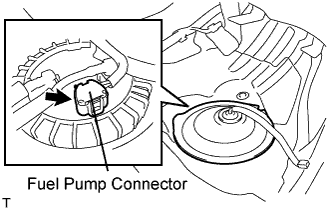 |
Disconnect the fuel pump connector.
Connect the cable to the negative (-) battery terminal.
Start the engine. After the engine has stopped on its own, turn the engine switch off.
Crank the engine again, then check that the engine does not start.
Loosen the fuel tank cap, then discharge the pressure in the fuel tank completely.
Connect the fuel pump connector.
| 2. DISCONNECT CABLE FROM NEGATIVE BATTERY TERMINAL |
| 3. REMOVE COOL AIR INTAKE DUCT SEAL |
 |
Remove the 7 clips and duct seal.
| 4. REMOVE ENGINE UNDER COVER |
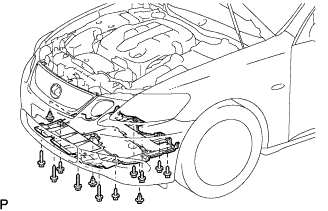 |
Using a clip remover, remove the 3 clips.
Remove the 10 screws and under cover.
| 5. DRAIN ENGINE COOLANT |
Remove the radiator cap and reservoir cap.
Loosen the radiator drain cock plug and 2 cylinder block drain cock plugs. Then drain the coolant.

| 6. REMOVE ENGINE ROOM SIDE COVER RH |
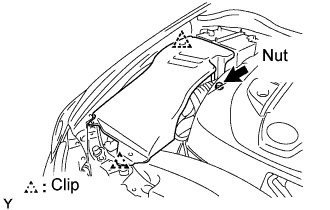 |
Loosen the nut and remove the 2 clips and side cover.
| 7. REMOVE V-BANK COVER |
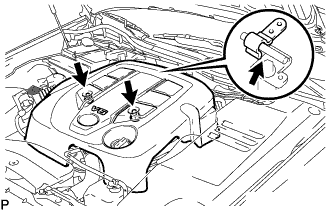 |
Remove the 2 nuts and V-bank cover.
| 8. DISCONNECT NO. 2 VENTILATION HOSE |
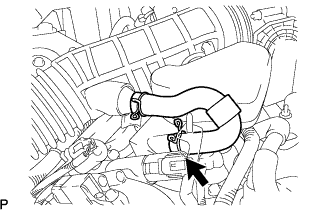 |
Disconnect the ventilation hose from the cylinder head.
| 9. REMOVE AIR CLEANER CAP WITH AIR CLEANER HOSE |
 |
Disconnect the MAF meter connector.
Disconnect the clamp from the air cleaner.
 |
Disconnect the VSV (for EVAP).
 |
Disconnect the 4 clamps.
Remove the hose clamp and air cleaner cap with air cleaner hose.
| 10. DISCONNECT WATER BY-PASS HOSE |
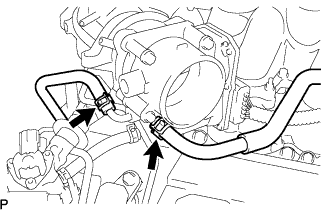 |
Disconnect the 2 water by-pass hoses from the throttle body.
| 11. DISCONNECT HEATER WATER INLET HOSE |
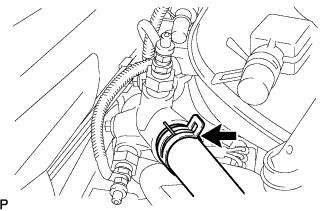 |
Disconnect the hose from the water hose joint.
| 12. REMOVE ENGINE REAR COVER |
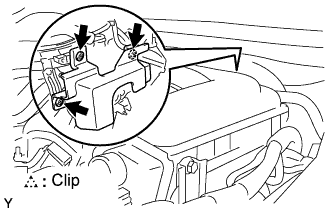 |
Remove the 3 clips and engine rear cover.
| 13. DISCONNECT FUEL MAIN TUBE |
 |
Remove the fuel pipe clamp.
 |
Pinch and pull the fuel tube's connector to disconnect it from the fuel main pipe.
 |
| 14. DISCONNECT UNION TO CHECK VALVE HOSE |
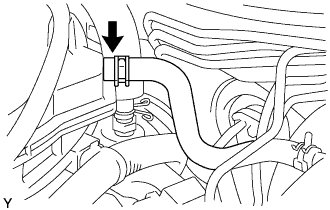 |
Disconnect the hose from the surge tank.
| 15. DISCONNECT VENTILATION HOSE |
 |
Disconnect the ventilation hose from the ventilation valve.
| 16. REMOVE INTAKE AIR SURGE TANK |
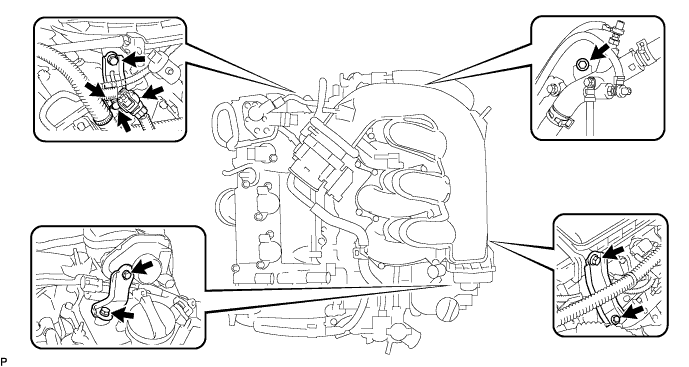
Disconnect the throttle motor connector.
Disconnect the IACV connector.
Disconnect the wire harness clamp from the surge tank.
Remove the 2 bolts and intake manifold stay.
Disconnect the 2 wire harness clamps from the surge tank stays.
Remove the 4 bolts and 2 surge tank stays.
Remove the bolt and disconnect the water hose joint.
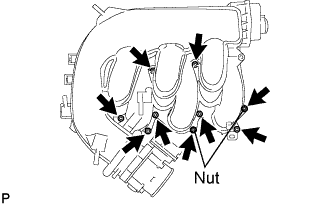 |
Using a 5 mm hexagon socket wrench, remove the 7 bolts, 2 nuts and gasket.
| 17. REMOVE INTAKE MANIFOLD |
 |
Disconnect the DC motor connector for the SCV.
Disconnect the SCV position sensor connector.
Remove the 4 bolts, 4 nuts, intake manifold and gasket.
| 18. DISCONNECT NO. 1 FUEL PIPE |
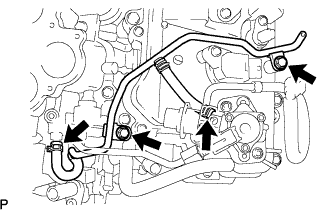 |
Disconnect the fuel pipe hose.
Remove the 2 bolts and fuel pipe.
| 19. REMOVE FUEL PRESSURE PULSATION DAMPER |
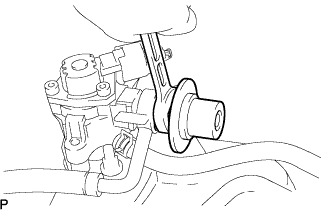 |
Remove the fuel pulsation damper and 2 gaskets, and disconnect the fuel main tube from the fuel pump.
| 20. DISCONNECT NO. 2 FUEL PIPE |
Disconnect the fuel high pressure side fuel pump connector.
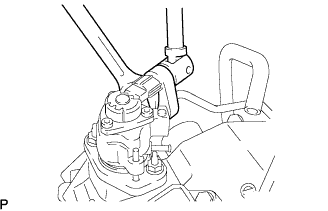 |
Fix the union bolt on the fuel pump side in place with a 21 mm wrench. Using a 19 mm union nut wrench, loosen the union and remove the fuel pipe.
 |
Remove the 2 bolts on the delivery pipe side.
| 21. REMOVE HIGH PRESSURE SIDE FUEL PUMP |
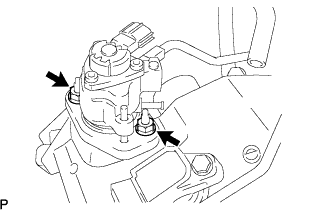 |
Disconnect the fuel hose.
Remove the 2 nuts, fuel pump and fuel pump insulator.
