DTC    P0340    Camshaft Position Sensor Circuit Malfunction

DTC    P0342    Camshaft Position Sensor "A" Circuit Low Input (Bank 1 or Single Sensor)

DTC    P0343    Camshaft Position Sensor "A" Circuit High Input (Bank 1 or Single Sensor)

DTC    P0345    Camshaft Position Sensor "A" Circuit (Bank 2)

DTC    P0347    Camshaft Position Sensor "A" Circuit Low Input (Bank 2)

DTC    P0348    Camshaft Position Sensor "A" Circuit High Input (Bank 2)

for Preparation Click here


DESCRIPTION

The intake camshaft's Variable Valve Timing (VVT) sensor (G signal) consists of a magnet and MRE element.
The VVT camshaft drive gear has a sensor plate with 3 teeth on its outer circumference. When the gear rotates, changes occur in the air gaps between the sensor plate and pickup coil, which affects the magnet. As a result, the resistance of the MRE material fluctuates. The VVT sensor converts the gear rotation data to pulse signals, and uses the pulse signals to determine the camshaft angle, which it sends to the ECM. Then the ECM uses this data to control fuel injection time and injection timing.
The crankshaft angle sensor plate has 34 teeth. The pickup coil generates 34 signals for each engine revolution. Based the G signal and actual crankshaft angle, the ECM detects the normal crankshaft angle. Also, based on the NE signal, the ECM detects the engine speed.

DTC No.
DTC Detection Condition
Trouble Area
P0340
P0345
  1. Input voltage to ECM remains 0.3 V or less, or 4.7 V or higher for more than 5 seconds, when 2 more seconds have elapsed after turning engine switch on (IG)
    (1 trip detection logic)
  2. No VVT sensor signal to ECM during cranking
    (1 trip detection logic)
  1. Open or short in VVT sensor for intake camshaft circuit
  2. VVT sensor for intake camshaft
  3. Camshaft timing gear for intake camshaft
  4. Jumped tooth of timing chain for intake camshaft
  5. ECM
P0342
P0347
Output voltage of VVT sensor 0.3 V or less for 5 seconds
(1 trip detection logic)
  1. Open or short in VVT sensor for intake camshaft circuit
  2. VVT sensor for intake camshaft
  3. Camshaft timing gear for intake camshaft
  4. Jumped tooth of timing chain for intake camshaft
  5. ECM
P0343
P0348
Output voltage of VVT sensor 4.7 V or more for 5 seconds
(1 trip detection logic)
  1. Open or short in VVT sensor for intake camshaft circuit
  2. VVT sensor for intake camshaft
  3. Camshaft timing gear for intake camshaft
  4. Jumped tooth of timing chain for intake camshaft
  5. ECM
A107148E02
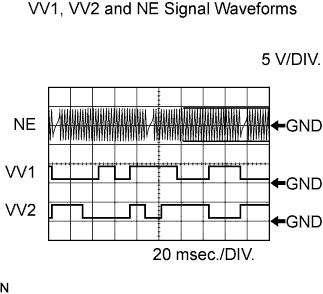
  1. Reference: Inspection using an oscilloscope

HINT:
  1. The correct waveform is shown.
  2. VV1+ and VV2+ stand for the VVT sensor signal, and NE+ stands for the CKP sensor signal.

Item
Content
Terminals
NE+ - NE-
VV1+ - VV1-
VV2+ - VV2-
Equipment Settings
5 V/DIV., 20 msec./DIV.
Conditions
Cranking or idling

MONITOR DESCRIPTION

If no signal is transmitted by the VVT sensor despite the engine revolving, or the rotations of the camshaft and the crankshaft are not synchronized, the ECM interprets this as a malfunction of the sensor.

WIRING DIAGRAM

Refer to DTC P0335 on page Click here.

INSPECTION PROCEDURE

HINT:
Read freeze frame data using the intelligent tester. Freeze frame data records the engine conditions when a malfunction is detected. When troubleshooting, freeze frame data can help determine if the vehicle was running or stopped, if the engine was warmed up or not, if the air-fuel ratio was LEAN or RICH, and other data from the time the malfunction occurred.

1.CHECK ECM TERMINAL VOLTAGE
A107709E03
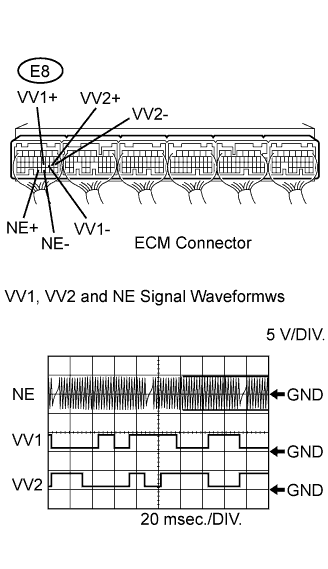
  1. Inspect the ECM using an oscilloscope.

    1. While the engine is idling, check the waveform between the terminals of the ECM connector.

      Standard voltage:
      Tester Connection
      Specified Condition
      VV1+ (E8-21) - VV1- (E8-20)
      Correct waveform shown
      VV2+ (E8-19) - VV2- (E8-18)
      Correct waveform shown
      NE+ (E8-32) - NE- (E8-31)
      Correct waveform shown


NG
REPLACE VVT SENSOR
OK


2.CHECK VVT SENSOR FOR INTAKE CAMSHAFT (SENSOR POWER SOURCE)
A107149E06
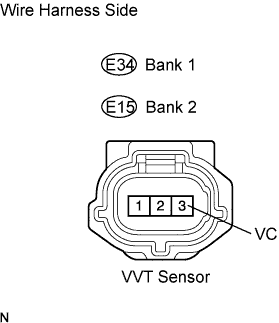
  1. Disconnect the E34 or E15 VVT sensor connector.

  1. Measure the voltage between the terminals of the wire harness side connector and body ground.

    Standard voltage:
    Tester Connection
    Specified Condition
    VC (E34-3) - Body ground
    4.5 to 5.0 V
    VC (E15-3) - Body ground
    4.5 to 5.0 V

  1. Reconnect the VVT sensor connector.


NG
REPAIR OR REPLACE HARNESS AND CONNECTOR
OK


3.CHECK HARNESS AND CONNECTOR (VVT SENSOR FOR INTAKE CAMSHAFT - ECM)
A107710E03
  1. Disconnect the E34 or E15 VVT sensor connector.

  1. Disconnect the E8 ECM connector.

  1. Measure the resistance.

    Standard resistance (Check for open):
    Tester Connection
    Specified Condition
    VVR+ (E34-1) - VV1+ (E8-21)
    Below 1 Ω
    VVR- (E34-2) - VV1- (E8-20)
    Below 1 Ω
    VVL+ (E15-1) - VV2+ (E8-19)
    Below 1 Ω
    VVL- (E15-2) - VV2- (E8-18)
    Below 1 Ω

    Standard resistance (Check for short):
    Tester Connection
    Specified Condition
    VVR+ (E34-1) or VV1+ (E8-21) - Body ground
    10 kΩ or higher
    VVR- (E34-2) or VV1- (E8-20) - Body ground
    10 kΩ or higher
    VVL+ (E15-1) or VV2+ (E8-19) - Body ground
    10 kΩ or higher
    VVL- (E15-2) or VV2- (E8-18) - Body ground
    10 kΩ or higher

  1. Reconnect the VVT sensor connector.

  1. Reconnect the ECM connector.


NG
REPAIR OR REPLACE HARNESS AND CONNECTOR
OK


4.CHECK SENSOR INSTALLATION (VVT SENSOR FOR INTAKE CAMSHAFT)
BR03795E17
  1. Check the CKP sensor installation.

    OK:
    Sensor is installed correctly.


NG
TIGHTEN SENSOR
OK


5.CHECK CAMSHAFT TIMING GEAR ASSEMBLY (TEETH OF PLATE)
  1. Check the teeth of the signal plate.

    OK:
    Sensor plate teeth do not have any cracks or deformation.


NG
REPLACE CAMSHAFT TIMING GEAR ASSEMBLY
OK

REPLACE ECM