REAR WHEEL ALIGNMENT > ADJUSTMENT |
| 1. INSPECT TIRES |
| 2. MEASURE VEHICLE HEIGHT |
| 3. INSPECT TOE-IN |
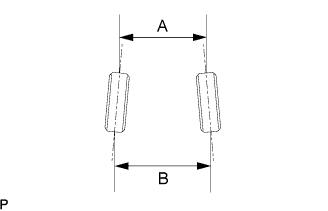 |
Bounce the vehicle at the corners up and down to stabilize the suspension and inspect vehicle height.
| Toe-in (total) | A - B: 3 +- 2 mm (0.12 +- 0.08 in.) |
| 4. ADJUST TOE-IN |
 |
Loosen the toe adjust cam nut.
Turn the adjust cams by an equal amount to adjust toe-in.
Tighten the nut.
| 5. INSPECT CAMBER |
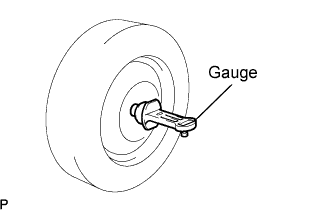 |
Install a camber-caster-kingpin gauge or put the wheels on a wheel alignment tester.
Inspect the camber.
| Camber | -1°10' +- 45' (-1.17° +- 0.75°) |
| Right-left error | 30' (0.5°) or less |
| Camber | -1°19' +- 45' (-1.32° +- 0.75°) |
| Right-left error | 30' (0.5°) or less |
| 6. INSPECT SUSPENSION PARTS |
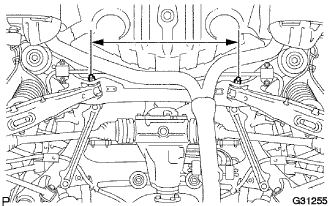 |
Inspect the rear suspension member.
Measure the distance between the centers of the installation bolts of the rear suspension arm assembly No.2 LH and RH.
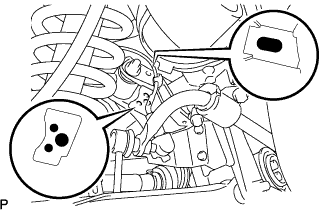 |
Visually inspect the press holes on the installation area of the upper control arm assembly rear No.2.
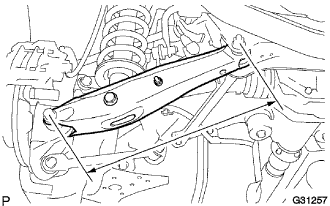 |
Inspect the rear suspension arm assembly No.2.
Remove the rear wheel.
Measure the distance between the centers of the 2 installation bolts of the rear suspension arm assembly No.2.
Install the rear wheel.
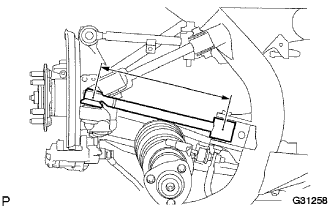 |
Inspect the upper control arm assembly rear No.2.
Measure the distance between the centers of the installation bolt of the upper control arm assembly rear No.2 and the ball joint stud.
