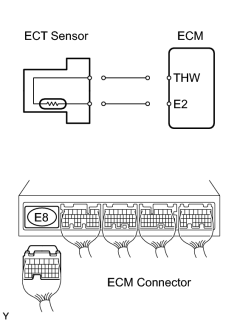
- Open or short in Engine Coolant Temperature (ECT) sensor circuit
- Engine Coolant Temperature (ECT) sensor
- ECM
| Last Modified: 4-30-2014 | 6.6 C | Doc ID: RM000000UCS00BX |
| Model Year: 2006 | Model: LX470 | Prod Date Range: [05/2005 - ] |
| Title: 2UZ-FE ENGINE CONTROL SYSTEM: SFI SYSTEM: P0115,P0117,P0118; Engine Coolant Temperature Circuit; 2006 MY LX470 [05/2005 - ] | ||
|
DTC |
P0115 |
Engine Coolant Temperature Circuit |
|
DTC |
P0117 |
Engine Coolant Temperature Circuit Low Input |
|
DTC |
P0118 |
Engine Coolant Temperature Circuit High Input |
DESCRIPTION
-
A thermistor is built into the Engine Coolant Temperature (ECT) sensor and changes the resistance value according to the engine coolant temperature.
The structure of the sensor and connection to the ECM is the same as the Intake Air Temperature (IAT) sensor.
HINT:
If the ECM detects the DTC P0115, P0117 or P0118, it operates the fail-safe function in which the ECT is assumed to be 80°C (176°F).
|
DTC No. |
DTC Detection Condition |
Trouble Area |
|---|---|---|
|
P0115 |
Open or short in Engine Coolant Temperature (ECT) sensor circuit for 0.5 seconds (1 trip detection logic) |
|
|
P0117 |
Short in ECT sensor circuit for 0.5 seconds (1 trip detection logic) |
|
|
P0118 |
Open in ECT sensor circuit for 0.5 seconds (1 trip detection logic) |
|
HINT:
Confirm the ECT using the intelligent tester. Enter the following menus: DIAGNOSIS / ENHANCED OBD II / DATA LIST / PRIMARY / COOLANT TEMP.
|
Temperature Displayed |
Malfunction |
|---|---|
|
-40°C (-40°F) |
Open circuit |
|
140°C (284°F) or more |
Short circuit |
MONITOR DESCRIPTION
The Engine Coolant Temperature (ECT) sensor is used to monitor the engine coolant temperature. The ECT sensor has a thermistor that varies its resistance depending on the temperature of the engine coolant. When the coolant temperature is low, the resistance in the thermistor increases. When the temperature is high, the resistance drops. The variations in resistance are reflected in the voltage output from the sensor. The ECM monitors the sensor voltage and uses this value to calculate the ECT. When the sensor output voltage deviates from the normal operating range, the ECM interprets this as a fault in the ECT sensor and sets a DTC.
Example:
When the ECM calculates that the ECT is -40°C (-40°F) (P0118) or more than 140°C (284°F) (P0117) and that either condition continues for 0.5 seconds or more, the ECM will set a DTC.
This monitor runs for 0.5 seconds after the ignition switch ON.
MONITOR STRATEGY
|
Related DTCs |
P0115: ECT sensor range check (fluttering) P0117: ECT sensor range check (low resistance) P0118: ECT sensor range check (high resistance) |
|
Required Sensors/Components (Main) |
ECT sensor |
|
Required Sensors/Components (Related) |
- |
|
Frequency of Operation |
Continuous |
|
Duration |
0.5 seconds |
|
MIL Operation |
Immediate |
|
Sequence of Operation |
None |
TYPICAL ENABLING CONDITIONS
|
Monitor will run whenever these DTCs are not present |
None |
|
The typical enabling condition is not available |
- |
TYPICAL MALFUNCTION THRESHOLDS
P0115:
|
ECT sensor voltage [Engine coolant temperature] |
Less than 0.14 V, or more than 4.91 V |
P0117:
|
ECT sensor voltage [Engine coolant temperature] |
Less than 0.14 V |
P0118:
|
ECT sensor voltage [Engine coolant temperature] |
More than 4.91 V |
COMPONENT OPERATING RANGE
|
ECT sensor resistance [ECT] |
79 Ω to 156 kΩ [-40 to 140°C (-40 to 284°F)] |
WIRING DIAGRAM
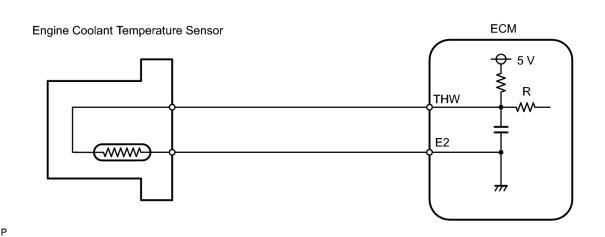
INSPECTION PROCEDURE
HINT:
- If other DTCs relating to different systems that have terminal E2 as the ground terminal are output simultaneously, terminal E2 may have an open circuit.
- Read freeze frame data using the intelligent tester. Freeze frame data records the engine conditions when malfunctions are detected. When troubleshooting, freeze frame data can help determine if the vehicle was running or stopped, if the engine was warmed up or not, if the air fuel ratio was lean or rich, and other data from the time the malfunction occurred.
PROCEDURE
|
1. |
READ VALUE USING INTELLIGENT TESTER (ENGINE COOLANT TEMPERATURE) |
(a) Connect the intelligent tester to the CAN VIM. Then connect the CAN VIM to the DLC3.
(b) Turn the ignition switch ON and turn the intelligent tester ON.
(c) Enter the following menus: DIAGNOSIS / ENHANCED OBD II / DATA LIST / PRIMARY / COOLANT TEMP.
(d) Read the values.
Standard:
Same value as the actual ECT.
|
Engine Coolant Temperature |
Proceed to |
|---|---|
|
-40°C (-40°F) |
A |
|
140°C (284°F) or more |
B |
|
OK (same as present temperature) |
C |
HINT:
If there is an open circuit, the intelligent tester indicates -40°C (-40°F).
If there is a short circuit, the intelligent tester indicates 140°C (284°F) or more.
| B |

|
| C |
|
|

|
2. |
READ VALUE USING INTELLIGENT TESTER (CHECK FOR OPEN IN WIRE HARNESS) |
|
(a) Disconnect the E2 Engine Coolant Temperature (ECT) sensor connector. (b) Connect terminals 1 and 2 of the ECT sensor wire harness side connector. (c) Turn the ignition switch ON. (d) Enter the following menus: DIAGNOSIS / ENHANCED OBD II / DATA LIST / PRIMARY / COOLANT TEMP. (e) Read the value. Standard: 140°C (284°F) or more |
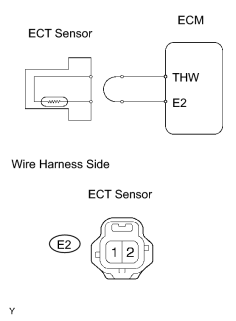
|
| OK |
|
CONFIRM GOOD CONNECTION TO SENSOR. IF OK, REPLACE ENGINE COOLANT TEMPERATURE SENSOR |
|
|
3. |
READ VALUE USING INTELLIGENT TESTER (CHECK FOR OPEN IN ECM) |
|
(a) Disconnect the E2 ECT sensor connector. (b) Connect terminals THW and E2 of the E8 ECM connector. HINT: Before checking, do a visual and contact pressure check for the ECM connector. (c) Turn the ignition switch ON. (d) Enter the following menus: DIAGNOSIS / ENHANCED OBD II / DATA LIST / PRIMARY / COOLANT TEMP. (e) Read the value. Standard: 140°C (284°F) or more |
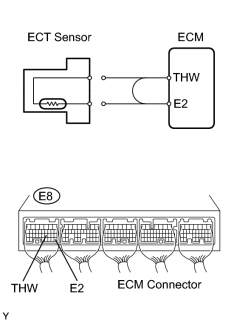
|
| NG |
|
| OK |
|
|
4. |
READ VALUE USING INTELLIGENT TESTER (CHECK FOR SHORT IN WIRE HARNESS) |
|
(a) Disconnect the E2 ECT sensor connector. (b) Turn the ignition switch ON. (c) Enter the following menus: DIAGNOSIS / ENHANCED OBD II / DATA LIST / PRIMARY / COOLANT TEMP. (d) Read the value. Standard: -40°C (-40°F) |
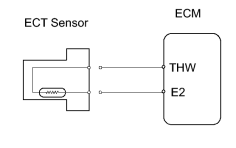
|
| OK |
|
|
|
5. |
READ VALUE USING INTELLIGENT TESTER (CHECK FOR SHORT IN ECM) |
|
(a) Disconnect the E2 ECT sensor connector. (b) Disconnect the E8 ECM connectors. (c) Turn the ignition switch ON. (d) Enter the following menus: DIAGNOSIS / ENHANCED OBD II / DATA LIST / PRIMARY / COOLANT TEMP. (e) Read the value. Standard: -40°C (-40°F) |
|
| NG |
|
| OK |
|

|

|