| Last Modified: 4-30-2014 | 6.6 G | Doc ID: RM0000019ZG001X |
| Model Year: 2006 | Model: LX470 | Prod Date Range: [05/2005 - ] |
| Title: BRAKE: HYDRAULIC BRAKE BOOSTER: ON-VEHICLE INSPECTION; 2006 MY LX470 [05/2005 - ] | ||
ON-VEHICLE INSPECTION
|
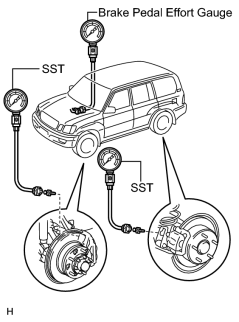
1. CHECK HYDRAULIC BRAKE BOOSTER FLUID PRESSURE CHANGE (a) Check the battery positive (+) voltage. Standard voltage: 10 to 14 V (b) Turn the ignition switch OFF, and depress the brake pedal more than 40 times. HINT: When a pressure in power supply system is released, reaction force becomes light and stroke becomes longer. (c) Install LSPV gauge (SST) and brake pedal effort gauge, and then bleed air. SST: 09709-29018 (d) When operating the hydraulic brake booster and depressing the brake pedal (see table below), check the fluid pressure. Standard fluid pressure: At 245 N (25 kgf, 55 lbf) At 343 N (35 kgf, 77 lbf)
(e) When operating the hydraulic brake booster: (1) Turn the ignition switch ON. Wait until the pump motor has stopped. (2) Depress the brake pedal (see table below) and check the fluid pressure. Standard fluid pressure: At 49 N (5 kgf, 11 lbf) At 98 N (10 kgf, 22 lbf) At 147 N (15 kgf, 33 lbf) At 196 N (20 kgf, 44 lbf)
|
|
2. CHECK HYDRAULIC BRAKE BOOSTER OPERATION (Using Intelligent Tester)
(a) Check the battery positive (+) voltage.
Standard voltage:
10 to 14 V
(b) Turn the ignition switch OFF, and depress the brake pedal more than 40 times.
HINT:
When a pressure in power supply system is released, reaction force becomes light and stroke becomes longer.
(c) Check that the brake pedal becomes easy to depress.
HINT:
If the pedal does not become easy to depress, check and replace brake line and hydraulic brake booster.
(d) Turn the ignition switch ON, and check the pump motor operation noise.
HINT:
If the pump motor does not operate, check and replace the wire harness and pump motor.
|
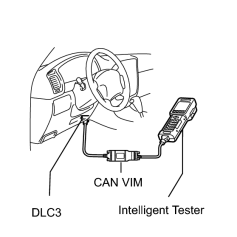
(e) Connect the intelligent tester. (1) Connect the intelligent tester (with CAN VIM) to the DLC3. (2) Turn the ignition switch ON. (3) Select the "Active Test" mode on the intelligent tester. HINT:
|
|
(f) Check the front TRAC & VSC solenoid operation.
(1) Select "SA1" and "SA2" on the intelligent tester.
(2) With "SA1" and "SA2" turned ON simultaneously with the intelligent tester, depress the brake pedal with stable force and check that the pedal cannot be depressed.
HINT:
To protect the solenoids, the intelligent tester turns OFF automatically 2 seconds after every solenoid has been turned ON.
If the pedal can be depressed, replace the hydraulic brake booster.
NOTICE:
When operating the solenoid continuously, set the interval of more than 20 seconds.
(3) Release the brake pedal.
(4) When the solenoids are OFF, depress the brake pedal again and check that the brake pedal can be depressed.
If the pedal cannot be depressed, replace the hydraulic brake booster.
(g) Check the front ABS solenoid operation.
(1) Select "SFRH" and "SFLH" on the intelligent tester.
(2) With "SFRH" and "SFLH" turned ON simultaneously with the intelligent tester, depress the brake pedal with stable force and check that the brake pedal cannot be depressed.
HINT:
To protect the solenoids, the intelligent tester turned OFF automatically 2 seconds after every solenoid has been turned ON.
If the pedal can be depressed, replace the hydraulic brake booster.
(3) Release the brake pedal when the solenoids are OFF, and ten check that the brake pedal can be depressed.
If the pedal cannot be depressed, replace the hydraulic brake booster.
(4) Release the brake pedal. After depressing and holding the brake pedal with stable force, turn the "SFRH" and "SFRR" solenoids ON simultaneously.
HINT:
To protect the solenoids, the intelligent tester turns OFF automatically 2 seconds after every solenoid has been turned ON.
(5) When the solenoids are OFF, check that the brake pedal can be depressed.
If the pedal cannot be depressed, replace the hydraulic brake booster.
(6) Release the brake pedal. After depressing and holding the brake pedal with stable force, turn the "SFLH" and "SFLR" solenoids ON simultaneously.
HINT:
To protect the solenoids, the intelligent tester turns OFF automatically 2 seconds after every solenoid has been turned ON.
(7) When the solenoids are OFF, check that the brake pedal can be depressed.
If the pedal cannot be depressed, replace the hydraulic brake booster.
(h) Jack up and support the vehicle.
(i) Release the parking brake lever.
(j) Shift the transfer shift lever to "N" position and check that the rear wheels rotates by hand.
(k) Check the rear TRAC & VSC solenoid operation.
(1) Select the "SA3" and "STR" on the intelligent tester.
(2) Turn the "SA3" and "STR" ON simultaneously with the intelligent tester, and check that the rear wheels do not rotate by hand.
HINT:
When rotating the wheel fast, the fail-safe function is activated and judgement cannot be made properly. So rotate the wheel as slowly as possible.
If the rear wheels rotate, replace the hydraulic brake booster.
(3) Turn the "SA3" and "STR" OFF simultaneously, and check that the rear wheels rotate by hand.
HINT:
- To protect the solenoids, the intelligent tester turns OFF automatically 2 seconds after every solenoid has been turned ON.
- When rotating the wheel fast, the fail-safe function is activated and judgement cannot be made properly. So rotate the wheel as slowly as possible.
NOTICE:
When operating the solenoid continuously, set the interval of more than 20 seconds.
If the rear wheels do not rotate, replace the hydraulic brake booster.
(l) Check the right rear ABS solenoid.
(1) Select the "SA3", "STR" and "SRRH" on the intelligent tester.
(2) Turn the "SA3", "STR" and "SRRH" ON simultaneously with the intelligent tester, and check that the right rear wheel rotates by hand.
HINT:
- To protect the solenoids, the intelligent tester turns OFF automatically 2 seconds after every solenoid has been turned ON.
- When rotating wheel fast, the fail-safe function is activated and judgement cannot be made properly. So rotate the wheel as slowly as possible.
- When solenoid is OFF, the wheel might stop temporarily. However if the wheel rotates again, the function works normally.
If the right rear wheel does not rotate, replace the hydraulic brake booster.
(3) Turn the "SA3", "STR" and "SRRH" OFF, and check that the right rear wheel rotates by hand.
HINT:
- To protect the solenoids, the intelligent tester turns OFF automatically 2 seconds after every solenoid has been turned ON.
- When rotating wheel fast, the fail-safe function is activated and judgement cannot be made properly. So rotate the wheel as slowly as possible.
If the right rear wheel does not rotate, replace the hydraulic brake booster.
(4) Depress the pedal with stable force, then turn the "SRRH" and "SRRR" ON simultaneously.
(5) When the solenoids are ON, check that the right rear wheel by rotating it by hand.
(m) Check the left rear ABS solenoid operation.
(1) Select the "SA3", "STR" and "SRLH" on the intelligent tester.
(2) Turn the "SA3", "STR" and "SRLH" ON with the intelligent tester, and check that the left rear wheel rotates by hand.
HINT:
When rotating the wheel fast, the fail-safe function is activated and judgement cannot be made properly. So rotate the wheel as slowly as possible.
If the left rear wheel does not rotate, replace the hydraulic brake booster.
(3) Turn the "SA3", "STR" and "SRLH" OFF, and check that the left rear wheel rotates by hand.
HINT:
- To protect the solenoids, the intelligent tester turns OFF automatically 2 seconds after every solenoid has been turned ON.
- When rotating the wheel fast, the fail-safe function is activated and judgement cannot be made properly. So rotate the wheel as slowly as possible.
- When solenoids are OFF, the wheel might stop temporarily. However if the wheel rotates again, the function works normally.
If the left rear wheel does not rotate, replace the hydraulic brake booster.
(4) Depress the pedal with stable force, then turn the "SRLH" and "SRLR" ON simultaneously.
HINT:
To protect the solenoids, the intelligent tester turns OFF automatically 2 seconds after every solenoid has been turned ON.
(5) When the solenoids are ON, check that the left rear wheel by rotating it by hand.
HINT:
When rotating the wheel fast, the fail-safe function is activated and judgement cannot be made properly. So rotate the wheel as slowly as possible.
(n) Lower the vehicle.
(o) Disconnect the intelligent tester.
3. CHECK HYDRAULIC BRAKE BOOSTER OPERATION (Using ABS Actuator Checker)
(a) Check the battery positive (+) voltage.
Standard voltage:
10 to 14 V
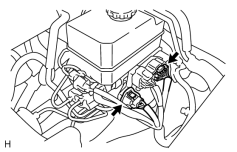
(b) Disconnect the 2 connectors from the hydraulic brake booster.
(c) Connect the actuator checker (SST) to the hydraulic brake booster side wire harness via the sub-wire harness S (SST), as shown in the following illustration.
SST: 09990-00150
SST: 09990-00480
HINT:
Connect the connector with the label of "FRONT" attached to the connector of the actuator checker.
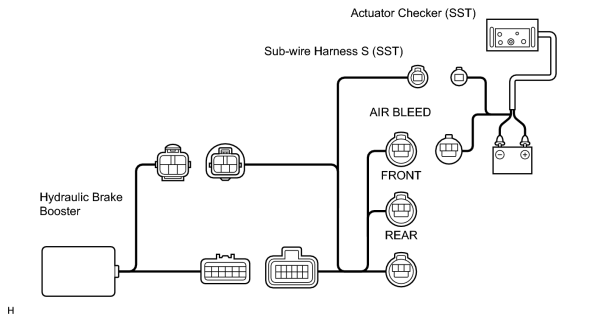
(d) Connect the red cable of the checker to the battery positive (+) terminal and the black cable to the negative (-) terminal.
(e) Place "SHEET G" (SST) of "FRONT" on the actuator checker.
SST: 09990-00240
(f) Turn the ignition switch OFF, and depress the brake pedal more than 40 times.
HINT:
When a pressure in power supply system is released, reaction force becomes easy and stroke becomes longer.
(g) Check that the brake pedal becomes easy to depress.
If the pedal does not become easy to depress, check and replace the brake line and hydraulic brake booster.
(h) Turn the ignition switch ON, and check the pump motor operation noise.
If the pump motor operation noise cannot be heard, check the wire harness and pump motor. If necessary replace them.
|
(i) Check the front TRAC and VSC solenoids operation. (1) Push in and hold the "SA1" and "SA2" switches simultaneously, depress strongly and hold the brake pedal with stable force. NOTICE: Do not keep the "SA1" and "SA2" pushed down for more than 10 seconds. When operating the solenoid continuously, set the interval of more than 20 seconds. (2) Check that the brake pedal cannot be depressed. HINT: If the pedal can be depressed, replace the hydraulic brake booster. (3) Release the "SA1" switch and check that the brake pedal can be depressed. If the pedal cannot be depressed, replace the hydraulic brake booster. (4) Release the "SA2" switch and check that the brake pedal can be depressed. If the pedal cannot be depressed, replace the hydraulic brake booster. |
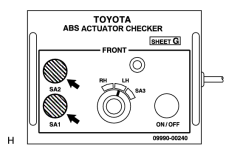
|
(j) Check the right front ABS solenoid operation.
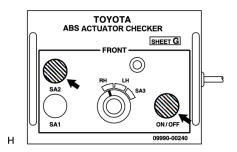
(1) Turn the selector switch to "RH" position.
(2) Push and hold in the MAIN push switch and "SA2" switch simultaneously, depress and hold the brake pedal with stable force.
NOTICE:
Do not keep the MAIN push switch and "SA2" pushed down for more than 10 seconds. When operating the solenoid continuously, set the interval of more than 20 seconds.
(3) Check that the brake pedal cannot be depressed.
If the pedal can be depressed, replace the hydraulic brake booster.
(4) Release the MAIN push switch and "SA2" switch simultaneously and check that the brake pedal can be depressed.
If the pedal cannot be depressed, replace the hydraulic brake booster.
(5) Release the brake pedal.
|
(6) Depress and hold the brake pedal with stable force, push and hold in the MAIN push switch. NOTICE: Do not keep the MAIN push switch pushed down for more than 10 seconds. When operating it continuously, set the interval of more than 20 seconds. |
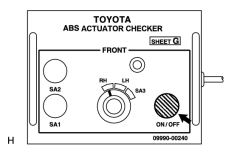
|
(7) Check that the brake pedal cannot be depressed.
If the pedal can be depressed, replace the hydraulic brake booster.
(8) Release the MAIN push switch, and check that the brake pedal can be depressed.
If the pedal cannot be depressed, replace the hydraulic brake booster.
(9) Release the brake pedal.
(k) Check the left front ABS solenoid operation.
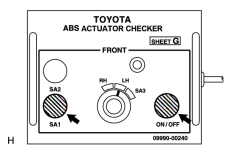
(1) Turn the selector switch to "LH" position.
(2) Push and hold in the MAIN push switch and "SA1" switch simultaneously, depress and hold the brake pedal with stable force.
NOTICE:
Do not keep the MAIN push switch and "SA1" pushed down for more than 10 seconds. When operating the solenoid continuously, set the interval of more than 20 seconds.
(3) Check that the brake pedal cannot be depressed.
If the pedal can be depressed, replace the hydraulic brake booster.
(4) Release the MAIN push switch and "SA1" switch simultaneously, and check that the brake pedal can be depressed.
If the pedal cannot be depressed, replace the hydraulic brake booster.
(5) Release the brake pedal.
|
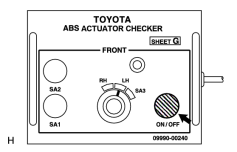
(6) Depress and hold the brake pedal with stable force, push and hold in the MAIN push switch. NOTICE: Do not keep the MAIN push switch pushed down for more than 10 seconds. When operating it continuously, set the interval of more than 20 seconds. |
|
(7) Check that the brake pedal cannot be depressed.
If the pedal can be depressed, replace the hydraulic brake booster.
(8) Release the MAIN push switch, and check that the brake pedal can be depressed.
If the pedal cannot be depressed, replace the hydraulic brake booster.
(9) Release the brake pedal.
(l) Turn the ignition switch OFF, then reconnect the connector of sub-wire harness from the one with the label of "FRONT" to "REAR".
(m) Place "SHEET G" of "REAR" on the actuator checker.
(n) Jack up and support the vehicle.
(o) Start the engine and run it at idle.
|
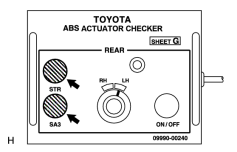
(p) Check the rear TRAC and VSC solenoid. (1) Release the parking brake lever and shift lever to "L" position. (2) Push and hold the "SA3" switch and "STR" switch simultaneously. NOTICE:
(3) Check that the rear wheels stop. If the rear wheels rotate, replace the hydraulic brake booster. (4) Release the "SA3" switch and "STR" switch simultaneously, and check that the rear wheels rotate. If the rear wheels stop, replace the hydraulic brake booster. |
|
|
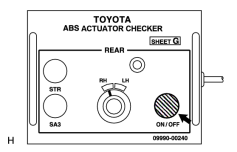
(q) Check the right rear ABS solenoid. (1) Turn the selector switch to "RH" position. (2) Depress the brake pedal several times and release the brake pedal when the pump begins rotating. Wait until the pump stops. (3) Turn the ignition switch OFF. (4) Depress the brake pedal with a force of 343 N (35 kgf, 77 lbf), record the fluid surface in the reservoir tank of the hydraulic brake booster. (5) Press the MAIN push switch for 10 seconds, and check that the fluid surface in the reservoir tank of the hydraulic brake booster does not rise up at this time. If the fluid surface level rise up, replace the hydraulic brake booster. NOTICE: Do not press the MAIN push switch for more than 10 seconds. When operating the switch continuously, set the interval of more than 20 seconds. (6) Start the engine and run it at idle. (7) Depress the bake pedal. (8) Release the parking brake lever and shift the shift lever to "L" position. (9) Release the brake pedal. After depressing the brake pedal with stable force, then push and hold the MAIN push switch. (10) Check that the right rear wheel rotates. If the right rear wheel does not rotate, replace the hydraulic brake booster. |
|
|
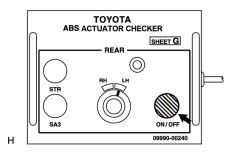
(r) Check the left rear ABS solenoid. (1) Turn the selector switch to "LH" position. (2) Depress the brake pedal several times and release the brake pedal when the pump begins rotating. Wait until the pump stops. (3) Turn the ignition switch OFF. (4) Depress the brake pedal with a force of 343 N (35 kgf, 77 lbf), and record the fluid surface in the reservoir tank of the hydraulic brake booster. (5) Press the MAIN push switch for 10 seconds, and check that the fluid surface in the reservoir tank of the hydraulic brake booster does not rise up at this time. If the fluid surface level rises up, replace the hydraulic brake booster. NOTICE: Do not press the MAIN push switch for more than 10 seconds. When operating the switch continuously, set the interval of more than 20 seconds. (6) Start the engine and run it at idle. (7) Depress the brake pedal. (8) Release the parking brake lever and shift the shift lever to "L" position. (9) Release the brake pedal. After depressing the brake pedal with stable force, then push and hold the MAIN push switch. (10) Check that the left rear wheel rotates. If the left rear wheel does not rotate, replace the hydraulic brake booster. |
|
(s) Stop the engine and lower the vehicle.
(t) Remove the "SHEET G" (SST) and disconnect the actuator checker (SST) and sub-wire harness S (SST) from the hydraulic brake booster.
(u) Connect the 2 connectors to the actuator.
(v)
Clear the DTC
![2006 MY LX470 [05/2005 - ]; BRAKE CONTROL: VEHICLE STABILITY CONTROL SYSTEM: DIAGNOSIS SYSTEM](../../../../stylegraphics/info.gif "2006 MY LX470 [05/2005 - ]; BRAKE CONTROL: VEHICLE STABILITY CONTROL SYSTEM: DIAGNOSIS SYSTEM") .
.

|

|