- Incorrect timing
- Fouled, shorted or improperly gapped plugs
| Last Modified: 7-3-2017 | 6.8:8.0.40 | Doc ID: RM0000013K8009X |
| Model Year Start: 2007 | Model: LX470 | Prod Date Range: [08/2006 - ] |
| Title: 2UZ-FE ENGINE MECHANICAL: ENGINE: ON-VEHICLE INSPECTION; 2007 MY LX470 [08/2006 - ] | ||
ON-VEHICLE INSPECTION
1. CHECK IGNITION TIMING
|
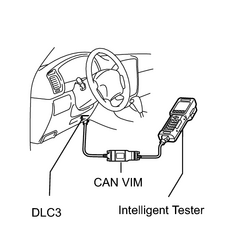
(a) When using the intelligent tester: (1) Connect the intelligent tester to the DLC3. HINT: Refer to the intelligent tester operator's manual for further details. Standard ignition timing: 5 to 15° BTDC @ idle (Shift lever on N) (2) Disconnect the intelligent tester from the DLC3. |
|
(b) When not using the intelligent tester:
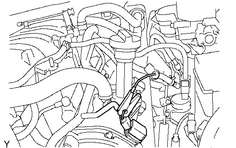
(1) Remove the V-bank cover.
(2) Connect the tester probe of a timing light to the wire of the ignition coil connector for the No. 1 cylinder.
|
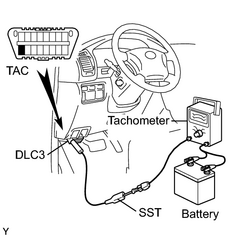
(3) Using SST, connect the tachometer probe to terminal TAC of the DLC3. SST: 09843-18030 |
|
|
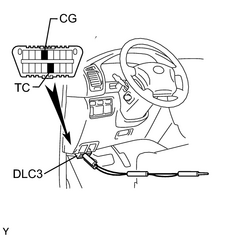
(4) Using SST, connect terminals TC and CG of the DLC3. SST: 09843-18040 |
|
|
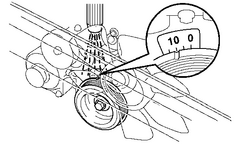
(5) Using the timing light, check the ignition timing. Standard ignition timing: 5 to 15° BTDC @ idle (Shift lever on N) |
|
(6) Remove the SST from the DLC3.
(7) Disconnect the timing light from the engine.
(8) Install the V-bank cover.
2. CHECK ENGINE IDLE SPEED
|
(a) When using the intelligent tester: (1) Connect the intelligent tester to the DLC3. HINT: Refer to the intelligent tester operator's manual for further details. (2) Maintain the engine at 2,500 rpm for approximately 90 seconds. (3) Check the idle speed. Standard idle speed: 700 +- 50 rpm If the idle speed is not as specified, check the air intake system. (4) Disconnect the intelligent tester from the DLC3. |
|
|
(b) When not using the intelligent tester: (1) Using SST, connect the tachometer probe to terminal TAC of the DLC3. SST: 09843-18030 HINT: Refer to the intelligent tester operator's manual for further details. (2) Maintain the engine at 2,500 rpm for approximately 90 seconds. (3) Check the idle speed. Standard idle speed: 700 +- 50 rpm (4) Remove the SST from the DLC3. (5) Disconnect the tachometer from the DLC3. |
|
3. CHECK COMPRESSION
(a) Remove the V-bank cover.
(b) Remove the air cleaner hose assembly.
(c) Disconnect the throttle position sensor and control motor connector.
(d) Remove the oil dipstick guide.
(e) Remove the 8 ignition coils.
(f) Remove the 8 spark plugs.
(g) Disconnect the 8 injector connectors.
|
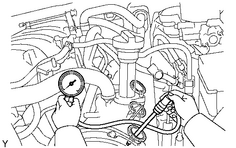
(h) Check the cylinder compression pressure. NOTICE: Check each cylinder's compression pressure in the same way. (1) Insert a compression gauge into the spark plug hole. (2) Fully open the throttle. (3) While cranking the engine, measure the compression pressure. Standard compression pressure: 1,373 kPa (14.0 kgf/cm 2 , 199 psi) or more Minimum pressure: 1,030 kPa (10.5 kgf/cm 2 , 149 psi) Difference between each cylinder: 98 kPa (1.0 kgf/cm 2 , 14 psi) NOTICE:
If the cylinder compression is low, pour a small amount of engine oil into the cylinder through the spark plug hole and inspect again. HINT: If adding oil increases the compression, the piston rings and/or cylinder bore may be worn or damaged. If pressure stays low, a valve may be stuck or seated improperly, or there may be leakage in the gasket. |
|
(i) Connect the 8 injector connectors.
(j) Install the 8 spark plugs.
(k) Install the 8 ignition coils.
(l) Install the oil dipstick guide.
(m) Connect the throttle position sensor and control motor connector.
(n) Install the air cleaner hose assembly.
(o) Install the V-bank cover.
4. CHECK CO/HC
HINT:
This check is used only to determine whether or not the idle CO/HC complies with regulations.
(a) Start the engine.
(b) Maintain the engine at 2,500 rpm for approximately 180 seconds.
|
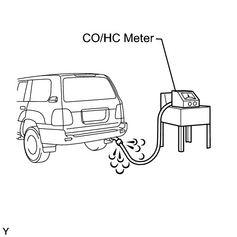
(c) Insert a CO/HC meter testing probe at least 40 cm (1.3 ft.) into the tailpipe during idling. |
|
(d) Check CO/HC concentration at idle and/or 2,500 rpm.
HINT:
- Complete the measurement within 3 minutes.
- Check regulations in your area when performing 2 mode CO/HC concentration testing (engine check at both idle speed and at 2,500 rpm).
(e) If the CO/HC concentration does not comply with regulations, perform troubleshooting in the order given below.
(1)
Check the heated oxygen sensor operation
![2007 MY LX470 [08/2006 - ]; 2UZ-FE ENGINE CONTROL SYSTEM: SFI SYSTEM: P0136-P0138,P0156-P0158; Oxygen Sensor Circuit Malfunction (Bank 1 Sensor 2)](../../../../stylegraphics/info.gif "2007 MY LX470 [08/2006 - ]; 2UZ-FE ENGINE CONTROL SYSTEM: SFI SYSTEM: P0136-P0138,P0156-P0158; Oxygen Sensor Circuit Malfunction (Bank 1 Sensor 2)") .
.
(2) See the table below for possible causes, and then inspect and repair.
|
CO |
HC |
Symptom |
Causes |
|---|---|---|---|
|
Normal |
High |
Rough idle |
1. Faulty ignitions: 2. Incorrect valve clearance 3. Leaky intake and exhaust valves 4. Leaky cylinder |
|
Low |
High |
Rough idle (Fluctuating HC reading) |
1. Vacuum leaks:
2. Lean mixture causing misfire |
|
High |
High |
Rough idle (Black smoke from exhaust) |
1. Restricted air filter 2. Faulty SFI system:
|

|

|