| Last Modified: 7-3-2017 | 6.8:8.0.40 | Doc ID: RM00000185U001X |
| Model Year Start: 2007 | Model: LX470 | Prod Date Range: [08/2006 - ] |
| Title: ENGINE IMMOBILISER: ENGINE IMMOBILISER SYSTEM: REGISTRATION; 2007 MY LX470 [08/2006 - ] | ||
REGISTRATION
1. KEY REGISTRATION IN AUTOMATIC REGISTRATION (NEW REGISTRATION)
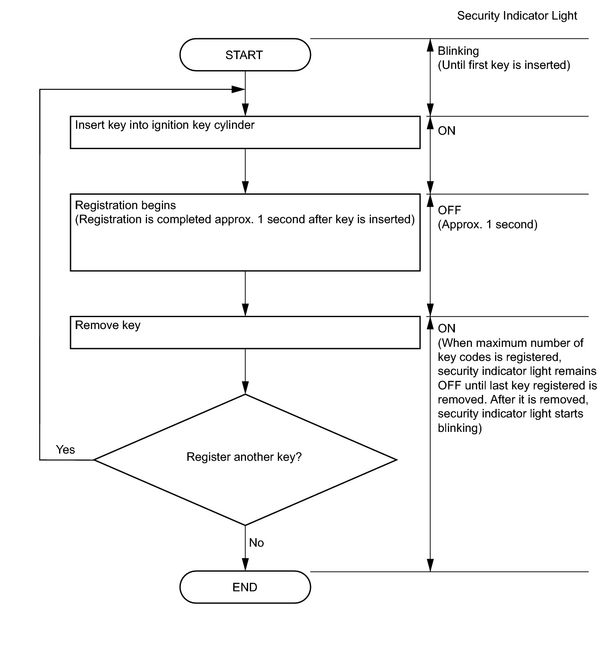
(a) When an ignition key is inserted into the ignition key cylinder, the key code (immobiliser code) registration is automatic. In this mode, a maximum of 4 codes can be registered. Any order of registration for the master keys and sub-key can be registered. Any order of registration for the master keys and sub-keys is possible because the transponder key ECU can distinguish between different types of keys.
HINT:
- When a new transponder key ECU is installed, key codes (immobiliser codes) must be registered in the transponder key ECU.
- New transponder key ECUs are automatically set to automatic key code registration mode.
HINT:
- When no key is inserted into the ignition key cylinder in automatic key code registration mode, the security indicator light remains ON.
- When the engine immobiliser system is operating normally and the key is pulled out, the security indicator light blinks continuously.
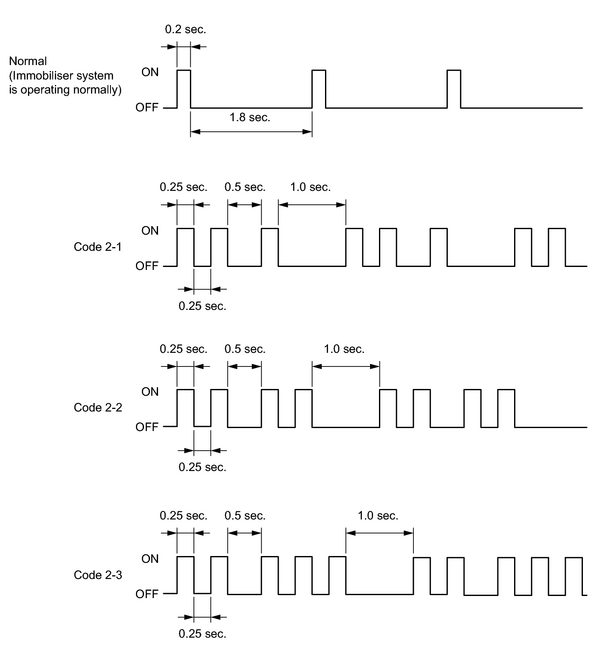
- If the key code registration has failed in automatic key code registration mode, code 2-1 will be output from the security indicator light. Trying to reregister an already registered key will cause code 2-2 to be output when the key is inserted. If the number of registered key codes exceeds the limit, code 2-3 will be output from the security indicator light. The output details are shown below.
(b) Finish the automatic key code registration mode.
The automatic key code registration mode can be forced to end when at least 1 key code (immobiliser code) for the master key has been registered.
-
Without using intelligent tester:
Turn the ignition switch "LOCK" → "ON" 5times within 10 sec.
-
With using intelligent tester:
With the intelligent tester, require automatic registration mode completion.
2. REGISTRATION OF ADDITIONAL KEY (ADDITIONAL REGISTRATION)
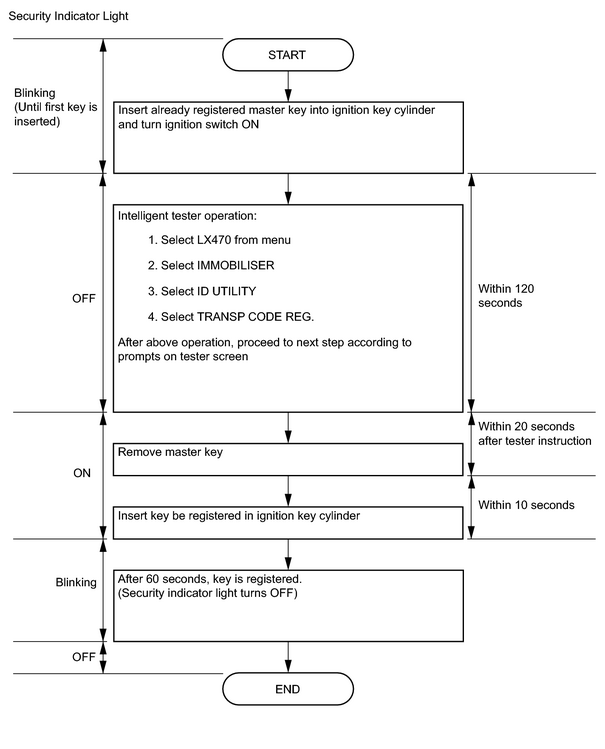
(a) Register an additional key using the intelligent tester.
HINT:
- A maximum of 5 key codes and 3 sub-key codes can be registered.
- Registration mode will end if each step is not completed within the specified time.
- When the ignition key cylinder or the door key cylinder set is replaced, remove the transmitter module from the original master key. Then install this transmitter module to a new key and use the new key as the master key. If necessary, use this master key to register other keys.
NOTICE:
When the ignition key cylinder has been replaced, locking and unlocking doors is possible with the new master key's transmitter module (taken from the original master key). However, the new master key will not be able to lock and unlock doors through the door key cylinder. Keep the original master key. If the new master key's transmitter module's battery fails, the original master key can be used to lock and unlock doors through the door key cylinder.
HINT:
- A brief outline of procedures for key code registration is shown above. For more information, please refer to the intelligent tester screen's instructions.
- When the engine immobiliser system is operating normally and the key is pulled out, the security indicator light blinks continuously.
- If the key code registration has failed in automatic key code registration mode, code 2-1 will be output from the security indicator light. Trying to reregister an already registered key will cause code 2-2 to be output when the key is inserted. If the number of registered key codes exceeds the limit, code 2-3 will be output from the security indicator light. The output details are shown in the previous step (new registration).
3. ERASURE OF KEY CODE
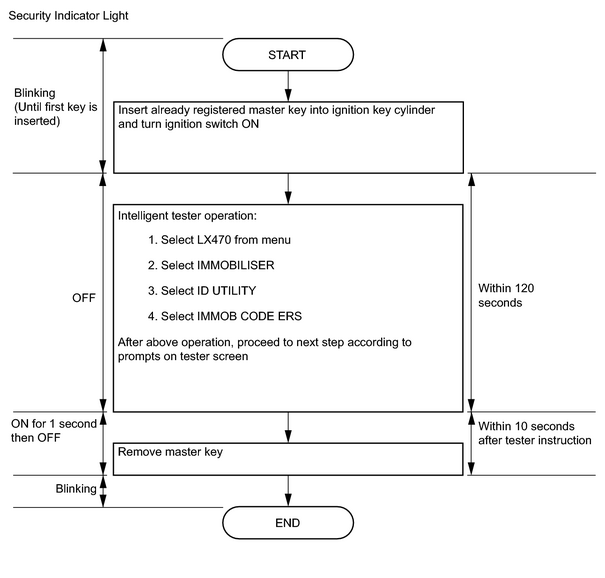
(a) Erase the key codes using the intelligent tester.
HINT:
- All key codes are erased except for the master key that is used to erase the key codes. In order to use a key whose code has been erased, a new key code must be registered.
- Registration will be canceled if each step is not completed within the specified time.
HINT:
- A brief outline of procedures for the key code erasure is shown above. For more detailed information, please refer to the intelligent tester screen's instructions.
- When the engine immobiliser system is operating normally and the key is pulled out, the security indicator light blinks continuously.
4. ECU COMMUNICATION ID REGISTRATION
NOTICE:
- When the transponder key ECU is replaced, the ECU communication ID of the ECM must be registered into the transponder key ECU to match their ECU communication IDs.
- The engine cannot be started unless the ECU communication IDs match.
- Do not turn the ignition switch from on to off 20 times or more before registering the ECU communication ID. Turning the ignition switch from on to off 20 times or more will result in the engine not starting unless the transponder key ECU is replaced with a new one.
- After the registration, turning the ignition switch may not start the engine on the first try. If this occurs, turn the ignition switch again.
-
After the engine is started, erase DTC B2799 (code for ECM's immobiliser communication error) by either of the following:
- Using the intelligent tester.
- Disconnecting the battery for 30 seconds.
(a) Register the ECU communication ID
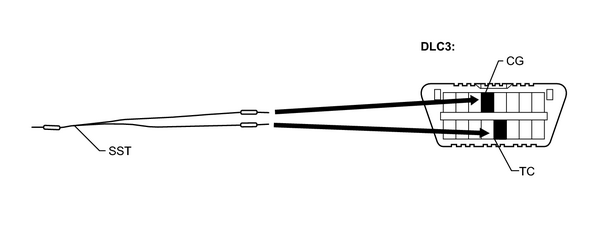
(b) Using SST, connect terminals 13 (TC) and 4 (CG) of the DLC3.
SST: 09843-18040
(c) Turn the ignition switch on (do not start the engine), and then leave it on for 30 minutes.
(d) Turn the ignition switch off and disconnect terminals 13 (TC) and 4 (CG).
(e) Check that the engine starts.

|

|