| Last Modified: 7-3-2017 | 6.8:8.0.40 | Doc ID: RM0000018R7005X |
| Model Year Start: 2007 | Model: LX470 | Prod Date Range: [08/2006 - ] |
| Title: 2UZ-FE FUEL: FUEL SYSTEM: ON-VEHICLE INSPECTION; 2007 MY LX470 [08/2006 - ] | ||
ON-VEHICLE INSPECTION
1. CHECK FUEL PUMP OPERATION AND FUEL LEAKS
|
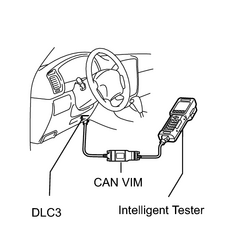
(a) Operate the fuel pump. (1) Connect the intelligent tester to the Controller Area Network Vehicle Interface Module (CAN VIM). Then connect the CAN VIM to the DLC3. (2) Turn the ignition switch ON. NOTICE: Do not start the engine. (3) Push the intelligent tester main switch ON. (4) Select Active Test and enter the following menus: DIAGNOSIS / ENHANCED OBD II / ACTIVE TEST / FUEL PUMP / SPD. |
|
|
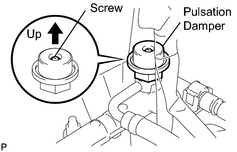
(b) Check the fuel pump operation and for fuel leaks. (1) Check that the pulsation damper screw rises up when the fuel pump operates. If the operation is not as specified, check the following parts:
If no malfunctions are found in the aforementioned components, replace the pulsation damper. (2) Check that there are no fuel leaks after performing maintenance anywhere on the system. If there are fuel leaks, repair or replace the fuel leakage part. |
|
2. CHECK FUEL SYSTEM PRESSURE
(a) Check that the battery positive voltage is above 12 V.
(b)
Discharge the fuel system pressure
![2007 MY LX470 [08/2006 - ]; 2UZ-FE FUEL: FUEL SYSTEM: PRECAUTION](../../../../stylegraphics/info.gif "2007 MY LX470 [08/2006 - ]; 2UZ-FE FUEL: FUEL SYSTEM: PRECAUTION") .
.
(c) Disconnect the negative (-) terminal cable from the battery.
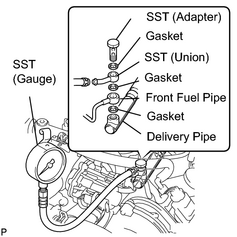
(d) Remove the front fuel pipe from the delivery pipe LH.
|
(e) Install the front fuel pipe and SST (pressure gauge) to the delivery pipe with the 3 lower gaskets and SST (adapter). SST: 09268-45014 09268-41190 90405-06167 Torque: 39 N·m {400 kgf·cm, 29ft·lbf} |
|
(f) Wipe off any splattered gasoline.
(g) Reconnect the cable to the negative (-) battery terminal.
|
(h) Operate the fuel pump. (1) Connect the intelligent tester to the Controller Area Network Vehicle Interface Module (CAN VIM). Then connect the CAN VIM to the DLC3. (2) Turn the ignition switch ON. NOTICE: Do not start the engine. (3) Push the intelligent tester main switch ON. (4) Select Active Test and enter the following menus: DIAGNOSIS / ENHANCED OBD II / ACTIVE TEST / FUEL PUMP / SPD. |
|
(i) Measure the fuel pressure.
Fuel pressure:
265 to 304 kPa (2.7 to 3.1 kgf/cm 2 , 38 to 44 psi)
If the pressure is high, replace the fuel pressure regulator.
If the pressure is low, check the fuel hoses and connections, fuel pump, fuel filter and fuel pressure regulator.
(j) Disconnect the intelligent tester from the DLC3.
(k) Start the engine.
(l) Measure the fuel pressure at idle.
Fuel pressure:
265 to 304 kPa (2.7 to 3.1 kgf/cm 2 , 38 to 44 psi)
(m) Stop the engine.
(n) Check that the fuel pressure remains as specified for 5 minutes after the engine has stopped.
Fuel pressure:
147 kPa (1.5 kgf/cm 2 , 21 psi) or more
If the pressure is not as specified, check the fuel pump, pressure regulator and/or injectors.
(o)
After checking the fuel pressure, discharge fuel system pressure
.
(p) Disconnect the cable from the negative (-) battery terminal and carefully remove the SST to prevent gasoline from splashing.
(q) Reinstall the front fuel pipe to the LH delivery pipe.
3. CONNECT CABLE TO NEGATIVE BATTERY TERMINAL
4. PERFORM INITIALIZATION
(a)
Perform initialization
.
NOTICE:
Certain systems need to be initialized after disconnecting and reconnecting the cable from the negative (-) battery terminal.

|

|