| Last Modified: 11-27-2007 | 1.6 D | |
| Service Category: Vehicle Interior | Section: Supplemental Restraint Systems | |
| Model Year: 2008 | Model: LX570 | Doc ID: RM000000VVK00SX |
| Title: PRE-COLLISION: PRE-COLLISION SYSTEM: SYSTEM DESCRIPTION (2008 LX570) | ||
SYSTEM DESCRIPTION
1. PRE-COLLISION SYSTEM
(a) The pre-collision system optimizes and activates occupant protection equipment in an attempt to reduce injury in a collision.
2. OUTLINE OF PRE-COLLISION SYSTEM
|
Operating Condition |
Control |
Transmitting ECU |
Receiving ECU |
Part Operated |
|---|---|---|---|---|
|
Operates according to sensor detection |
Pre-collision seat belts |
Distance control ECU |
Seat belt control ECU |
Front seat outer belts |
|
Operates according to sensor detection |
Pre-collision brake assist |
Distance control ECU |
Master cylinder solenoid (skid control ECU) |
Brake assist system |
|
Operates when sudden braking occurs |
Pre-collision seat belts |
Master cylinder solenoid (skid control ECU) |
Seat belt control ECU |
Front seat outer belts |
(a) When operating according to sensor detection:
The distance control ECU uses information from the millimeter wave radar sensor to determine if the pre-collision system should be activated. If so, the distance control ECU sends signals to the master cylinder solenoid (skid control ECU) and seat belt control ECU through CAN communication. In response to these signals, the pre-collision system operates as follows:
- The seat belt control ECU initiates control of the pre-collision seat belts.
- The master cylinder solenoid (skid control ECU) activates the pre-collision brake assist system.
(b) When operating as a result of sudden braking:
The master cylinder solenoid (skid control ECU) uses brake pressure information and other data to determine if the driver has suddenly applied the brakes. If so, the master cylinder solenoid (skid control ECU) sends a signal to the seat belt control ECU through CAN communication and the pre-collision seat belt activates.
3. OUTLINE OF PRE-COLLISION SEAT BELT CONTROL
(a) Pre-collision seat belt operation conditions:
- The driver firmly depresses the brake pedal suddenly.
- The driver oversteers or the vehicle is spinning.
(b) Pre-collision seat belt non-operation conditions:
If any of the following conditions are met, the pre-collision seat belt does not operate.
- The seat belts are not fastened.
- The engine switch is off or on (ACC).
- The vehicle speed is approximately 30 km/h (18.6 mph) or less.
- When the pre-collision seat belts are repeatedly operated and the seat belt control ECU overheats, seat belt operation is prohibited to protect the ECU.
HINT:
The PCS warning indicator light in the combination meter will blink at this time.
4. OUTLINE OF PRE-COLLISION BRAKE ASSIST SYSTEM
(a) The pre-collision brake assist system operates depending on what the sensor detects. The system then enters standby mode before a collision. When the driver depresses the brake pedal, brake fluid pressure is increased to improve fluid pressure response and improve vehicle speed reduction rate.
(b) Operative condition
(1) Refer to the sensor description under "outline of pre-collision system" (see above).
(2) When the driver depresses the brake pedal after the distance control ECU determines that a collision is unavoidable:
Brake fluid pressure is increased at the same time the driver depresses the brake pedal.
(3) When the driver depresses the brake pedal before the distance control ECU determines that a collision is unavoidable:
Brake fluid pressure is increased at the same time that the distance control ECU receives a pre-collision sensor signal (indicating that other vehicles or objects are in front of the vehicle).
5. OPERATIVE CONDITION AND INOPERATIVE CONDITION OF EACH CONTROL (REVIEW)
|
Pre-collision Seat Belts*1 |
Pre-collision Seat Belts*2 |
Pre-collision Brake Assist*2 |
|
|---|---|---|---|
|
When the engine switch is off or on (ACC). |
- |
- |
- |
|
When a warning message is displayed on the multi-information display. |
*3 |
*3 |
*3 |
|
When the seat belt(s) is/are fastened. |
*4 |
*4 |
○ |
|
Operates when the vehicle speed is 30 km/h (18.6 mph) or more, regardless of relative speed. |
○ |
- |
- |
|
Operates when the vehicle speed is 5 km/h (3 mph) or more and relative speed is 30 km/h (18.6 mph). |
- |
○ |
- |
|
Operates when the vehicle speed is 30 km/h (18.6 mph) or more and relative speed is 30 km/h (18.6 mph). |
- |
- |
○ |
|
When the vehicle collides with an object outside the detection range of the millimeter wave radar sensor (side collision, rear collision, etc.). |
*5 |
- |
- |
|
When the millimeter wave radar sensor cannot detect a possible collision object. |
*5 |
- |
- |
HINT:
- *1: Operates when brakes are suddenly applied
- *2: Operates according to sensor detection
- *3: Inoperative parts are different depending on malfunction areas
- *4: Only operates when a seat belt is fastened
- *5: Pre-collision seat belts may operate when brakes are suddenly applied
6. PRECAUTION FOR PRE-COLLISION SYSTEM OPERATION
(a) When the millimeter wave radar sensor detects an object in front of the vehicle under the conditions described below, the distance control ECU may determine that a collision is unavoidable, and activate the pre-collision system. However, this is not abnormal.
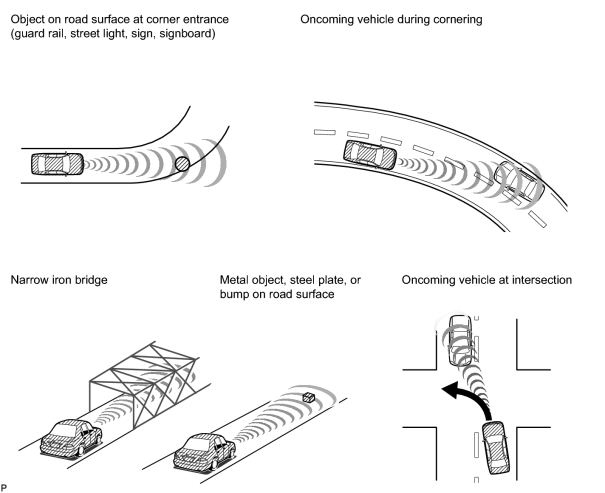
HINT:
- The pre-collision system will not activate when the pre-collision sensor detects safety cones and other plastic objects.
-
The pre-collision system may or may not activate when the pre-collision sensor detects the following objects: people, bicycles, motorcycles, trees, animals and snow fences.
Object Type
Example
Objects that cannot be detected.
Plastic items (safety cones)
Objects that cannot be detected in a stable manner.
People, bicycles, motorcycles, trees, animals, snow fences, etc.

|

|