- Cool air bypass damper servo motor
- Air conditioning harness assembly
- Air conditioning amplifier assembly
| Last Modified: 11-27-2007 | 1.6 C | |
| Service Category: Vehicle Interior | Section: Heating/Air Conditioning | |
| Model Year: 2008 | Model: LX570 | Doc ID: RM000002SM2009X |
| Title: HEATING / AIR CONDITIONING: AIR CONDITIONING SYSTEM: DESCRIPTION (2008 LX570) | ||
|
DTC |
B1445/45 |
Passenger Side Cool Air Bypass Damper Control |
DESCRIPTION
The cool air bypass damper servo motor sends pulse signals to inform the air conditioning amplifier assembly of the damper position. The air conditioning amplifier assembly activates the motor (normal or reverse) based on the signals to move the cool air bypass damper to any position. As a result, when the air conditioner is operating, the temperature of the air blowing toward the head area is controlled.
HINT:
Confirm that no mechanical problem is present because this trouble code can be stored when either a damper link or damper is mechanically locked.
|
DTC Code |
DTC Detection Condition |
Trouble Area |
|---|---|---|
|
B1445/45 |
The cool air bypass damper position does not change even if the air conditioning amplifier assembly operates the cool air bypass damper servo motor. |
|
WIRING DIAGRAM
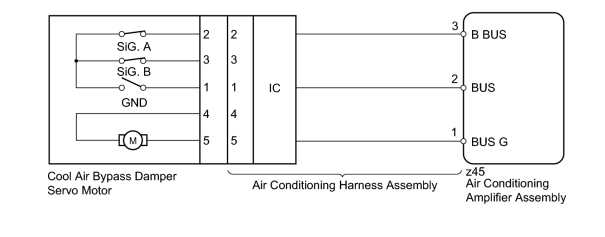
INSPECTION PROCEDURE
PROCEDURE
|
1. |
READ VALUE USING TECHSTREAM (COOL AIR BYPASS DAMPER SERVO MOTOR) |
(a) Use the Data List to check if the servo motor is functioning properly.
Air Conditioner
|
Tester Display |
Measurement Item/Range |
Normal Condition |
Diagnostic Note |
|---|---|---|---|
|
Cool Air Bypass Pulse |
Cool air bypass damper servo motor target pulse / Min.: 6, Max.: 57 |
Shut: 6 (pulse) Open: 57 (pulse) |
- |
OK:
The display is as specified in the normal condition.
|

|
2. |
CHECK COOL AIR BYPASS DAMPER SERVO MOTOR (OPERATION) |
(a) Replace the cool air bypass damper servo motor
 .
.
HINT:
Since the servo motor cannot be inspected while it is removed from the vehicle, replace the servo motor with a normal one.
|
|
3. |
CHECK FOR DTC |
(a) Clear the DTCs
.
(b) Check for DTCs
.
OK:
DTC B1445 is not output.
|

|

|