| Last Modified: 11-27-2007 | 1.6 G | |
| Service Category: Vehicle Interior | Section: Interior Panels/Trim | |
| Model Year: 2008 | Model: LX570 | Doc ID: RM000003BUD002X |
| Title: INTERIOR PANELS / TRIM: FRONT CONSOLE BOX (w/ Cool Box): INSPECTION (2008 LX570) | ||
INSPECTION
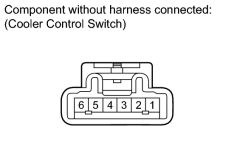
1. INSPECT COOLER CONTROL SWITCH SUB-ASSEMBLY
|
(a) Measure the resistance according to the value(s) in the table below. Standard Resistance:
|
(b) Apply battery voltage to the cooler control switch connector and check that the indicator illuminates.
OK:
|
Measurement Condition |
Specified Condition |
|---|---|
|
Battery positive (+) → Terminal 3 Battery negative (-) → Terminal 4 |
Indicator illuminates |
If the result is not as specified, replace the cooler control switch sub-assembly.
2. INSPECT NO. 1 COOLER BLOWER MOTOR SUB-ASSEMBLY
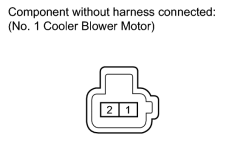
(a) Apply battery voltage to the blower motor connector and check the operation of the blower motor.
OK:
|
Measurement Condition |
Specified Condition |
|---|---|
|
Battery positive (+) → Terminal 1 Battery negative (-) → Terminal 2 |
Motor operates smoothly |
If the result is not as specified, replace the blower motor sub-assembly.
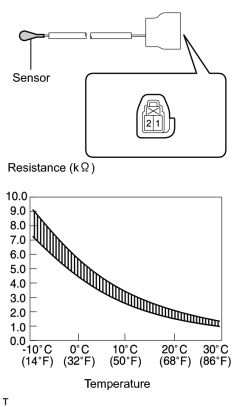
3. INSPECT NO. 3 COOLER THERMISTOR
|
(a) Measure the resistance according to the value(s) in the table below. Standard Resistance:
If the result is not as specified, replace the cooler thermistor. NOTICE:
HINT:
As the temperature increases, the resistance decreases (See the graph). |

|

|