DTC    P0335    Crankshaft Position Sensor "A" Circuit

for Preparation Click here


DESCRIPTION

The crankshaft position sensor (NE signal) consists of a magnet, iron core and pickup coil.
The NE signal plate (crankshaft position sensor plate) has 34 teeth and is installed on the crankshaft. The NE signal sensor generates 34 signals for each engine revolution. This sensor monitors a plate (timing rotor) located on the crankshaft timing pulley and is used by the ECM to detect crankshaft angle and engine speed (RPM/NE). As the crankshaft timing pulley rotates through an engine revolution, this sensor communicates the rotation of the NE signal plate as a pulse signal to the ECM. Based on the signal, the ECM controls fuel injection time and ignition timing.

DTC No.
DTC Detection Condition
Trouble Area
P0335
No CKP sensor signal to ECM while engine running (Engine rotating signal from HV Control ECU) (1 trip detection logic)
  1. Open or short in CKP sensor circuit
  2. CKP sensor
  3. CKP sensor plate
  4. HV Control ECU
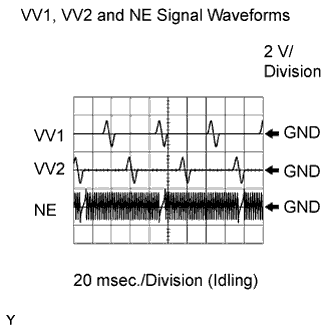
Reference: Inspection using an oscilloscope.
A110929E01

HINT:
  1. The correct waveform is as shown.
  2. VV1+ and VV2+ stands for the VVT sensor signal, and NE+ stands for the CKP sensor signal.


Item
Content
Terminals
VV1+ - NE-
VV2+ - NE-
NE+ - NE-
Equipment Settings
5 V/Division, 20 ms/Division
Conditions
Cranking or idling

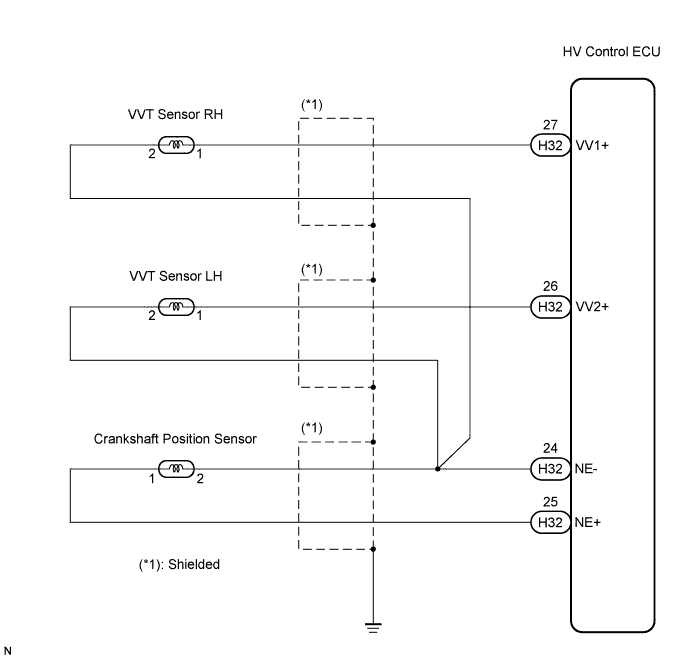
WIRING DIAGRAM


A110940E04


INSPECTION PROCEDURE

HINT:
  1. If no problem is found by this diagnostic troubleshooting procedure, troubleshooting the engine mechanical system.
  2. Check the engine speed. The engine speed can be checked by using the intelligent tester. To check, follow the operation below:
    1. Connect the intelligent tester to the DLC3.
    2. Put the engine in inspection mode (Click here).
    3. Start the engine.
    4. Turn the tester ON
    5. Enter the following menus: Powertrain / Engine / Data List / Engine Speed.
    1. The engine speed may be indicated as zero despite the engine revolving normally. This is caused by a lack of NE signals from the crankshaft position (CKP) sensor. Alternatively, the engine speed may be indicated as lower than the actual engine speed, if the CKP sensor output voltage is insufficient.
  3. Read freeze frame data using the intelligent tester. The ECM records vehicle and driving condition information as freeze frame data the moment a DTC is stored. When troubleshooting, freeze frame data can help determine if the vehicle was running or stopped, if the engine was warmed up or not, if the air-fuel ratio was LEAN or RICH, and other data from the time the malfunction occurred.

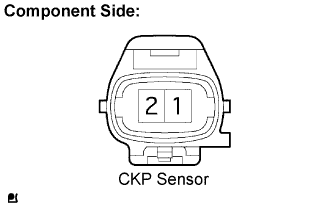
1.INSPECT CRANKSHAFT POSITION SENSOR


    A064984E03
  1. Disconnect the C3 crankshaft position (CKP) sensor connector.

  1. Measure the resistance of the between terminal 1 and 2.

    Standard resistance:
    Tester Connection
    Condition
    Specified Condition
    1 - 2
    Cold
    1,630 to 2,740 Ω
    1 - 2
    Hot
    2,065 to 3,225 Ω

    HINT:
    Terms cold and hot refer to the temperature of the coils. "Cold" means approximately -10 to 50°C (14 to 122°F). "Hot" means approximately 50 to 100°C (122 to 212°F).

  1. Reconnect the CKP sensor connector.


NG
REPLACE CRANKSHAFT POSITION SENSOR
OK


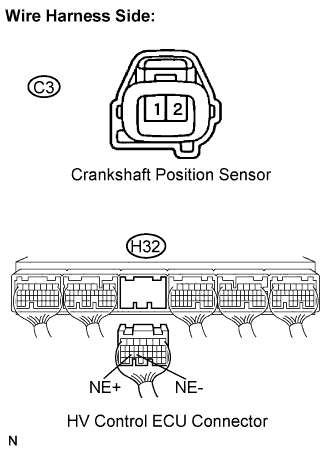
2.CHECK HARNESS AND CONNECTOR (CRANKSHAFT POSITION SENSOR - HV CONTROL ECU)


    A110906E04
  1. Disconnect the C3 CKP sensor connector.

  1. Disconnect the H32 HV Control ECU connector.

  1. Measure the resistance of the wire harness side connectors.

    Standard resistance (Check for open):
    Tester Connection
    Specified Condition
    C3-1 - NE+ (H32-25)
    Below 1 Ω
    C3-2 - NE- (H32-24)
    Below 1 Ω

    Standard resistance (Check for short):
    Tester Connection
    Specified Condition
    C3-1 or NE+ (H32-25) - Body ground
    10 kΩ or higher
    C3-2 or NE- (H32-24) - Body ground
    10 kΩ or higher

  1. Reconnect the HV Control ECU connector.

  1. Reconnect the CKP sensor connector.


NG
REPAIR OR REPLACE HARNESS AND CONNECTOR
OK


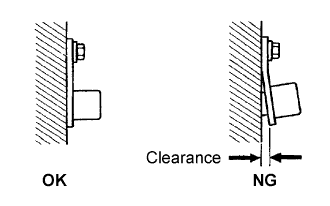
3.CHECK SENSOR INSTALLATION (CRANKSHAFT POSITION SENSOR)


    BR03795E10
  1. Check the CKP sensor installation.

    OK:
    Sensor is installed correctly.


NG
TIGHTEN SENSOR
OK


4.CHECK CRANKSHAFT POSITION SENSOR PLATE (TEETH OF SENSOR PLATE)
  1. Check the teeth of the sensor plate.

    OK:
    Sensor plate does not have any crack or deformation.


NG
REPLACE CRANKSHAFT POSITION SENSOR PLATE
OK

REPLACE HV CONTROL ECU