DTC    P0420    Catalyst System Efficiency Below Threshold (Bank 1)

DTC    P0430    Catalyst System Efficiency Below Threshold (Bank 2)

for Preparation Click here


MONITOR DESCRIPTION

The ECM (Included in HV Control ECU) uses the two sensors, mounted in front of and behind the Three-way Catalytic Converter (TWC), to monitor its efficiency.
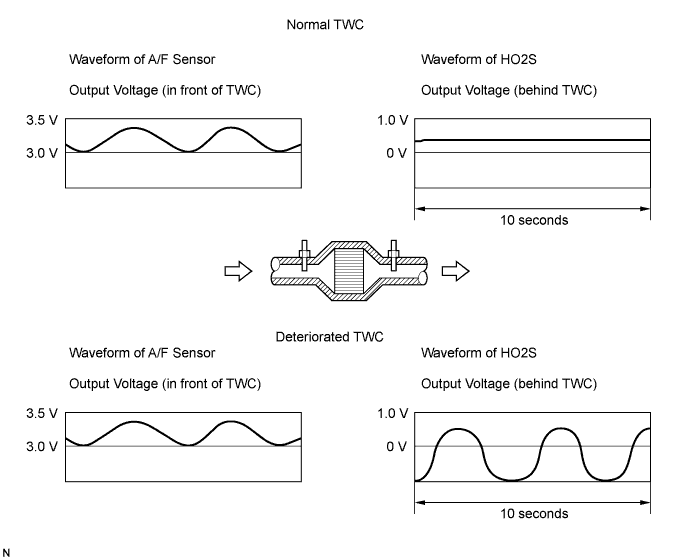
The first sensor, the Air-Fuel Ration (A/F) sensor (sensor 1), sends pre-catalyst information to the ECM. The second sensor, the Heated Oxygen (HO2) sensor (sensor 2), sends post-catalyst information to the ECM. The ECM compares the information transmitted by these two sensors to determine the efficiency of the TWC performance and its ability to store oxygen.
When the TWC is functioning properly, the variation in the oxygen concentration in the exhaust gas, after it has passed through the TWC, is small. As a result, the voltage output of sensor 2 slowly alternates between the rich and lean signal voltages (shown in the illustration below). As the TWC performance efficiency deteriorates, its oxygen storage capacity decreases, and the variation in the oxygen concentration in the exhaust gas increases. As a result, the sensor voltage output fluctuates frequently.
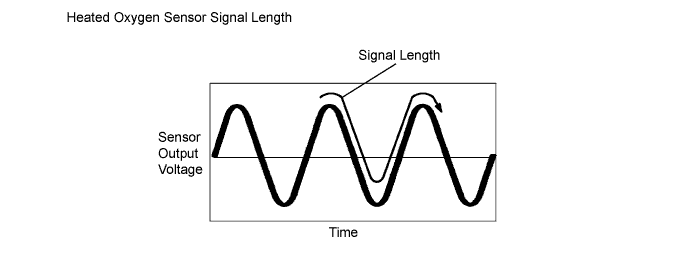
While the catalyst monitor is running, the ECM measures the signal length of both sensors 1 and 2, and calculate the ratio of the signal lengths to determine the extent of the TWC deterioration. If the deterioration level exceeds the preset threshold, the ECM interprets this as the TWC malfunction. The ECM then illuminates the MIL and sets the DTC.

A107145E01


A082718E03


DTC No.
DTC Detection Condition
Trouble Area
P0420
After engine and TWC warmed up, and while vehicle driven within set vehicle and engine speeds, waveform of Heated Oxygen (HO2) sensor (bank 1 sensor 2) alternates frequently between rich and lean (2 trip detection logic)
  1. Gas leakage from exhaust system
  2. A/F sensor (bank 1 sensor 1)
  3. HO2 sensor (bank 1 sensor 2)
  4. Three-Way Catalytic Converter (TWC) (Exhaust manifold)
P0430
After engine and catalyst are warmed up, and while vehicle is driven within set vehicle and engine speed ranges:
Waveform of heated oxygen sensor (bank 2 sensor 2) alternates frequently between rich and lean (2 trip detection logic)
  1. Gas leakage from exhaust system
  2. A/F sensor (bank 2 sensor 1)
  3. HO2 sensor (bank 2 sensor 2)
  4. Three-Way Catalytic Converter (TWC) (Exhaust manifold)

HINT:
  1. Bank 1 refers to the bank that includes cylinder No. 1
  2. Bank 2 refers to the bank that does not include cylinder No. 1
  3. Sensor 1 refers to the sensor closest to the engine assembly.
  4. Sensor 2 refers to the sensor farthest away from the engine assembly.


CONDITIONING FOR SENSOR TESTING

HINT:
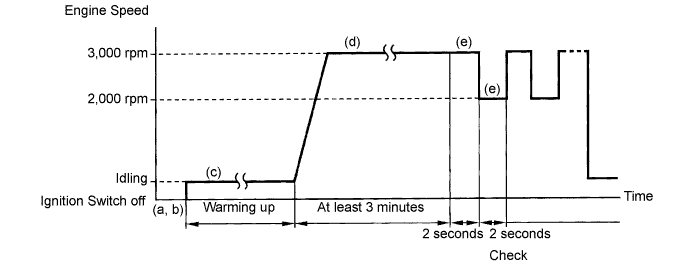
Perform the operation with the engine speeds and time durations described below prior to checking the waveforms of the A/F and HO2 sensors. This is in order to activate the sensors sufficiently to obtain the appropriate inspection results.


A093766E11

  1. (a) Connect the intelligent tester to the DLC3.
  2. (b) Put the engine in inspection mode (Click here).
  3. (c) Start the engine and warm it up with all the accessories switched OFF, until the engine coolant temperature stabilizes.
  4. (d) Run the engine at engine speed of between 2,500 rpm and 3,000 rpm for at least 3 minutes.
  5. (e) While running the engine at 3,000 rpm for 2 seconds and 2,000 rpm for 2 seconds, check the waveforms of the A/F and HO2 sensors using the tester or scan tool.

NOTICE:
The Air-Fuel Ratio (A/F) sensor has an output delay of a few seconds and the Heated Oxygen (HO2) sensor has a maximum output delay of approximately 20 seconds.


Case
A/F Sensor (Sensor 1)
Output Voltage
HO2 Sensor (Sensor 2)
Output Voltage
Main Suspected Trouble Area
1
Injection Volume
+25 %
-12.5 %
A103184
Injection Volume
+25 %
-12.5 %
A103184
-
Output Voltage
More than 3.35 V
Less than 3.0 V
A107708
Output Voltage
More than 0.55 V
Less than 0.4 V
A103186
2
Injection Volume
+25 %
-12.5 %
A103184
Injection Volume
+25 %
-12.5 %
A103184
  1. A/F sensor
  2. A/F sensor heater
    A/F sensor circuit
Output Voltage
Almost
no reaction
A103185
Output Voltage
More than 0.55 V
Less than 0.4 V
A103186
3
Injection Volume
+25 %
-12.5 %
A103184
Injection Volume
+25 %
-12.5 %
A103184
  1. HO2 sensor
  2. HO2 sensor heater
  3. HO2 sensor circuit
Output Voltage
More than 3.35 V
Less than 3.0 V
A107708
Output Voltage
Almost
no reaction
A103185
4
Injection volume
+25 %
-12.5 %
A103184
Injection Volume
+25 %
-12.5 %
A103184
  1. Injector
  2. Fuel pressure
  3. Gas leakage from exhaust system
    (Air-fuel ratio extremely lean or rich)
Output Voltage
Almost
no reaction
A103185
Output Voltage
Almost
no reaction
A103185
Following the A/F Control procedure enables technicians to check and graph the output voltages of both the A/F and HO2 sensors.

INSPECTION PROCEDURE

HINT:
Read freeze frame data using the intelligent tester. The ECM records vehicle and driving condition information as freeze frame data the moment a DTC is stored. When troubleshooting, freeze frame data can help determine if the vehicle was running or stopped, if the engine was warmed up or not, if the air-fuel ratio was LEAN or RICH, and other data from the time the malfunction occurred.

1.CHECK ANY OTHER DTCS OUTPUT (IN ADDITION TO DTC P0420 AND/OR P0430)
  1. Connect the intelligent tester to the DLC3.

  1. Turn the ignition switch ON and turn the tester ON.

  1. Enter the following menus: Powertrain / Engine / DTC.

  1. Read DTCs.

    Result:

    Display (DTC output)
    Proceed to
    P0420 and/or P0430
    A
    P0420 and/or P0430 and other DTCs
    B

    HINT:
    If any DTCs other than P0420 or P0430 are output, troubleshoot those DTCs first.


B
GO TO DTC CHART
A


2.PERFORM ACTIVE TEST USING INTELLIGENT TESTER (A/F CONTROL)
  1. Connect the intelligent tester to the DLC3.

  1. Put the engine in inspection mode (Click here).

  1. Start the engine and turn the tester ON.

  1. Warm up the engine at engine speed of 2,500 rpm for approximately 90 seconds.

  1. On the tester, enter the following menus: Powertrain / Engine / Active Test / Control the Injection Volume for A/F Sensor.

  1. Perform the A/F Control operation with the engine in an idling condition (press the Right or Left button to change the fuel injection volume.).

  1. Monitor the output voltages of the A/F and HO2 sensors (AFS B1S1 and O2S B1S2 or AFS B2S1 and O2S B2S2) displayed on the tester.

    HINT:
    1. The A/F Control operation lowers the fuel injection volume by 12.5 % or increases the injection volume by 25 %.
    2. Each sensor reacts in accordance with increases and decreases in the fuel injection volume.


    Standard:

    Tester Display
    (Sensor)
    Injection Volume
    Status
    Voltage
    AFS B1S1 or AFS B2S1
    (A/F)
    +25 %
    Rich
    Less than 3.0
    AFS B1S1 or AFS B2S1
    (A/F)
    -12.5 %
    Lean
    More than 3.35
    O2S B1S2 or O2S B2S2
    (HO2)
    +25 %
    Rich
    More than 0.55
    O2S B1S2 or O2S B2S2
    (HO2)
    -12.5 %
    Lean
    Less than 0.4


    Result:

    Status
    AFS B1S1
    or
    AFS B2S1
    Status
    O2S B1S2
    or
    O2S B2S2
    A/F Condition and A/F and
    HO2 Sensor Conditions
    Misfire
    Main Suspected Trouble Areas
    Proceed to
    Lean/Rich
    Lean/Rich
    Normal
    -
    1. Three-Way Catalytic Converter (TWC)
    2. Gas leakage from exhaust system
    A
    Lean
    Lean/Rich
    A/F sensor malfunction
    -
    1. A/F sensor
    B
    Rich
    Lean/Rich
    A/F sensor malfunction
    May occur
    1. A/F sensor
    B
    Lean/Rich
    Lean
    HO2 sensor malfunction
    -
    1. HO2 sensor
    2. Gas leakage from exhaust system
    C
    Lean/Rich
    Rich
    HO2 sensor malfunction
    -
    1. HO2 sensor
    2. Gas leakage from exhaust system
    C
    Lean
    Lean
    Actual air-fuel ratio lean
    May occur
    1. Extremely rich or lean actual air-fuel ratio
    2. Gas leakage from exhaust system
    A
    Rich
    Rich
    Actual air-fuel ratio lean
    -
    1. Extremely rich or lean actual air-fuel ratio
    2. Gas leakage from exhaust system
    A

    Lean: During A/F Control, the A/F sensor output voltage (AFS) is consistently more than 3.35 V, and the HO2 sensor output voltage (O2S) is consistently less than 0.4 V.
    Rich: During A/F Control, the AFS is consistently less than 3.0 V, and the O2S is consistently more than 0.55 V.
    Lean/Rich: During A/F Control of the Active Test, the output voltage of the HO2 sensor alternates correctly.


B
CHECK AND REPLACE AIR FUEL RATIO SENSOR

C
CHECK AND REPLACE HEATED OXYGEN SENSOR, AND CHECK AND REPAIR EXHAUST GAS LEAKAGE
A


3.CHECK FOR EXHAUST GAS LEAKAGE

OK:
No gas leakage.


NG
REPAIR OR REPLACE EXHAUST GAS LEAKAGE POINT
OK

REPLACE THREE-WAY CATALYTIC CONVERTER