DTC    B1423/23    Pressure Switch Circuit

for Preparation Click here


DESCRIPTION


E109249E01

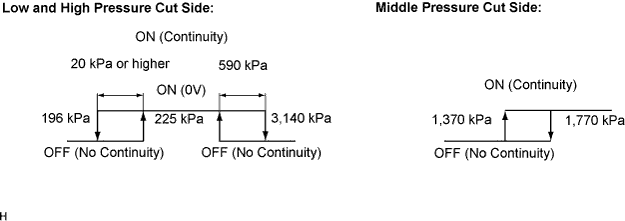
The A/C pressure switch to detect the refrigerant pressure is located in the sight glass side of the pipe on the high-pressure side. This DTC is output when the refrigerant pressure is either significantly low (below 196 kPa (2.0 kgf/cm2, 28 psi) or significantly high (over 3,140 kPa (32.0 kgf/cm2, 455 psi). Then the A/C pressure switch has built-in switches to detect high and low pressure and is turned off when either of them is determined to be detective. The A/C amplifier assembly continuously monitors the pressure switch signal after the ignition switch is turned on. It stops compressor control and outputs the DTC when it detects the signal indicating that the switch is turned off.

DTC No.
DTC Detecting Condition
Trouble Area
B1423/23
  1. Open or short in pressure switch circuit
  2. Abnormal refrigerant pressure
    Below 196 kPa (2.0 kgf/cm2, 28 psi)
    Over 3,140 kPa (32.0 kgf/cm2, 455 psi)
  1. A/C Pressure switch
  2. Harness or connector between A/C pressure switch and hybrid vehicle control ECU, A/C Pressure switch and body ground
  3. Multiplex communication circuit
  4. Refrigerant pipe line
  5. Hybrid vehicle control ECU
  6. A/C amplifier assembly

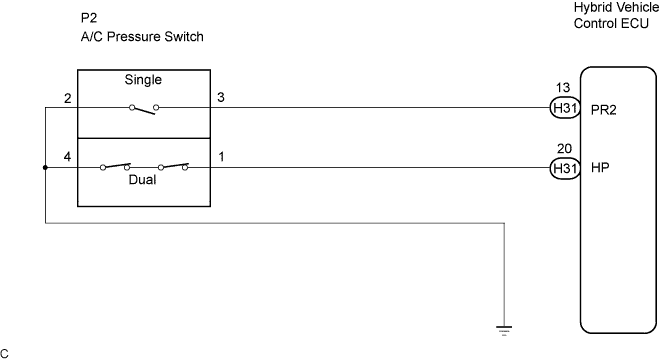
WIRING DIAGRAM


E109254E03


INSPECTION PROCEDURE

1.INSPECT REFRIGERANT PRESSURE
  1. Set the manifold gauge (Click here).

  1. Read the manifold gauge pressure when the following conditions are established.

    1. Temperature at the air inlet with the switch set at RECIRCULATION is 30 to 35°C (86 to 95°F)
    2. Ignition switch is ON.
    3. Blower speed control switch is at "HI" position
    4. Temperature control dial is at "COOL" position
    5. Air conditioning switch is ON
    6. Doors are fully open

    Standard pressure:
    Pressure on high pressure side:
    1.37 to 1.57 MPa (13.9 to 16.0 kgf/cm2, 198 to 228 psi)

    HINT:
    If the refrigerant pressure is below 196 kPa (2.0 kgf/cm2, 28 psi), the refrigerant amount in the air conditioning cycle may have decreased significantly for reasons such as a gas leakage.


NG
CHECK AND REPLACE AIR CONDITIONING CYCLE
OK


2.CHECK AIR CONDITIONING OPERATION


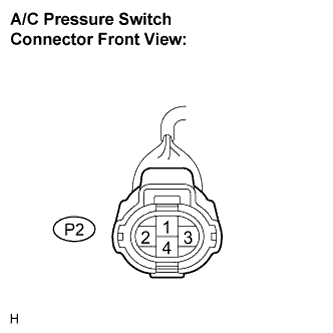
    E109313E02
  1. Disconnect the connector from the A/C pressure switch.

  1. Connect the terminals 1 and 4 of the connector of the pressure switch on the vehicle wire harness side using a service wire.

  1. Turn the ignition switch ON.

  1. Turn the air conditioning switch ON and check that the compressor is operated.

  1. Check that the compressor is not operated when terminals 1 and 4 are disconnected (that were connected in the prior step).

    OK:
    Terminals 1 and 4 connected: the compressor is operated
    Terminals 1 and 4 disconnected: the compressor is not operated

  1. Check that the electrical fan is operated when terminals 2 and 3 are disconnected (that were connected in the prior step).

    OK:
    Terminals 2 and 3 connected: the electrical fan is operated
    Terminals 2 and 3 disconnected: the electrical fan is not operated


NG
Go to step 3
OK

REPLACE A/C PRESSURE SWITCH 

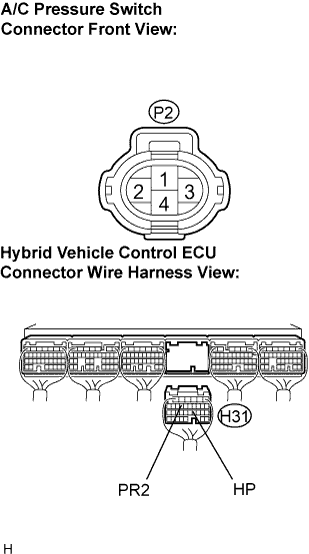
3.CHECK HARNESS AND CONNECTOR (A/C PRESSURE SWITCH - HYBRID VEHICLE CONTROL ECU)


    E108924E04
  1. Disconnect the connectors from the A/C pressure sensor and the hybrid vehicle control ECU.

  1. Measure the resistance according to the value(s) in the table below.

    Resistance:
    Tester connection
    (Symbols)
    Condition
    Specified condition
    H31-13 (PR2) - P2-3
    Always
    Below 1 Ω
    H31-20 (HP) - P2-1
    Always
    Below 1 Ω
    H31-13 (PR2) - Body round
    Always
    10 kΩ or higher
    H31-20 (HP) - Body ground
    Always
    10 kΩ or higher
    P2-2 - Body ground
    Always
    Below 1 Ω
    P2-4 - Body ground
    Always
    Below 1 Ω


    Result:

    Result
    Proceed to
    NG
    A
    OK (Checking from the PROBLEM SYMPTOMS TABLE)
    B
    OK (Checking from the DTC)
    C


B
PROCEED TO NEXT CIRCUIT INSPECTION SHOWN IN PROBLEM SYMPTOMS TABLE

C
REPLACE HYBRID VEHICLE CONTROL ECU
A

REPAIR OR REPLACE HARNESS OR CONNECTOR