POWER DOOR LOCK CONTROL SYSTEM > Driver Side Door Lock Motor Circuit |
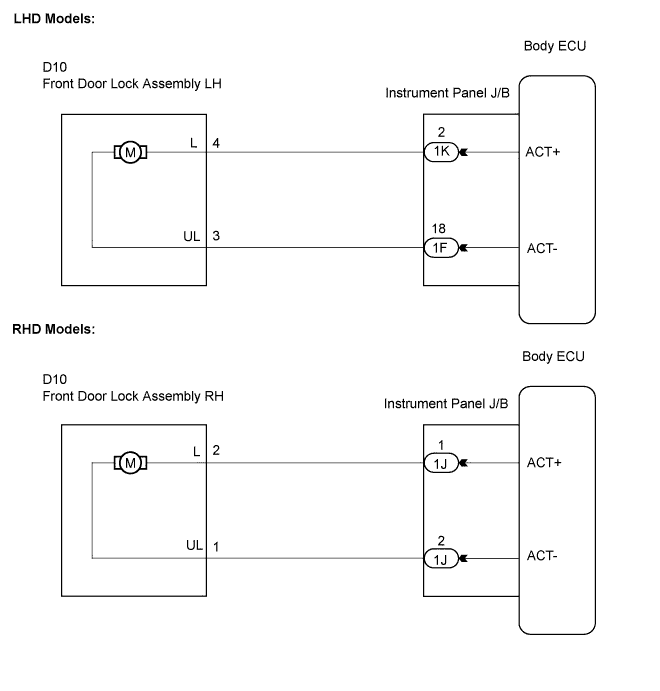
| 1.INSPECT FRONT DOOR LOCK ASSEMBLY (DOOR LOCK MOTOR) |
LHD Models:
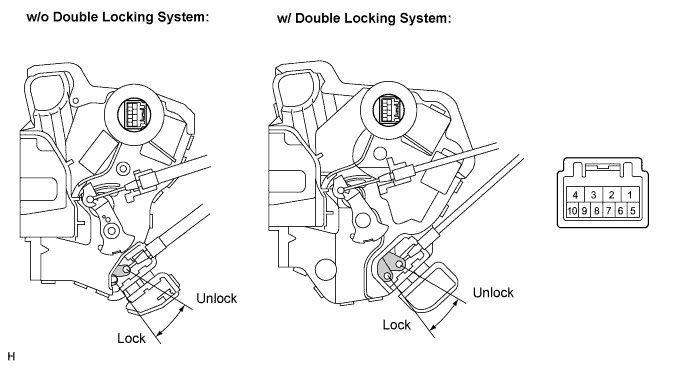
Apply battery voltage and check operation of the door lock motor.
| Measurement Condition | Specified Condition |
| Battery positive (+) → Terminal 4 Battery negative (-) → Terminal 3 | Lock |
| Battery positive (+) → Terminal 3 Battery negative (-) → Terminal 4 | Unlock |
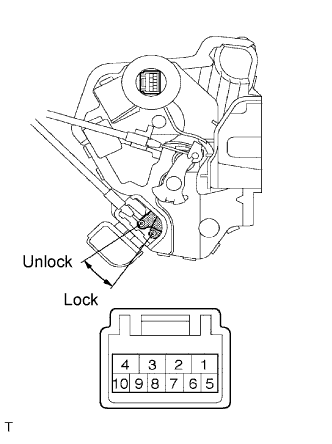 |
RHD Models:
Remove the front door lock assembly RH.
Apply battery voltage and check operation of the door lock motor.
| Measurement Condition | Specified Condition |
| Battery positive (+) → Terminal 2 Battery negative (-) → Terminal 1 | Lock |
| Battery positive (+) → Terminal 1 Battery negative (-) → Terminal 2 | Unlock |
|
| ||||
| OK | |
 |
| 2.CHECK WIRE HARNESS (FRONT DOOR LOCK ASSEMBLY - INSTRUMENT PANEL J/B) |
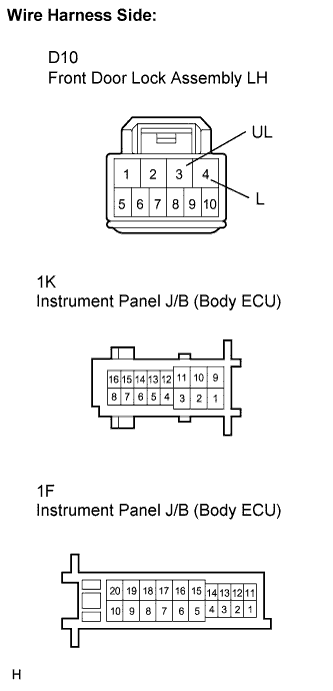 |
LHD Models:
Disconnect the front door lock assembly LH connector.
Disconnect the instrument panel J/B connectors.
Measure the resistance according to the value(s) in the table below.
| Tester Connection | Condition | Specified Condition |
| D10-4 (L) - 1K-2 | Always | Below 1 Ω |
| D10-3 (UL) - 1F-18 | Always | Below 1 Ω |
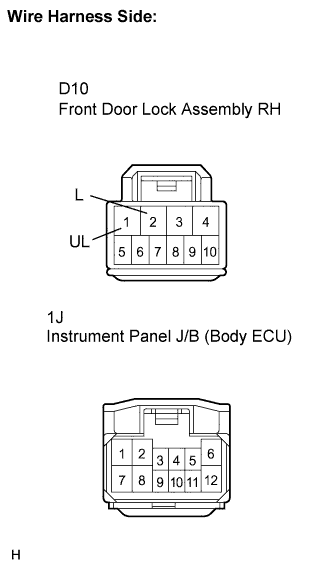 |
RHD Models:
Disconnect the front door lock assembly RH connector.
Disconnect the instrument panel J/B connector.
Measure the resistance according to the value(s) in the table below.
| Tester Connection | Condition | Specified Condition |
| D10-2 (L) - 1J-1 | Always | Below 1 Ω |
| D10-1 (UL) - 1J-2 (ACT-) | Always | Below 1 Ω |
|
| ||||
| OK | ||
 | ||
| ||

