DTC P0325 Knock Sensor 1 Circuit |
DTC P0327 Knock Sensor 1 Circuit Low Input (Bank 1 or Single Sensor) |
DTC P0328 Knock Sensor 1 Circuit High Input (Bank 1 or Single Sensor) |
DTC P0330 Knock Sensor 2 Circuit |
DTC P0332 Knock Sensor 2 Circuit Low Input (Bank 2) |
DTC P0333 Knock Sensor 2 Circuit High Input (Bank 2) |
| DTC No. | DTC Detection Condition | Trouble Area |
| P0325 P0330 | Knock sensor signal level remains at low for more than 10 seconds |
|
| P0327 P0332 | Output voltage of the knock sensor 1 or 2 is 0.5 V or less |
|
| P0328 P0333 | Output voltage of the knock sensor 1 or 2 is 4.5 V or more |
|
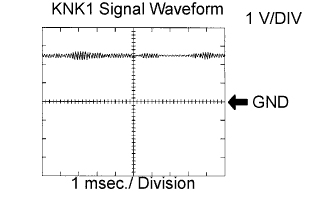
| Item | Details |
| Terminal | KNK1 - EKNK or KNK2 - EKN2 |
| Equipment Settings | 0.01 to 10 V/Division, 0.01 to 10 msec./Division |
| Condition | After warming up the engine, keep the engine speed at 4,000 rpm. |
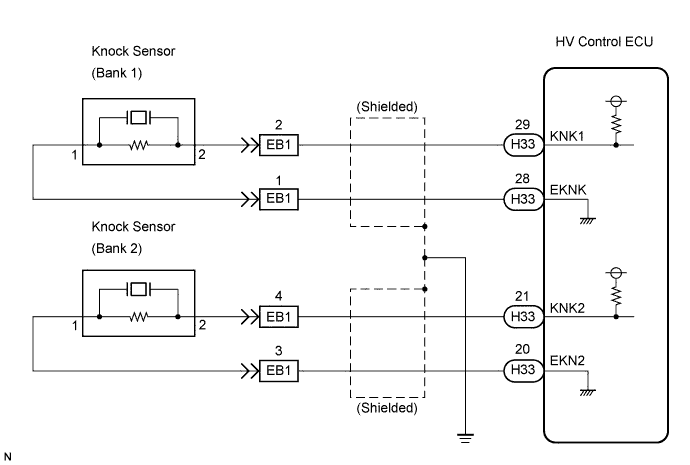
| 1.READ OUTPUT DTC (CHECK KNOCK SENSOR CIRCUIT) |
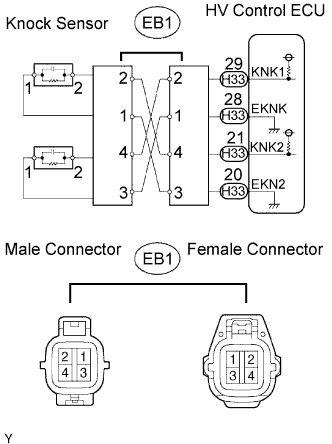 |
Disconnect the EB1 connector.
Using lead wires, connect the EB1 terminals as follows.
| Male Connector - Female Connector |
| Terminal 2 - Terminal 4 |
| Terminal 1- Terminal 3 |
| Terminal 4- Terminal 2 |
| Terminal 3- Terminal 1 |
Warm up the engine.
Run the engine at 3,000 rpm for 10 seconds or more.
Connect the intelligent tester to the DLC3.
Turn the ignition switch to ON and turn the intelligent tester ON.
Select the item: Powertrain / Engine /DTC.
Read DTCs.
| Display | Proceed to |
| DTCs same as when vehicle brought in P0325, P0327, P0328 → P0325, P0327, P0328 or P0330, P0332, P0333 → P0330, P0332, P0333 | A |
| DTCs different from when vehicle brought in P0325 → P0330 or P0330 → P0325 | B |
| DTCs different from when vehicle brought in P0327, P0328 → P0332, P0333 or P0332, P0333 → P0327, P0328 | C |
Reconnect the EB1 connector.
|
| ||||
|
| ||||
| A | |
 |
| 2.CHECK HARNESS AND CONNECTOR |
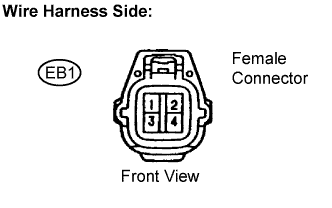 |
Disconnect the EB1 connector.
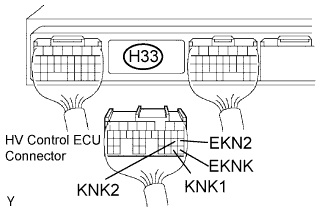 |
Disconnect the H33 HV Control ECU connector.
Measure the resistance between the wire harness side connectors.
| Tester Connection | Specified Condition |
| EB1 female connector 2 - KNK1 (H33-29) | Below 1 Ω |
| EB1 female connector 1- EKNK (H33-28) | |
| EB1 female connector 4 - KNK2 (H33-21) | |
| EB1 female connector 3 - EKN2 (H33-20) |
| Tester Connection | Specified Condition |
| EB1 female connector 2 or KNK1 (H33-29) - Body ground | 10 kΩ or higher |
| EB1 female connector 1 or EKNK (H33-28) - Body ground | |
| EB1 female connector 4 or KNK2 (H33-21) - Body ground | |
| EB1 female connector 3 or EKN2 (H33-20) - Body ground |
Reconnect the EB1 connector.
Reconnect the ECM connector.
|
| ||||
| OK | |
|
| 3.CHECK HV CONTROL ECU |
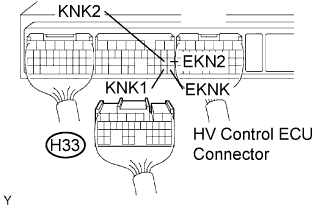 |
Disconnect the H33 HV Control ECU connector.
Turn the ignition switch to ON.
Measure the voltage between the specified ECM terminals
| Tester Connection | Specified Condition |
| KNK1 (H33-29) - EKNK (H33-28) | 4.5 to 5.5 V |
| KNK2 (H33-21) - EKN2 (H33-20) |
Reconnect the ECM connector.
|
| ||||
| OK | ||
 | ||
| ||
| 4.CHECK KNOCK SENSOR (SENSOR INSTALLATION) |
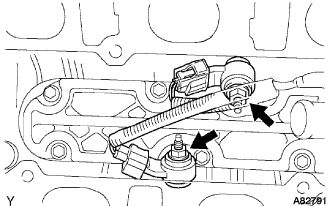 |
Check the installation condition of the knock sensors.
|
| ||||
| OK | ||
| ||
| ||
| 5.CHECK KNOCK CONTROL SENSOR (SENSOR RESISTANCE) |
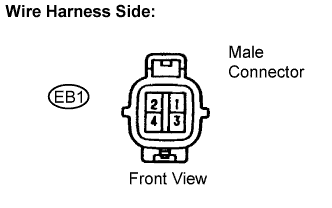 |
Disconnect the EB1 connector.
Measure the resistance between the terminals of the EB1 male connector.
| Tester Connection | Specified Condition |
| EB1 male connector 2 - 1 | 120 to 280 kΩ |
| EB1 male connector 4- 3 |
Reconnect the EB1 connector.
|
| ||||
| NG | |
|
| 6.CHECK HARNESS AND CONNECTOR (EA1 CONNECTOR - KNOCK SENSOR) |
|
Disconnect the EB1 connector.
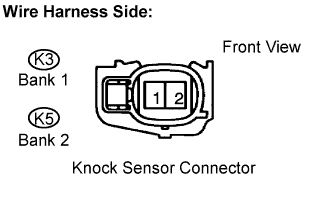 |
Disconnect the K3 or K5 knock sensor connector.
Measure the resistance between the wire harness side connectors.
| Tester Connection | Specified Condition |
| EB1 male connector 2 - K3-2 | Below 1 Ω |
| EB1 male connector 1- K3-1 | |
| EB1 male connector 4 - K5-2 | |
| EB1 male connector 3 - K5-1 |
| Tester Connection | Specified Condition |
| EB1 male connector 2 - K3-2 or Body ground | 10 kΩ or higher |
| EB1 male connector 1- K3-1 or Body ground | |
| EB1 male connector 4 - K5-2 or Body ground | |
| EB1 male connector 3 or K5-1 - Body ground |
Reconnect the EB1 connector.
Reconnect the knock sensor connector.
|
| ||||
| OK | ||
| ||
| ||


