DTC    P3190    Poor Engine Power

DTC    P3191    Engine dose not Start

DTC    P3193    Fuel Run Out

for Preparation Click here


DESCRIPTION

From the HV ECU, the ECM (Included in HV Control ECU) receives data such as power output required for the engine (required output), estimated torque produced by the engine (estimated torque), engine RPM of control target (target RPM), whether the engine is in start mode or not. Then, based on the required output and target RPM, the ECM (Included in HV Control ECU) calculates a target torque that is to be produced by the engine and compares it with the estimated torque. If the estimated torque is very low compared with the target torque, or the engine start mode continues for the specific duration calculated by water temperature, an abnormal condition is detected.

DTC No.
DTC Detection Condition
Trouble Area
P3190
Following conditions continue at a fixed engine RPM or a fixed length of time:
  1. Communication with HV ECU is normal
  2. Engine RPM is a fixed value or more
  3. Engine start mode is not active
  4. Target torque is a fixed value
  5. Ratio of estimated torque against target torque is less than 20 %
  1. Air induction system
  2. Throttle body
  3. Fuel pressure
  4. Engine
  5. Mass Air flow meter
  6. Out of fuel
  7. Engine coolant temperature sensor
  8. Crankshaft position sensor
  9. Camshaft position sensor
  10. HV Control ECU
P3191
Following conditions continue at a fixed engine RPM or a fixed length of time:
  1. Communication with HV ECU is normal
  2. Engine RPM is a fixed value or more
  3. Engine start mode is active
  1. Air induction system
  2. Throttle body
  3. Fuel pressure
  4. Engine
  5. Mass Air flow meter
  6. Out of fuel
  7. Engine coolant temperature sensor
  8. Crankshaft position sensor
  9. Camshaft position sensor
  10. HV Control ECU
P3193
Following conditions are met:
  1. Fuel low level signal input into ECM (Included in HV Control ECU)
  2. Detection condition for P3190 or P3191 is satisfied
  1. Out of fuel
  2. HV Control ECU

INSPECTION PROCEDURE

HINT:
Read freeze frame data using the intelligent tester or the OBD II scan tool. Freeze frame data records the engine condition when malfunction is detected. When troubleshooting, freeze frame data can help determine if the vehicle was running or stopped, if the engine was warmed up or not, if the air-fuel ratio was lean or rich, and other data from the time the malfunction occurred.

1.CHECK OTHER DTC OUTPUT (IN ADDITION TO DTC P3190, P3191 AND/OR P3193)
  1. Connect the intelligent tester to the DLC3.

  1. Turn the ignition switch ON.

  1. Turn the intelligent tester or the OBD II scan tool ON.

  1. On the intelligent tester, select the item: Powertrain / Engine / DTC.

  1. Read DTCs using the hand-held tester or the OBD II scan tool.

    Result:

    Display (DTC output)
    Proceed to
    P3190, P3191 and/or P3193
    A
    P3190, P3191 and/or P3193, and other DTCs
    B

    HINT:
    If any other codes besides P3190, P3191 and/or P3193 are output, perform troubleshooting for those DTCs first.


B
GO TO DTC CHART
A


2.CHECK SHORTAGE OF FUEL


NG
REFILL FUEL
OK


3.CHECK AIR INDUCTION SYSTEM

OK:
The air induction system has no leakage and blockages.


NG
REPAIR OR REPLACE AIR INDUCTION SYSTEM
OK


4.CHECK FOR UNUSUAL NOISE OR VIBRATION WHEN STARTING ENGINE OR REVVING UP

OK:
Unusual noise and vibration do not occur.


NG
REPAIR OR REPLACE MALFUNCTIONING PART
OK


5.CHECK FUEL PRESSURE
  1. Check the fuel pressure (Click here).

    Standard:
    304 to 343 kPa (3.1 to 3.5 kgf/cm2, 44.1 to 49.7 psi)


NG
CHECK AND REPLACE FUEL SYSTEM
OK


6.INSPECT MASS AIR FLOW METER ASSEMBLY


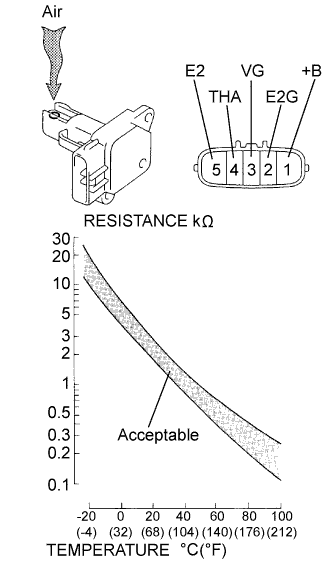
    A060548E02
  1. Connect the intelligent tester to the DLC3.

  1. Turn the ignition switch and tester ON.

  1. Enter the following menus: Powertrain / Engine / Data List / MAF.

    Standard:
    0.54 g/s or less

  1. Inspect resistance.

    1. Measure the resistance between the terminals of the mass air flow meter.

      Standard resistance:
      Tester Connection
      Specified Condition
      THA (4) - E2 (5)
      13.6 to 18.4 kΩ at -20°C (-4°F)
      THA (4) - E2 (5)
      2.21 to 2.69 kΩ at 20°C (68°F)
      THA (4) - E2 (5)
      0.49 to 0.67 kΩ at 60°C (140°F)

  1. Reinstall the mass air flow meter.


NG
REPLACE MASS AIR FLOW METER ASSEMBLY
OK


7.INSPECT ENGINE COOLANT TEMPERATURE SENSOR


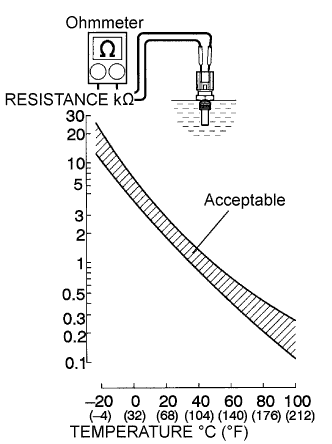
    A081700E04
  1. Remove the engine coolant temperature sensor.

  1. Measure the resistance between the terminals of the engine coolant temperature sensor.

    Standard resistance:
    Tester Connection
    Specified Condition
    1 - 2
    2 to 3 kΩ at 20°C (68°F)
    1 - 2
    0.2 to 0.4kΩ at 80°C (176°F)

    NOTICE:
    In case of checking the engine coolant temperature sensor in water, be careful not to allow water to contact the terminals. After checking, dry the sensor.

    HINT:
    Alternate procedure: Connect an ohmmeter to the installed engine coolant temperature sensor and read the resistance. Use an infrared thermometer to measure the engine temperature in the immediate vicinity of the sensor. Compare these values to the resistance/temperature graph. Change the engine temperature (warm up or allow to cool down) and repeat the test.

  1. Reinstall the engine coolant temperature sensor.


NG
REPLACE ENGINE COOLANT TEMPERATURE SENSOR
OK


8.INSPECT CRANKSHAFT POSITION SENSOR


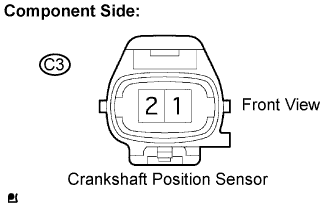
    A064984E09
  1. Disconnect the C3 crankshaft position sensor connector.

  1. Measure the resistance between the terminals of the crankshaft position sensor connector.

    Standard resistance:
    Tester Connection
    Specified Condition
    1 - 2
    985 to 1,600 Ω at cold
    1 - 2
    1,265 to 1,890 Ω at hot

  1. Reconnect the crankshaft position sensor connector.

    NOTICE:
    Terms "cold" and "hot" refer to the temperature of the coils. "Cold" means approximately -10°C to 50°C (14°F to 122°F). "Hot" means approximately 50°C to 100°C (122°F to 212°F).


NG
REPLACE CRANKSHAFT POSITION SENSOR
OK


9.INSPECT CAMSHAFT POSITION SENSOR


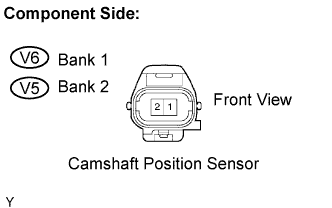
    A073303E06
  1. Disconnect the V6 and V5 camshaft position sensor connector.

  1. Measure the resistance between the terminals of camshaft position sensor connector.

    Standard resistance:
    Tester Connection
    Specified Condition
    1 - 2
    1,630 to 2,740 Ω at cold
    1 - 2
    2,065 to 3, 225 Ω at hot

  1. Reconnect the camshaft position sensor connector.

    NOTICE:
    Terms "cold" and "hot" refer to the temperature of the coils. "Cold" means approximately -10°C to 50°C (14°F to 122°F). "Hot" means approximately 50°C to 100°C (122°F to 212°F).


NG
REPLACE CAMSHAFT POSITION SENOR
OK


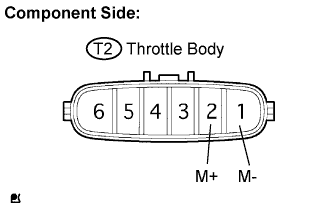
10.INSPECT THROTTLE CONTROL MOTOR


    A059778E08
  1. Disconnect the throttle control motor connector.

  1. Using an ohmmeter, measure the motor resistance between terminals 1 (M-) and 2 (M+).

    Standard resistance:
    Tester Connection
    Specified Condition
    1 - 2
    0.3 to 100 Ω at 20°C (68°F)


NG
REPLACE THROTTLE BODY ASSEMBLY
OK


11.INSPECT THROTTLE POSITION SENSOR
  1. Connect the intelligent tester to the DLC3.

  1. Turn the ignition switch ON and turn the intelligent tester ON.

  1. Enter the following menus: Powertrain / Engine / Data List / Throttle Sens Open Pos #1 and Throttle Sens Open Pos #2.

  1. Check the values displayed on the tester.

    Standard voltage:

    Item
    Condition
    Specified Condition
    Throttle Sens Open Pos #1
    Throttle fully closed
    2.15 to 2.35 V
    Throttle fully open
    4.5 to 5.0 V
    Throttle Sens Open Pos #2
    Throttle fully closed
    0.66 to 0.76 V
    Throttle fully open
    3.8 to 4.2 V


NG
REPLACE THROTTLE BODY ASSEMBLY
OK

REPLACE HV CONTROL ECU