FRONT WHEEL ALIGNMENT > ADJUSTMENT |
| 1. INSPECT TIRES |
Check the tires for wear and proper inflation pressure.
| Tire size | For driving under 180 km/h (112 mph) kPa (kgf/cm2, psi) | For driving at over 180 km/h (112 mph) kPa (kgf/cm2, psi) |
| 235/55R18 99V | 220 (2.2, 32) | 230 (2.3, 34) |
| 235/55R18 100V | 220 (2.2, 32) | 230 (2.3, 34) |
Using a dial indicator, check the tire runout (vertical and horizontal).
| 2. MEASURE VEHICLE HEIGHT |
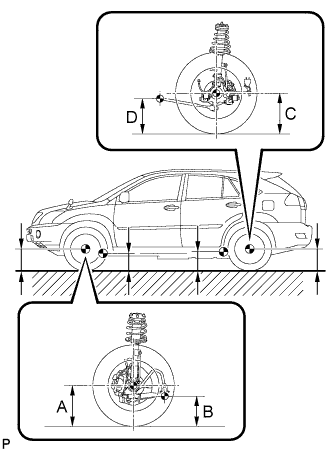 |
Bounce the vehicle at the corners up and down to stabilize the suspension and inspect vehicle height.
| Front A - B | Rear C - D |
| 110.6 mm (4.35 in.) | 21.1 mm (0.83 in.) |
| 3. INSPECT TOE-IN |
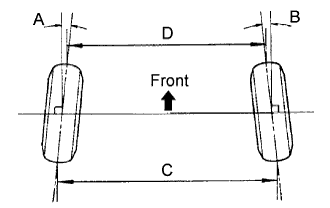 |
Bounce the vehicle at the corners up and down to stabilize the suspension and inspect toe-in.
| Toe-in (total) | - |
| A + B: C - D: | 0° +- 12' (0° +- 0.2°) 0 +- 2 mm (0 +- 0.08 in.) |
| 4. ADJUST TOE-IN |
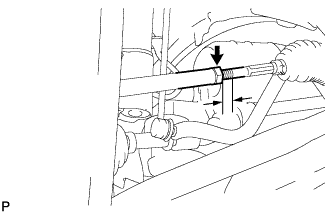 |
Measure the thread lengths of the right and left rack ends.
Remove the rack boot set clips.
Loosen the tie rod end lock nuts.
Adjust the rack ends if the difference in thread length between the right and left rack ends is not within the specified range.
Extend the shorter rack end if the measured toe-in deviates toward the outer-side.
Shorten the longer rack end if the measured toe-in deviates toward the inner-side.
Turn the right and left rack ends by equal amounts to adjust the toe-in.
Make sure that the lengths of the right and left rack ends are the same.
Tighten the tie rod end lock nuts.
Place the boots on the seats and install the clips.
| 5. INSPECT WHEEL ANGLE |
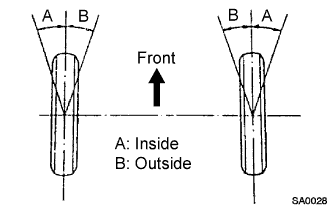 |
Turn the steering wheel fully left and right and measure the turning angle.
| Inside wheel | Outside wheel Reference |
| 35°38' +- 2° (35.63° +- 2°) | 31°20' (31.33°) |
| 6. INSPECT CAMBER, CASTER AND STEERING AXIS INCLINATION |
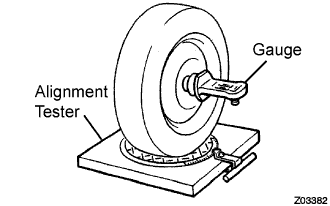 |
Put the front wheel on the center of the alignment tester.
Remove the center ornament.
Set the camber-caster-king pin gauge and attachment at the center of the axle hub or drive shaft.
Inspect the camber, caster and steering axis inclination.
| Camber Right-left difference | Caster Right-left difference | Steering axis inclination Right-left difference |
| -0°40' +- 45' (-0.67° +- 0.75°) 45' (0.75°) or less | 2°25' +- 45' (2.42° +- 0.75°) 45' (0.75°) or less | 10°40' +- 45' (10.67° +- 0.75°) 45' (0.75°) or less |
Remove the camber-caster-king pin gauge and attachment.
Install the center ornament.
If the caster and steering axis inclination are not within the specified range after the camber has been correctly adjusted, recheck the suspension parts for damage and/or wear.
| 7. ADJUST CAMBER |
Remove the front wheel.
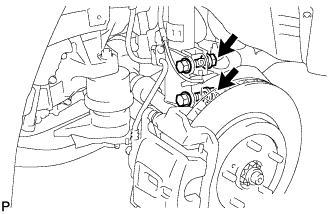 |
Remove the 2 nuts on the lower side of the front shock absorber.
Clean the installation surfaces of the front shock absorber and the steering knuckle.
Temporarily install the 2 nuts (Step A).
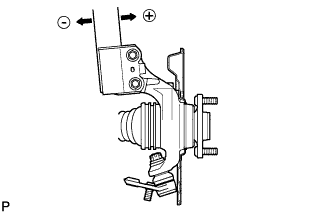 |
Fully push or pull the front axle hub in the direction of the required adjustment (Step B).
Tighten the nuts.
Install the front wheel.
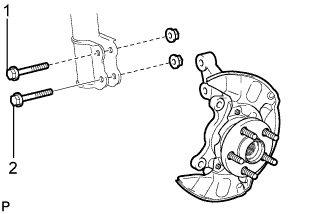   |
Check the camber.
If the measured value is not within the specification, calculate the required adjustment amount using the formula below.
(Camber adjustment amount) = Specified range medium - measured value
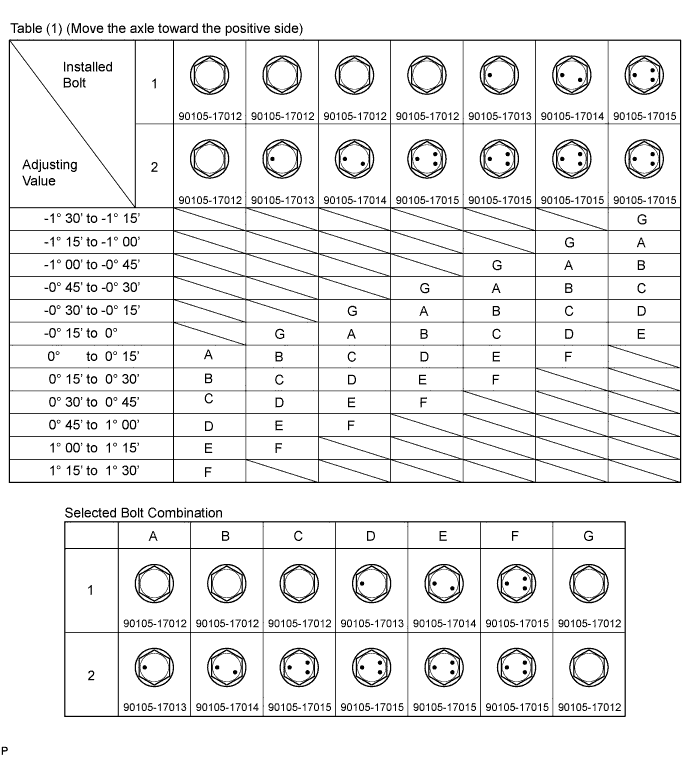
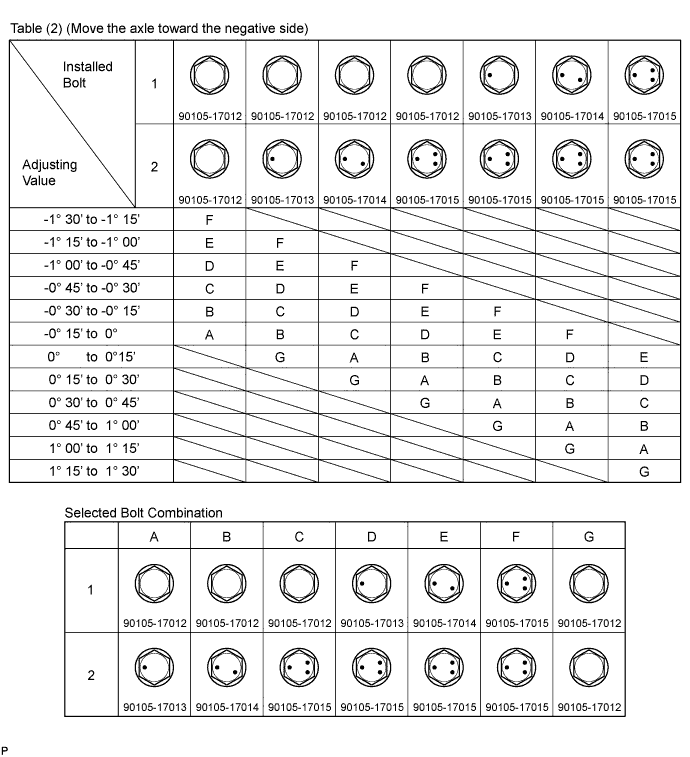
Check the combination of installed bolts. Select appropriate bolts from the table below to adjust the camber to the specified value.
| Move the axle toward (+) in step (B) | Move the axle toward (-) in step (B) |
| Refer to table (1) (Move the axle toward positive side) | Refer to table (2) (Move the axle toward negative side) |
Repeat the steps mentioned above. At step (A), replace 1 or 2 selected bolts.
