ENGINE > ON-VEHICLE INSPECTION |
| 1. INSPECT COOLANT |
Remove the radiator cap.
Check if there are any excessive deposits of rust or scales around the radiator cap and radiator filler hole. The coolant should be free of oil.
Install the radiator cap.
| 2. INSPECT ENGINE OIL |
Warm up the engine and then wait for 5 minutes after turning the engine off, the oil level should be between the low level and full level marks of the dipstick.
If low, check for leakage and add oil up to the full level mark.
| 3. INSPECT BATTERY |
| 4. INSPECT AIR CLEANER FILTER ELEMENT SUB-ASSEMBLY |
Remove the air cleaner filter element from the air cleaner case.
Visually check that there is no dirt, clog, and damage to the air cleaner filter element.
| 5. INSPECT SPARK PLUG |
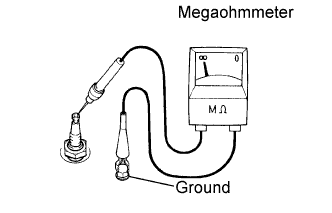 |
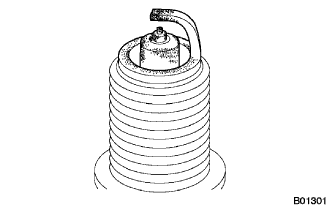
Check the electrode.
Using a megaohmmeter, measure the insulation resistance.
 |
Alternative inspection method:
Quickly accelerate the engine to 4,000 rpm 5 times.
Remove the spark plug.
Visually check the spark plug.
| Electrode condition | Next step |
| Dry | Go to next step |
| Wet | Proceed to step (c) |
Reinstall the spark plug.
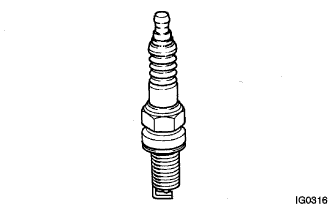 |
Check the spark plug for any damage to its threads and insulator.
If there is any damage, replace the spark plug.
| DENSO made | SK20R11 |
| NGK made | IFR6A11 |
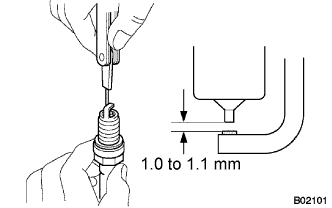 |
Check the spark plug electrode gap.
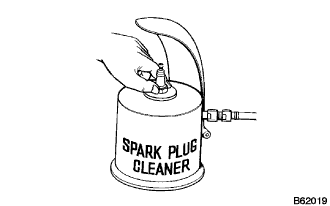 |
Clean the spark plugs.
If the electrode has traces of wet carbon, clean the electrode with a spark plug cleaner and then dry it.
| 6. INSPECT IGNITION TIMING |
Set the vehicle to inspection mode (Click here).
Warm up the engine.
When using the intelligent tester:
Connect the intelligent tester (with CAN VIM) to the DLC3.
Enter DATA LIST MODE on the intelligent tester.
Check that the ignition timing advances immediately when the engine speed is increased.
 |
When not using the intelligent tester:
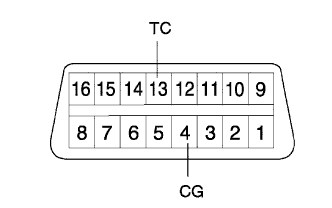
Using SST, connect terminals 13 (TC) and 4 (CG) of the DLC3.
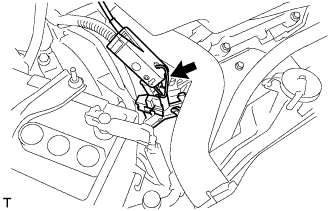 |
Pull out the red-colored wire harness as shown in the illustration.
Connect the tester terminal of the timing light to the engine.
Inspect ignition timing at idle.
Disconnect terminals 13 (TC) and 4 (CG) of the DLC3.
Inspect ignition timing at idle.
Confirm that the ignition timing advances when the engine rpm is increased.
Remove the timing light.
| 7. INSPECT ENGINE IDLE SPEED |
Set the vehicle to inspection mode (Click here).
Warm up the engine.
Connect the intelligent tester (with CAN VIM) to the DLC3.
Enter DATA LIST MODE on the intelligent tester.
| 8. INSPECT COMPRESSION |
Set the vehicle to inspection mode (Click here).
Warm up and stop the engine.
Remove the intake air surge tank (Click here).
Disconnect the injector connectors.
Remove the ignition coils.
Remove the spark plugs.
Inspect cylinder compression pressure.
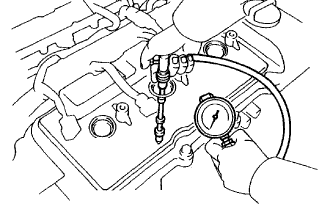 |
Insert a compression gauge into the spark plug hole.
Connect the intelligent tester (with CAN VIM) to the DLC3.
Enter ACTIVE TEST MODE on the intelligent tester.
While cranking the engine, measure the compression pressure.
If the cylinder compression is low, pour a small amount of engine oil into the cylinder through the spark plug hole and inspect again.
| 9. INSPECT CO/HC |
Set the vehicle to inspection mode (Click here).
Start the engine.
Run the engine at 2,500 rpm for approximately 180 seconds.
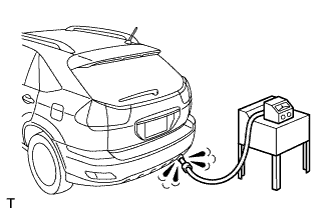 |
Insert the CO/HC meter testing probe at least 40 cm (1.3 ft) into the tailpipe during idling.
Check CO/HC concentration at idle and/or 2,500 rpm.
Check heated oxygen sensor operation (Click here).
Check heated air fuel ratio sensor operation (Click here).
See the table below for possible causes, and then inspect and repair the applicable causes if necessary.
| CO | HC | Problems | Causes |
| Normal | High | Rough idle |
|
| Low | High | Rough idle (Fluctuating HC reading) |
|
| High | High | Rough idle (Black smoke from exhaust) |
|
