PARKING ASSIST MONITOR SYSTEM > SYSTEM DESCRIPTION |
| GENERAL |
This system has a television camera mounted on the back door to display the rear view of the vehicle on the multi-display assembly. The display panel also shows a composite view consisting of the rear view and parking guidelines to assist the driver in parking the vehicle by monitoring the rear view.
This system consists of the following components: television camera ECU, television camera assembly, multi-display assembly, HV control ECU, combination meter and steering angle sensor.
This system is equipped with a self-diagnosis system, which is operated on a dedicated window that appears on the display panel, just as in the navigation system.
| FUNCTION OF COMPONENTS |
The television camera ECU controls the system by using information from the following components.
| Item | Function |
| Television Camera Assembly |
|
| Television Camera ECU |
|
| Multi-display Assembly | Receives video signals containing a composite of the rear view of the vehicle and the parking assist guideline signals from the television camera ECU, and displays them on the display panel. |
| Navigation ECU |
|
| Steering Angle Sensor | Detects the angle of the steering wheel and sends the resulting signals to the television camera ECU trough CAN communication. This sensor to the television camera ECU, via the CAN communication. |
| Combination Meter | A vehicle speed signal transmitted from the combination meter. |
| HV Control ECU | Transmits the shift position signal received from the park/neutral position switch to the television camera ECU, via the CAN communication. |
| Park/Neutral Position Switch | Transmits a received shift position signal to the HV control ECU. |
| OPERATION EXPLANATION |
The R position signal is input from the park/neutral position switch to the television camera ECU when the shift lever is moved to the R position.
After receiving the R position signal, the television camera ECU switches the display signal for the multi-display assembly from the navigation system to the rear view monitor system.
In parallel parking assist mode, an appropriate steering angle and timing information can be provided for the driver when parallel parking. This is based on the information from the steering angle sensor signal and the vehicle angle data signal that are sent to the television camera ECU.
| COMMUNICATION SYSTEM |
This rear view monitor system communicates between the components by AVC-LAN. Also, "PARALLEL PARKING ASSIST MODE" judges the vehicle angle data transmitted via AVC-LAN from the navigation ECU (the data is calculated by the navigation ECU by integrating the yaw rate of the gyro built in the navigation ECU).

| DIAGNOSTIC FUNCTION |
This rear view monitor system has a diagnostic function (displayed in "LEXUS NAVIGATION SYSTEM" of the navigation ECU).
A three-digit "unit code (physical address)" number (in hexadecimal notation) is set in each component that makes up the AVC-LAN.
A two-digit "logical address" number (in hexadecimal notation) is set in each function of the components that make up the AVC-LAN.
| OUTLINE OF AVC-LAN |
What is AVC-LAN?
AVC-LAN is the abbreviation for Audio Visual Communication-Local Area Network. This is a unified standard co-developed by 6 audio manufacturers associated with Toyota Motor Corporation.
The unified standard includes signals such as audio, visual, and signals for switch indication and communication.
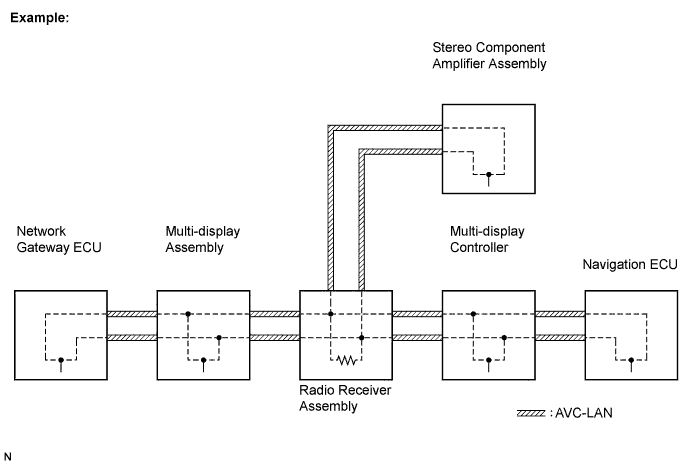
Objectives
Recently, developments in car audio systems have been rapid and functions have been changed drastically. The conventional system has been switched to the multi-media type such as a navigation system. At the same time, customers want to upgrade their audio systems. This is the factor that lies behind this standardization.
The concrete objectives are explained below.
When products by different manufacturers were combined, malfunctions such as sound failure occurred. This problem can be solved by standardization of signals.
Various types of after market products are available.
Because of the above, each manufacturer has been able to concentrate on developing products in their strongest field. This has enabled the development of inexpensive products.
In general, a new product developed by one particular manufacturer could not be used due to a lack of compatibility with other manufacturers products. By developing this new standard, users can enjoy a range of compatible products from different manufacturers anytime they want.
| NOTES FOR REAR VIEW MONITOR |
Notes for rear view monitor.
The rear view monitor may not function properly if subjected to a severe blow by any hard object.
Do not "scrub" the cover part of the camera (resin made). Scrubbing it may scratch the cover and affect the image. Prevent organic solvents, waxes, bond removing solvents, or glass coating from adhering to the cover. Clean it off immediately, and wash with water.
Exposing the camera to sudden temperature changes may affect proper function.
A clear image may not appear if the camera is dirty with snow, mud, etc. In that case, wash with water and wipe off. Use a detergent to remove dirt if necessary.
Images are difficult to discern even in normal conditions if:
Camera screen is frosted over (the image immediately after turning the ignition switch to the ON position may be blurred or darker than normal).
A strong beam of light, such as a sunbeam or headlight, hits the camera.
It is too dark around the camera (at night, etc.).
The ambient temperature around the camera is either too high or too low.
