DTC    P0A9C    Hybrid Battery Temperature Sensor "A"

DTC    P0A9D    Hybrid Battery Temperature Sensor "A" Circuit Low

DTC    P0A9E    Hybrid Battery Temperature Sensor "A" Circuit High

DTC    P0AC5    Hybrid Battery Temperature Sensor "B" Circuit

DTC    P0AC7    Hybrid Battery Temperature Sensor "B" Circuit Low

DTC    P0AC8    Hybrid Battery Temperature Sensor "B" Circuit High

DTC    P0ACA    Hybrid Battery Temperature Sensor "C"

DTC    P0ACC    Hybrid Battery Temperature Sensor "C" Circuit Low

DTC    P0ACD    Hybrid Battery Temperature Sensor "C" Circuit High

for Preparation Click here


DESCRIPTION

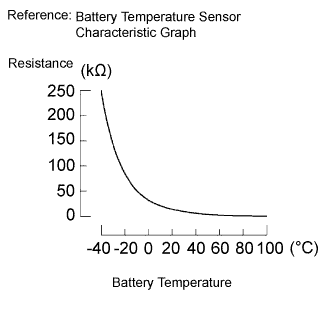
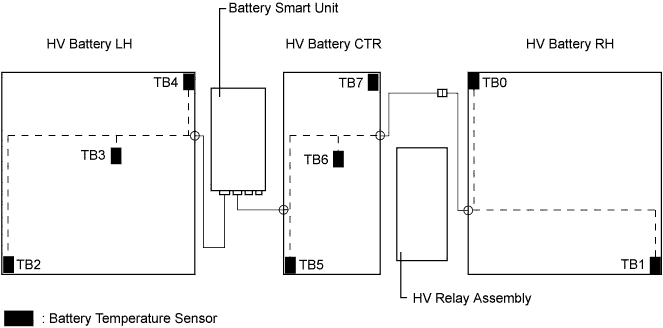
The battery temperature sensors are provided at 8 locations on the bottom of the HV battery. The resistance of the thermistor, which is built into each battery temperature sensor, varies in accordance with changes in the HV battery temperature. The lower the battery temperature, the higher the thermistor resistance. Conversely, the higher the temperature, the lower the resistance. The battery smart unit uses the battery temperature sensor to detect the HV battery temperature, and sends the detected value to the HV control ECU. Based on the results of this detection, the HV control ECU controls the blower fan. (The blower fan starts when HV battery temperature rises to a predetermined level.)
A115121E01

A108795E01


DTC No.
DTC Detection Condition
Trouble Area
P0A9C
P0A9D
P0A9E
P0AC5
P0AC7
P0AC8
P0ACA
P0ACC
P0ACD
  1. When the temperature of the battery temperature sensor is less than the standard value (open) or higher than the standard value (short) (1 trip detection)
  2. When the battery temperature sensor performance is abnormal (1 trip detection/2 trip detection)
  1. HV battery (Battery temperature sensor)
  2. Battery smart unit

HINT:
After confirming that a DTC is output, use the intelligent tester to check "Batt Temp 1 to 8" in the HV system ECU data list.


Temperature Displayed
Malfunction
Below -45°C
Open or +B short circuit
95°C or more
GND short circuit

MONITOR DESCRIPTION

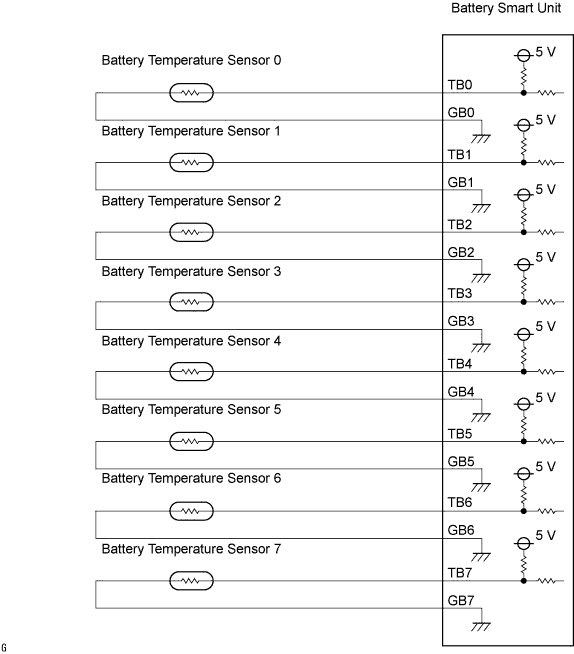
If the temperature indicated by the battery temperature sensor is lower than the standard level (open circuit), or is higher than the standard level (short circuit), the battery smart unit interprets this as a sensor malfunction. If the battery smart unit detects that HV battery temperature is out of normal range, the HV control ECU illuminates the MIL and sets a DTC.

WIRING DIAGRAM


A108799E01


INSPECTION PROCEDURE

CAUTION:
  1. Before inspecting the high-voltage system, take safety precautions to prevent electrical shocks, such as wearing insulated gloves and removing the service plug grip. After removing the service plug grip, put it in your pocket to prevent other technicians from reconnecting it while you are working on the high-voltage system.
  2. After disconnecting the service plug grip, wait for at least 5 minutes before touching any of the high-voltage connectors or terminals.

HINT:
At least 5 minutes is required to discharge the high-voltage capacitor inside the w/ converter inverter assembly.

1.READ OUTPUT DTC (DTC P0A1F IS OUTPUT)
  1. Connect the intelligent tester to the DLC3.

  1. Turn the ignition switch to the ON position.

  1. Select the following menu items: Powertrain / Hybrid Control / DTC.

  1. Read output DTCs. (Click here)

    Result:
    DTC P0A1F is output.


YES
REPLACE BATTERY SMART UNIT
NO


2.CHECK CONNECTION OF BATTERY TEMPERATURE SENSOR CONNECTOR (LOOSENESS AND POOR CONTACT)

CAUTION:
Be sure to wear insulated gloves and protective goggles.

  1. Turn the ignition switch off and remove the service plug grip. (Click here)

    NOTICE:
    Do not put the vehicle into the READY-on state with the service plug grip removed as this may cause a malfunction.

  1. Remove the battery cover. (Click here)
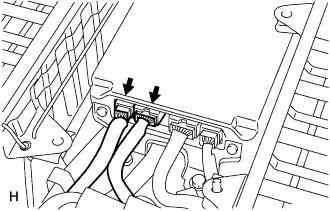


    A108243E01
  1. Check the connections of the B27 and B28 connectors of the battery smart unit.
    OK:
    Connectors are connected securely and there is no poor connection.


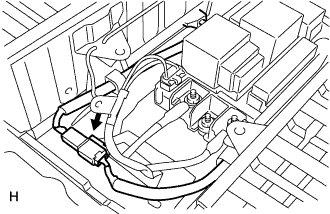
    A108235E01
  1. Check the connections of connectors between the battery temperature sensor (No.0) and battery temperature sensor (No.2).

    OK:
    Connectors are connected securely and there is no poor connection.


NG
CONNECT SECURELY
OK


3.CHECK HV BATTERY (BATTERY TEMPERATURE SENSOR)

CAUTION:
Be sure to wear insulated gloves and protective goggles.


    A109732E02
  1. Disconnect the B27 and B28 connectors from the battery smart unit.

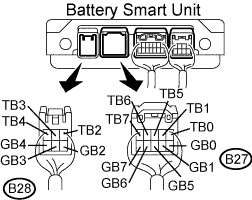
  1. Measure the resistance according to the conditions and value(s) in the tables below.
    Tester Connection
    Thermistor No.
    TB0 (B27-1) - GB0 (B27-6)
    0
    TB1 (B27-2) - GB1 (B27-7)
    1
    TB2 (B28-1) - GB2 (B28-4)
    2
    TB3 (B28-2) - GB3 (B28-5)
    3
    TB4 (B28-3) - GB4 (B28-6)
    4
    TB5 (B27-3) - GB5 (B27-8)
    5
    TB6 (B27-4) - GB6 (B27-9)
    6
    TB7 (B27-5) - GB7 (B27-10)
    7

    Standard Resistance:
    Thermistor Temperature
    Specified Condition (kΩ)
    0°C (32°F)
    27.0 to 27.6
    25°C (77°F)
    9.9 to 10.1
    40°C (104°F)
    5.77 to 5.89


NG
REPLACE HV BATTERY ASSEMBLY
OK


4.CHECK OUTPUT DTC
  1. Turn the ignition switch to the ON position.

  1. Select the following menu items: Powertrain / Hybrid Control / DTC.

  1. Check that the output DTCs indicate performance problems.

    Result:
    One or several of DTCs P0A9C, P0AC5 and P0ACA will be output.


NO
REPLACE BATTERY SMART UNIT
YES


5.CHECK INSTALLATION OF BATTERY TEMPERATURE SENSOR

CAUTION:
Be sure to wear insulated gloves and protective goggles.

  1. Remove the HV battery with the relevant battery temperature sensor.
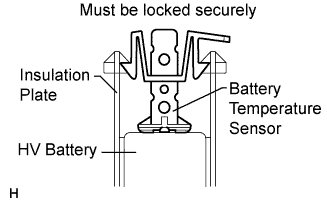


    A108237E01
  1. Turn over the relevant HV battery and check the installation of the battery temperature sensor.

    Result:
    Result
    Proceed to
    The battery temperature sensor is installed correctly.
    A
    The claws are damaged.
    B
    The battery temperature sensor is not installed correctly, but the claws are not damaged.
    C

    HINT:
    Do not leave the HV battery 10 minutes or more after turning the battery over.


B
REPLACE HV BATTERY ASSEMBLY

C
INSTALL CORRECTLY
A

REPLACE BATTERY SMART UNIT