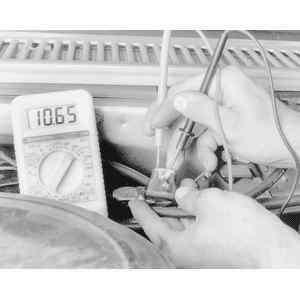
| Fig. 1: This voltage drop test revealed high resistance
(low voltage) in the circuit
|
When current flows through a load, the voltage beyond the load drops. This
voltage drop is due to the resistance created by the load and also by small
resistances created by corrosion at the connectors and damaged insulation
on the wires. The maximum allowable voltage drop under load is critical, especially
if there is more than one load in the circuit, since all voltage drops are
cumulative.
- Set the voltmeter selector switch to the 20 volt position.
- Connect the multimeter negative lead to a good ground.
- Operate the circuit and check the voltage prior to the first component
(load).
- There should be little or no voltage drop in the circuit prior to the
first component. If a voltage drop exists, the wire or connectors in the
circuit are suspect.
- While operating the first component in the circuit, probe the ground side
of the component with the positive meter lead and observe the voltage readings.
A small voltage drop should be noticed. This voltage drop is caused by the
resistance of the component.
- Repeat the test for each component (load) down the circuit.
- If a large voltage drop is noticed, the preceding component, wire or connector
is suspect.

