Many turbocharger failures are due to oil supply problems. Heat soak after
hot shutdown can cause the engine oil in the turbocharger and oil lines to "coke."
Often the oil feed lines will become partially or completely blocked with hardened
particles of carbon, blocking oil flow. Check the oil feed pipe and oil return
line for clogging. Clean these tubes well. Always use new gaskets above and
below the oil feed eyebolt fitting. Do not allow particles of dirt or old gasket
material to enter the oil passage hole and that no portion of the new gasket
blocks the passage.
- Disconnect the negative battery cable.
- Drain the engine oil, cooling system and remove the radiator. On vehicles
equipped with A/C, remove the condenser fan assembly with the radiator.
- Disconnect the oxygen sensor connector and remove the sensor.
- Remove the oil dipstick and tube.
- Remove the air intake bellows hose, the wastegate vacuum hose, the connections
for the air outlet hose, and the upper and lower heat shield.
- Unbolt the power steering pump and bracket assembly and leaving the hoses
connected, wire it aside.
- Remove the self-locking exhaust manifold nuts, the triangular engine hanger
bracket, the eyebolt and gaskets that connect the oil feed line to the turbo
center section and the water cooling lines. The water line under the turbo
has a threaded connection.
- Remove the exhaust pipe nuts and gasket and lift off the exhaust manifold.
Discard the gasket.
- Remove the 2 through bolts and 2 nuts that hold the exhaust manifold to
the turbocharger.
- Remove the 2 capscrews from the oil return line (under the turbo). Discard
the gasket. Separate the turbo from the exhaust manifold. The 2 water pipes
and oil feed line can still be attached.
- Visually check the turbine wheel (hot side) and compressor wheel (cold side)
for cracking or other damage. Check whether the turbine wheel and the compressor
wheel can be easily turned by hand. Check for oil leakage. Check whether or
not the wastegate valve remains open. If any problem is found, replace the
part. Inspect oil passages for restriction or deposits and clean as required.
- The wastegate can be checked with a pressure tester. Apply approximately
9 psi to the actuator and make sure the rod moves. Do not apply more than
10.3 psi or the diaphragm in the wastegate may be damaged. Vacuum applied
to the wastegate actuator should be maintained, replace if leaks vacuum. Do
not attempt to adjust the wastegate valve.
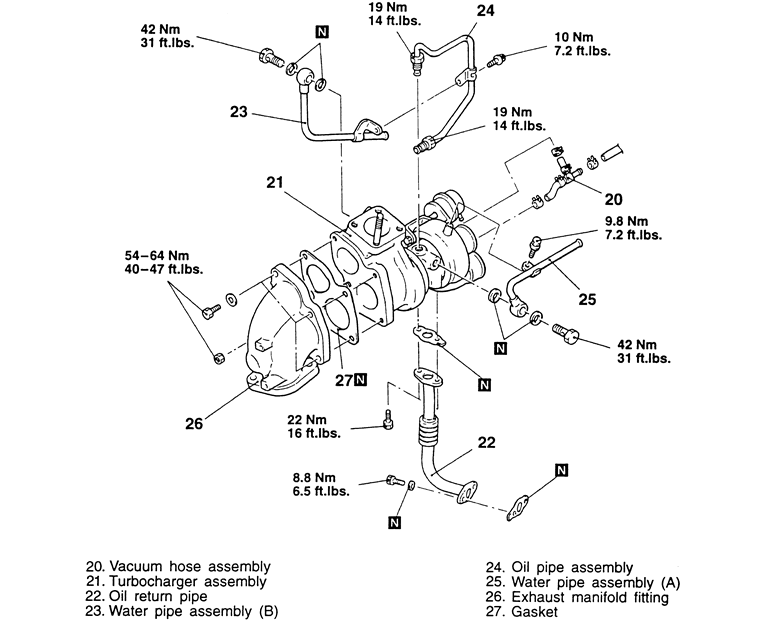
| Fig. 1: Exploded view of the turbocharger assembly — 1995–98
vehicles shown, earlier models similar
|
To install:
- Prime the oil return line with clean engine oil. Replace all locking nuts.
Before installing the threaded connection for the water inlet pipe, apply
light oil to the inner surface of the pipe flange. Assemble the turbocharger
and exhaust manifold.
- Install the exhaust manifold using a new gasket.
- Connect the water cooling lines, oil feed line and engine hanger.
- If removed, install the power steering pump and bracket.
- Install the heat shields, air outlet hose, wastegate hose and air intake
bellows.
- Install the oil dipstick tube and dipstick. Install the oxygen sensor.
- Install the radiator assembly.
- Fill the engine with oil, fill the cooling system and reconnect the negative
battery cable.