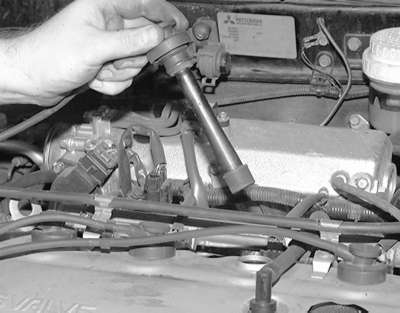
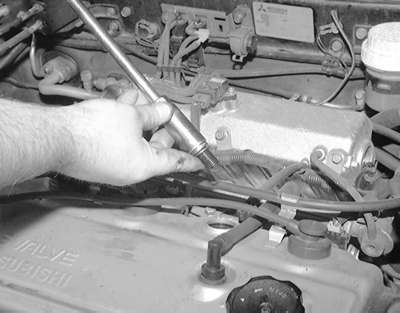
| Fig. 1: Carefully twist the boot end of the spark plug
wire and withdraw the spark plug wire boot from the cylinder head
|
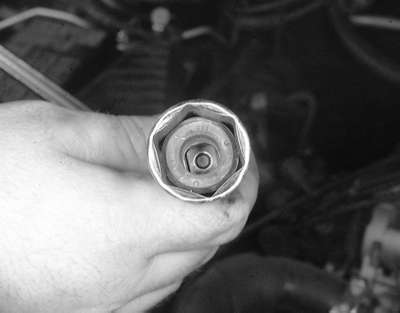
| Fig. 2: A special spark plug socket with a rubber insert
is required to remove the spark plugs. Typically the spark plugs require
a 5⁄8 spark
plug socket
|
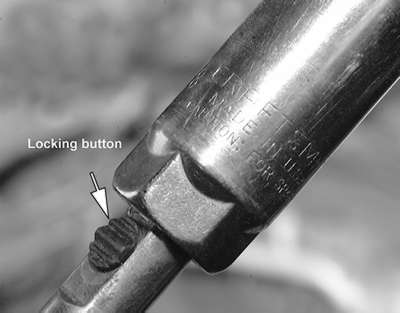
| Fig. 3: A locking extension such as this is extremely
helpful when removing spark plugs that are centrally located in the cylinder
head such as on the 2.4L engine
|
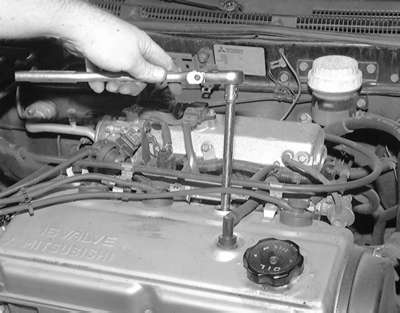
| Fig. 4: Using the appropriate sized spark plug socket,
necessary extensions and drive tools, loosen the spark plug . . .
|
| Fig. 5: . . . then carefully withdraw the spark plugs
from the engine
|
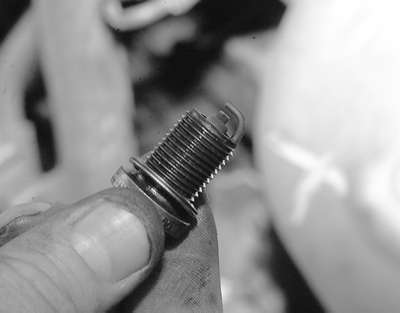
| Fig. 6: After removing the plug from the engine, inspect
it using the spark plug condition charts in this section to determine
the running condition of your engine
|
A set of spark plugs usually requires replacement after about 20,000–30,000 miles (32,000–48,000 km), depending on your style of driving. In normal operation plug gap increases about 0.001 in. (0.025mm) for every 2500 miles (4000 km). As the gap increases, the plug's voltage requirement also increases. It requires a greater voltage to jump the wider gap and about two to three times as much voltage to fire the plug at high speeds than at idle. The improved air/fuel ratio control of modern fuel injection combined with the higher voltage output of modern ignition systems will often allow an engine to run significantly longer on a set of standard spark plugs, but keep in mind that efficiency will drop as the gap widens (along with fuel economy and power).
When you're removing spark plugs, work on one at a time. Don't start by removing the plug wires all at once, because, unless you number them, they may become mixed up. Take a minute before you begin and number the wires with tape.
NOTE: Remove the spark plugs when the engine is cold, if possible, to prevent damage to the threads. If removal of the plugs is difficult, apply a few drops of penetrating oil or silicone spray to the area around the base of the plug, and allow it a few minutes to work.
WARNING
Be sure not to use a flexible extension on the socket. Use of a flexible
extension may allow a shear force to be applied to the plug. A shear force
could break the plug off in the cylinder head, leading to costly and frustrating
repairs.
To install:
WARNING
Do not use the spark plug socket to thread the plugs. Always carefully thread
the plug by hand or using an old plug wire to prevent the possibility of
crossthreading and damaging the cylinder head bore.