Use only quality oils. Never use straight mineral or non-detergent oils, that is, oils not equipped with special cleaning agents. You must not only choose the grade of oil, but the viscosity number. Viscosity refers to the thickness of the oil. It's actually measured by how rapidly it flows though a hole of calibrated size. Thicker oil flows more slowly and has higher viscosity numbers, such as SAE 40 or 50. Thinner oil flows more easily and has lower numbers, such as SAE 10 or 20.
Mitsubishi recommends the use of what are called " multigrade'' oils. These are specially formulated to change their viscosity with a change in temperature, unlike straight grade oils. The oils are designated by the use of two numbers, the first referring to the thickness of the oil, relative to straight mineral oils, at a low temperature such as 0°F (−18°C). The second number refers to the thickness, also relative to straight mineral oils, at high temperatures typical of highway driving (200°F (93°C)). These numbers are preceded by the designation "SAE'', representing the Society of Automotive Engineers which sets the viscosity standards. For example, use of an SAE 10W–40 oil would give nearly ideal engine operation under almost all operating conditions. The oil would be as thin as a straight 10 weight oil at cold cranking temperatures, and as thick as a straight 40 weight oil at hot running conditions.
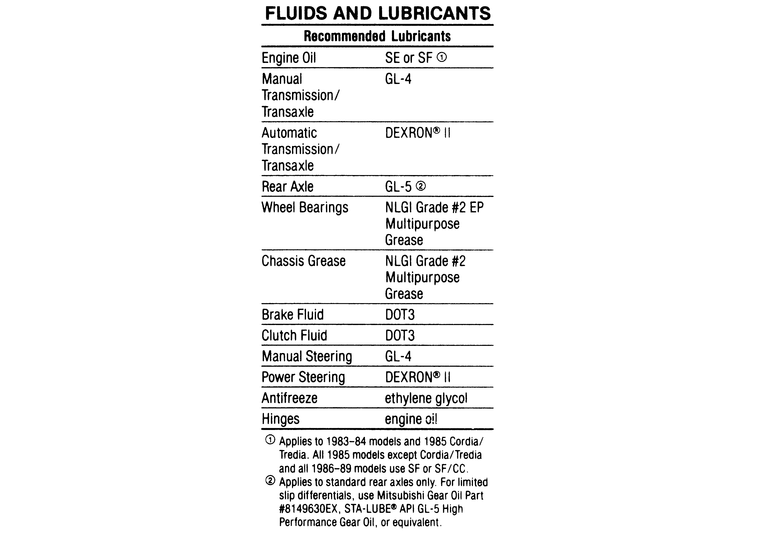
Note that diesel engines require different oils. This is because the oil gets much hotter, due to running with the high compression rates used in diesel engines. Be careful to adhere to all recommendations strictly for the longest possible engine life and best service. Oil recommendations are as follows.
| Fig. 1: Factory recommended fluids and lubricants for
Mitsubishi trucks and Monteros
|