CAUTION
Do not attempt this procedure on a frozen battery, it will probably explode.
The battery in the other vehicle must be a 12 volt, negatively grounded one.
Do not attempt to jump start your vehicle with a 24 volt power source; serious
electrical damage will result.
- Make sure that the voltages of the 2 batteries are the same. Most batteries
and charging systems are of the 12 volt variety.
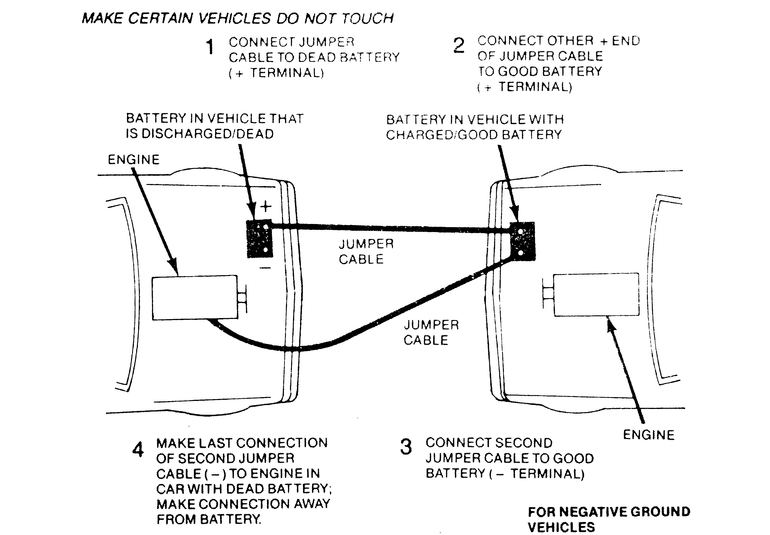
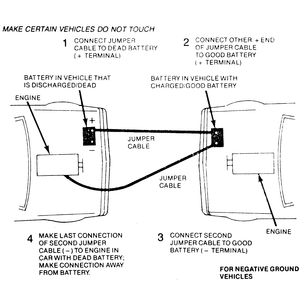
| Fig. 1: Connect the jumper cables to the batteries
and engine in the order shown
|
- Pull the jumping vehicle (with the good battery) into a position so the
jumper cables can reach the dead battery and that vehicle's engine. Make
sure that the vehicles do NOT touch.
- Place the transmissions of both vehicles in Neutral or Park, as applicable,
then firmly set their parking brakes.
NOTE: If necessary for safety reasons, both vehicle's
hazard lights may be operated throughout the entire procedure without
significantly increasing the difficulty of jumping the dead battery.
- Turn all lights and accessories off on both vehicles. Make sure the ignition
switches on both vehicles are turned to the OFF position.
- Cover the battery cell caps with a rag, but do not cover the terminals.
- Make sure the terminals on both batteries are clean and free of corrosion
or proper electrical connection will be impeded. If necessary, clean the
battery terminals before proceeding.
- Identify the positive (+) and negative (-) terminals on both battery posts.
- Connect the first jumper cable to the positive (+) terminal of the dead
battery, then connect the other end of that cable to the positive (+) terminal
of the booster (good) battery.
- Connect one end of the other jumper cable to the negative (–) terminal
of the booster battery and the other cable clamp to an engine bolt head,
alternator bracket or other solid, metallic point on the dead battery's
engine. Try to pick a ground on the engine that is positioned away from
the battery in order to minimize the possibility of the 2 clamps touching
should one loosen during the procedure. DO NOT connect this clamp to the
negative (–) terminal of the bad battery.
CAUTION
Be very careful to keep the jumper cables away from moving parts (cooling
fan, belts, etc.) on both engines.
- Check to make sure that the cables are routed away from any moving parts,
then start the donor vehicle's engine. Run the engine at moderate speed
for several minutes to allow the dead battery a chance to receive some initial
charge.
- With the donor vehicle's engine still running slightly above idle, try
to start the vehicle with the dead battery. Crank the engine for no more
than 10 seconds at a time and let the starter cool for at least 20 seconds
between tries. If the vehicle does not start in 3 tries, it is likely that
something else is also wrong or that the battery needs additional time to
charge.
- Once the vehicle is started, allow it to run at idle for a few seconds
to make sure that it is properly operating.
- Turn on the headlights, heater blower and, if equipped, the rear defroster
of both vehicles in order to reduce the severity of voltage spikes and subsequent
risk of damage to the vehicles' electrical systems when the cables are disconnected.
- Carefully disconnect the cables in the reverse order of connection. Start
with the negative cable that is attached to the engine ground, then the
negative cable on the donor battery. Disconnect the positive cable from
the donor battery and finally, disconnect the positive cable from the formerly
dead battery. Be careful when disconnecting the cables from the positive
terminals not to allow the alligator clips to touch any metal on either
vehicle or a short and sparks will occur.
NOTE: It is recognized that some or all of the precautions
outlined in this procedure are often ignored with no harmful results.
However, the procedure outlined is recommended to best assure safety to
the people and vehicles involved.