Previous Next

COMPONENT TESTING

Actuator Testing
  1. Check that the operating sound of the stepper motor can be heard over the idle air control motor when the ignition switch is turned to the ON position (without starting the engine).
  2. If no operating sound can be heard, check the stepper motor drive circuit. (If the circuit is good, a defective stepper motor or ECM is suspected.)
Coil Resistance Testing
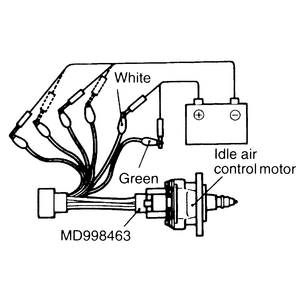
  1. Unplug the idle air control motor connector and fasten the test harness (Mitsubishi tool MD998463).
  2. Measure the resistance between terminal 2 (white clip on test harness) of the connector at the idle air control motor side and terminal 1 (red clip) or terminal 3 (blue clip). The resistance should be 28–33 ohms at 68°F (20°C).
  3. Measure the resistance between terminal 5 (green clip) of the connector at the idle air control motor side and terminal 6 (yellow clip) or terminal 4 (black clip). The resistance should be the same as above.
  4. If the coil failed either of these tests, replace the idle air control motor.
Idle Air Control Motor
  1. Remove the throttle body. Refer to section 5 for instructions.
  2. Remove the stepper motor.
  3. Fasten the test harness to the idle air control motor harness connector.
  4. Connect the positive (+) terminal of a power source (approximately 6 V) to the white or the green clip.
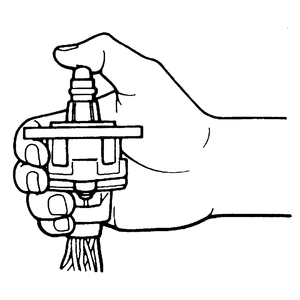
  5. While holding the idle air control motor as shown in the illustration, connect a negative (-) power source terminal to each clip in the following sequence, and check whether there is vibration of the stepper motor as a result of activation of the stepper motor.
    1. Connect the negative (-) power source terminal to the red and black clips.
    2. Connect the negative (-) power source terminal to the blue and black clips.
    3. Connect the negative (-) power source terminal to the blue and yellow clips.
    4. Connect the negative (-) power source terminal to the red and yellow clips.
    5. Connect the negative (-) power source terminal to the red and black clips.
    6. Repeat the test in the reverse (e through a) sequence.
  6. If vibration is felt as a result of this test, the stepper motor can be considered to be normal.

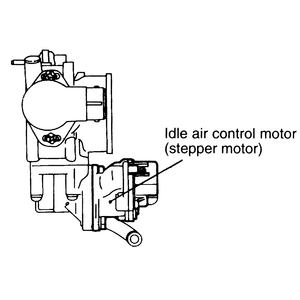
    Fig. 1: The location of the idle air control motor — 3.0L and 3.5L engines

    Fig. 2: Test the idle air control motor for vibration when the harness is connected to it — 3.0L and 3.5L engines

    Fig. 3: Use Mitsubishi tool MD998463 to test the idle air control motor — 3.0L and 3.5L engines

Previous Next