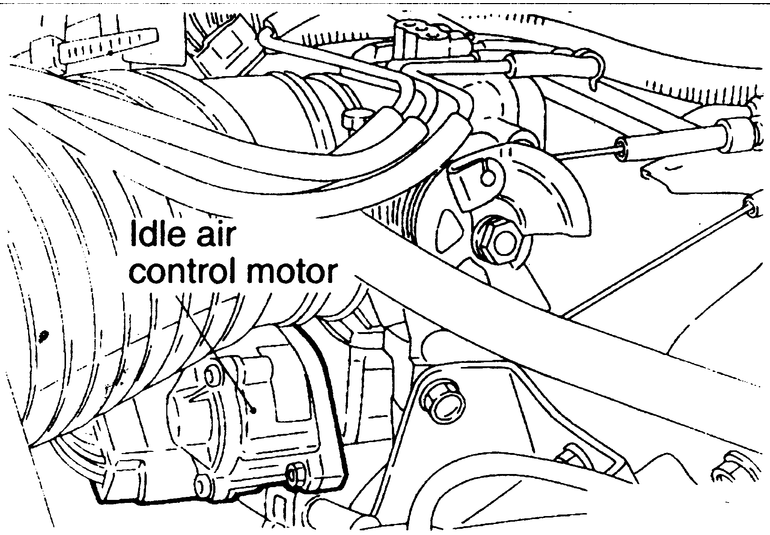
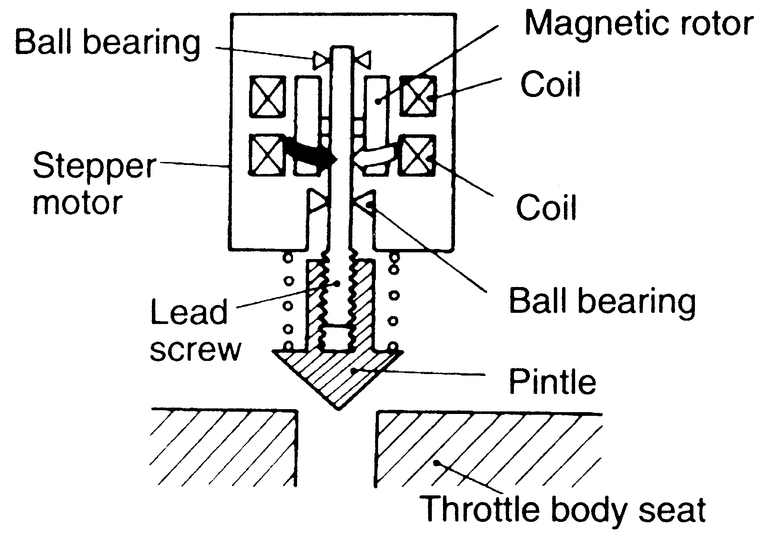
The amount of air taken in during idling is regulated by the opening and closing of the servo valve located in the air passage that bypasses the throttle valve. The servo valve is opened or closed by the activation of the stepper motor (incorporated within the idle air control motor) in the forward or reverse (clockwise or counter-clockwise) direction. Battery positive (+) voltage is supplied, by way of the MFI relay, to the coil of the stepper motor. The ECM switches the power transistors on (located within the ECM) in sequential order, and, when current floes to the stepper motor coil, the stepper motor is activated in the forward or reverse direction.
If the number of stepper motor steps increases to 100–200 steps or decreases to 0 steps, the cause is probably a malfunction of the stepper motor or damaged or disconnected wiring of the harness.
If the number of stepper motor steps is outside the standard value, even though the results of checking the harness of the idle air control motor and of the component itself indicates no abnormal condition, the cause is probably one of the following: incorrect adjustment of the standard idling speed, deposits adhering to the throttle valve, air drawn into the intake manifold from a leaking gasket, incomplete combustion inside a cylinder (malfunction of spark plugs, ignition coil, injectors, compression pressure, etc.).
| Fig. 1: The location of the idle air control motor (stepper
motor) — 3.0L and 3.5L engines
|
| Fig. 2: Internal components of the idle air control motor — 3.0L
and 3.5L engines
|