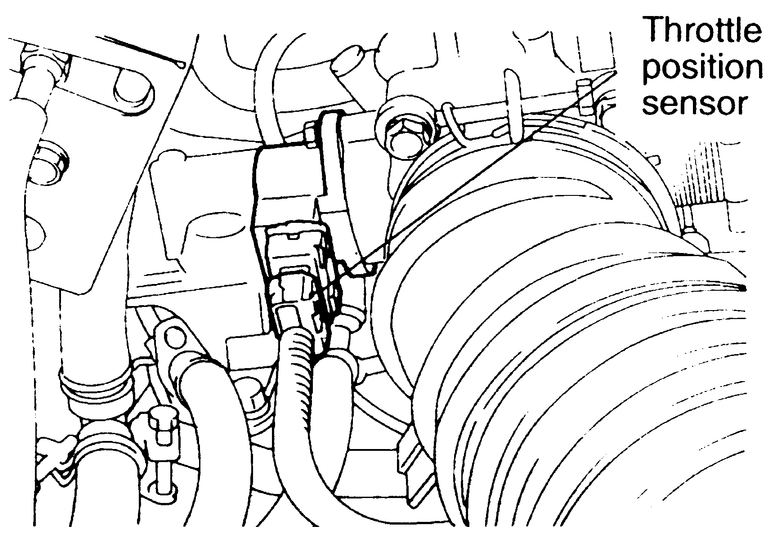
The Throttle Position Sensor (TPS), located at the entrance to the intake manifold plenum, sends voltage signals to the ECM depending on the position of the throttle. The electrical current the ECM sends into the TPS is monitored when it returns back to the ECM. Since the TPS is a resistor, the 5 volt current is changed depending on the TPS position. The further open the throttle is rotated, the greater the resistance in the TPS. Therefore, the more open the throttle, the less of the 5 volt current returns to the ECM.
| Fig. 1: The location of the TPS — all
models are similar
|
The ECM can measure this voltage and knows how far open the throttle is. It uses this knowledge to help decide how to control the other MFI system components.
The signals of the TPS are more important for control of the automatic transmission than for control of the engine; shifting "impact shocks'' are produced if there is a malfunction of the TPS.
If the voltage of the TPS deviates from the standard value, check once again after making the TPS adjustment. In addition, if there are any indications that the fixed Speed Adjusting Screw (SAS) has been moved, adjust the fixed SAS.