Raise and safely support the vehicle so that all four wheels are off of
the ground on jackstands. Keep the vehicle as close as possible to a horizontal
state.
Confirm that there is no dragging in the rear brake.
Warm up the engine.
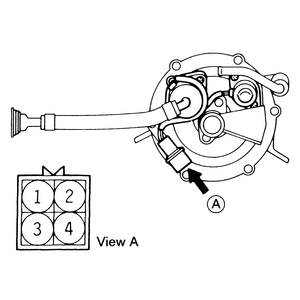
Fig. 1: Test the resistance between terminals 1 and
2, and between terminals 3 and 4 — 1992–95 Pick-ups
Keep the 4WD vehicle in the 2H condition.
Keep the engine in an idling condition. In case of a manual transmission,
put the shift lever in the 4th gear. In the case of an automatic transmission,
put the shift lever in the D range and after depressing the accelerator pedal
once, allow the engine to idle again.
While running the rear wheels, depress the brake pedal (also depress the
clutch pedal for vehicles with a manual transmission) with a force of 22–66
lbs. (100–300 N). Measure the time when the wheels have stopped running.
The standard value for normal conditions is 3–5 seconds, and while the
G-sensor is disconnected it should take less than 1 second.
If the G-sensor is connected and the wheels stop too soon or too late, the
modulator is malfunctioning. Have the modulator checked by an automotive mechanic
familiar with Mitsubishi vehicles.
Also check that the resistance value between the terminals of the electrical
connector is 4.3 ohms for terminals 1 and 2 (release valve) and 5.0 ohms for
terminals 3 and 4 (hold valve).
If any of these tests is failed, the modulator unit must be replaced with
a new unit.