Disassemble the brakes one wheel at a time. This will prevent parts confusion
and also prevent the opposite wheel cylinder pistons from popping out during
repair. While this work can be accomplished with common hand tools, there are
several specialty brake tools available in automotive parts and retail stores
which can make the job easier. The brake spring tool, in particular, is strongly
recommended.
| Fig. 1: Remove the wheel and pull the drum off of the
lug studs

|
| Fig. 2: If the drum is difficult to remove, lessen the
adjuster tension and use two bolts mounted in the holes on the face of
the drum to remove the drum

|
| Fig. 3: Tighten the bolts to push the drum off of the
lug studs — always tighten the bolts equally to prevent
the drum from cocking to one side

|
| Fig. 4: Once the drum is removed, the brake components
can be seen and identified

|
| Fig. 5: Clean the brake components with a brake cleaner
before working on the system — this will help reduce the
amount of brake dust in the air

|
| Fig. 6: Using the brake tool, remove the shoe return
spring from both brake shoes

|
| Fig. 7: Using another special brake tool (available at
most automotive stores), twist the spring retainer to unlock it from the
brake shoe's hold-down pin

|
| Fig. 8: After the pin has been loosened, remove the hold-down
spring and the two metal retaining caps

|
| Fig. 9: Remove one brake shoe and disconnect the shoe
retainer spring from the bottom of both shoes

|
| Fig. 10: Disconnect the parking brake cable from the
shoe — this is easier when the shoe has been removed from
the backing plate

|
| Fig. 11: Remove the other brake shoe using the same method
as the first — after removal, only the wheel cylinder
and the parking brake cable will remain

|
| Fig. 12: Disconnect the parking brake cable from the
backing plate and pull out through the back

|
| Fig. 13: Since the brake parts can easily be mixed up,
lay them out on a flat surface in the positions from which they were removed

|
- Raise and safely support the vehicle on jackstands.
- Remove the rear brake drums as described above.
- Using brake spring pliers, disconnect the shoe retainer spring (the bottom
spring connected to both brake shoes) and disconnect the shoe return spring
(the spring which is wrapped around the adjuster) and brake shoe adjuster.
- Remove the shoe hold-down spring on either side by first depressing slightly
and then twisting the retaining cap (there is a common brake tool that is
designed to make this almost effortless). The pins can rotate in the backing
plate, so reach around with one hand to keep the pin from spinning while twisting
the retaining caps. The tangs on the retaining post must line up with the
notches in the cap; release the cap in this way and then remove the cap, spring,
and spring seat. Remove shoe retaining spring with the pliers.
- Remove the shoe, to which the parking brake cable is not attached.
- Remove the other shoe then disconnect the parking brake cable at the shoe.
It's easier to disconnect the cable with the shoe removed from the backing
plate, but can be done otherwise if you wish.
- If the parking brake cable is to be removed entirely, you can now remove
the snapring at the backing plate and pull the end of the cable through.
- To install, first grease the surfaces of the shoe that will contact the
backing plate (this means the side edge of the shoe, NOT the friction surface),
the backing plate contact points, and the working surfaces of the anchor plate
and wheel cylinder pistons. Use a grease recommended for precisely this application
SAE J310, NLGI No. 1); not all lubricants are appropriate.
- Assemble hold down pins and springs and install the parking brake cable
to the shoe. Install the shoe and secure the spring pin with the push-and-twist
motion. (This can become a three-handed job; an assistant may be required.).
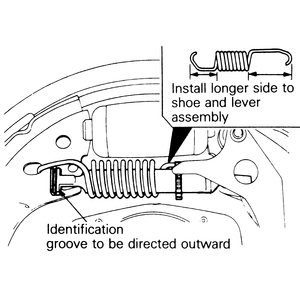
| Fig. 14: Install the shoe return spring so that the
long side of the spring is mounted to the lever assembly shoe
|
- Install the other shoe and secure it.
- Install the adjusting mechanism and springs, making sure the springs are
in the correct position. It is quite possible to install the springs backwards;
this will cause impaired function and noise. When installing the shoe retainer
spring and the shoe return spring, screw the adjuster in to its narrowest
setting. To correctly install the shoe return spring and adjuster, follow
this procedure:
- Install the right-hand thread brake adjuster to the left-hand side brake,
and the left-hand thread brake adjuster to the right-hand side brake.
- Install the brake shoe adjuster, so that the identification grooves
face outward.
- Attach the longer end of the shoe return spring to the shoe and lever
assembly.
- Turn the brake shoe adjuster to adjust the outside diameter of the brake
shoe assembly.
NOTE: The adjuster on Montero and Pick-up has an identification
groove on the non-forked end. This groove must face outward at installation.
- Double check the placement and installation of all components. Everything
must be accurately placed and securely fastened.
- Use the adjuster to set the brakes to the correct diameter. Use an accurate
measuring device to measure the outer diameter of the brake shoes. This measurement
must be set correctly; otherwise either the drum will not go over the shoes
or the adjustment will be too loose. Correct measurements are:
- Montero: 9.96–25.30–25.35cm
- Pick-up, 2WD 1983–86: 24.00–24.05cm
- Pick-up, all others: 25.30–25.35cm
- Install the brake drum as described above.
- Install the wheels. Make sure you depress the brake pedal repeatedly to
fully adjust the self-adjusters before operating the vehicle. Operate the
vehicle at very low speed in both forward and reverse gears, pumping the brake
pedal repeatedly. Bring the vehicle to a full stop and operate the parking
brake several times. Pedal feel should be normal, but the vehicle should roll
freely (with no drag) when the pedal is released. If any condition is abnormal,
the brake adjustment and/or components must be investigated and corrected.

