FUEL
INJECTION CONTROL
FUEL INJECTION AMOUNT CONTROL
Based on the signals provided by various sensors, the engine-ECU calculates the optimal
fuel injection amount that suits the operating conditions. Then, it controls the fuel injection
amount by actuating the solenoid valves of the injectors located at the cylinders.
System Configuration Diagram
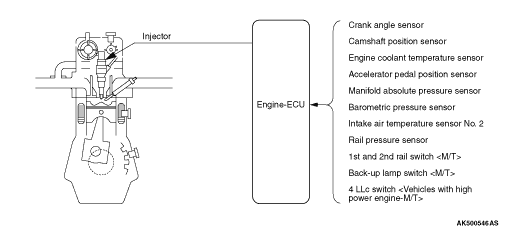
The engine-ECU compares the basic fuel injection amount against the maximum fuel injection amount.
Then, it uses the lower injection amount to calculate the intended injection amount, which is achieved
by controlling the actuation time of the solenoid valves in the injectors. The longer the actuation
time of the solenoid valves, the greater will be the injection amount. Conversely, the shorter
the actuation time of the solenoid valves, the lesser will be the injection amount.
Basic fuel injection amount:
Calculated based on the signals provided by the accelerator pedal position sensor and
the crank angle sensor.
Maximum fuel injection amount:
Calculated by applying corrections based on various sensors to the basic fuel injection
amount.
DRIVE TRAIN SYSTEM PROTECTION CONTROL
This control protects the drive train from extreme loads at the start by controlling
the engine speed under the predetermined speed of 3,000 r/min.
The engine-ECU controls the fuel injection amount at the following the conditions.
- The transmission shift: first or reverse
- The vehicle speed: 5 km/h or lower
LEARNING PRE-INJECTION AMOUNT
The engine-ECU determines the variances in the fuel injection amount by monitoring the
engine speed. Based on the changes in engine speed, the engine-ECU regulates the actual injection
amount for each cylinder by correcting their fuel injection amount command values. The engine-ECU
stores the correction values in its memory in the form of learning values.
The engine-ECU keeps the learning values stored in its memory until it is updated with subsequent
learning values.
The system learns the injection amount with a higher injection pressure than normal.
Although the sound of the engine changes while the system is learning the injection amount,
this is normal.
The system learns the injection amount automatically, or can be forced to learn through
the use of an M.U.T.-III.
FUEL INJECTION TIMING CONTROL
Based on the signals provided by various sensors, the engine-ECU calculates the optimal
fuel injection timing that suits the operating conditions. Then, it controls the fuel injection
timing by actuating the injectors.
In addition, the engine-ECU performs pilot injection, which injects fuel preceding the
main injection, for the purpose of reducing the generation of combustion sound and NOx emissions.
System Configuration Diagram
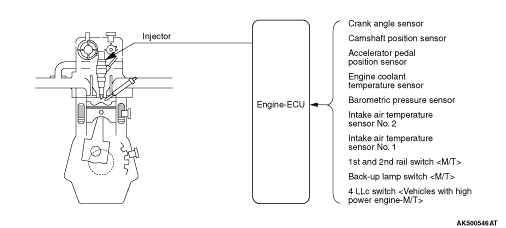
Based on the signals input by various sensors, the engine-ECU calculates the fuel injection timing
by applying corrections to a predetermined basic target fuel injection timing. Thus, it controls
the injection timing by controlling the actuation timing of the injectors.
Basic target fuel injection timing:
Calculated based on the crank angle sensor signal and the fuel injection amount.
The system advances the actuation timing of the injectors to advance the injection timing,
and retards the actuation timing of the injectors to retard the injection timing.
The ignition becomes retarded only during the main injection, thus increasing the amount
of fuel that is injected from the start of injection until the fuel is ignited. For this reason,
the combustion of the fuel occurs suddenly at a high temperature and pressure. This increases
the combustion sound and the amount of NOx that is emitted.
With the combination of pilot injection and main injection, the pilot injection that injects
a small amount of fuel preceding the main injection makes the combustion constant, thus reducing
the combustion sound and the amount of NOx that is emitted.
)
)