Code No. C101C
Abnormality in FR wheel speed sensor signal
|
|
| caution |
If there is any problem in
the CAN bus lines, an incorrect diagnosis code may be set. Prior to this diagnosis, diagnose
the CAN bus lines (Refer to GROUP 54C - CAN Bus Diagnostics Table  ). ).
|
|
|
|
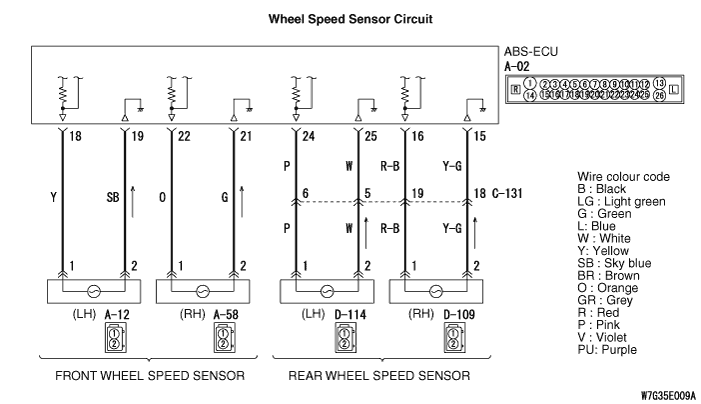
- The wheel speed sensor is a kind of a pulse generator.
It consists of encoders (a plate on which north and south pole sides of the magnets are arranged
alternately) for detecting the wheel speed which rotates at the same speed of the wheels and
wheel speed sensors. This sensor outputs frequency pulse signals in proportion to the wheel
speed.
- The pulse signals, which the wheel speed sensor creates, are sent to ABS-ECU. ABS-ECU
uses the frequency of the pulse signals to determine the wheel speed.
|
|
|
DIAGNOSIS CODE SET CONDITIONS
|
|
|
ABS-ECU monitors the signals from each wheel speed sensor while the vehicle is being driven.
If any fault below is found in these sensor signals, ABS-ECU will set the relevant diagnosis code.
|
|
|
- Irregular change in the wheel speed sensor signal
- Wheel speed sensor signal continuously indicates high value.
|
|
|
Current trouble
- Excessive gap between the wheel speed sensor and the wheel speed detection encoder
- Adhesion of foreign materials on the wheel speed sensor
- Adhesion of foreign materials on the wheel speed detection encoder
- Wheel bearing malfunction
- Malfunction of wheel speed sensor
- Damaged wiring harness and connectors
- External noise interference
- Improper installation of the wheel speed sensor
- Deformation of the wheel speed detection encoder
- ABS-ECU malfunction
- Disturbance of magnetisation pattern for wheel speed detection encoder
- The number of poles on the magnetic encoder for wheel speed detection (the number
of N-pole and S-pole) is changed.
|
|
|
Past trouble
- When the diagnosis code No. C1015 is also set, carry out diagnosis
with particular emphasis on wiring harness and connector failures between ABS-ECU and the wheel
speed sensor. For diagnosis procedures, refer to How to treat past trouble (GROUP 00 - How
to Use Troubleshooting/How to Treat Past Trouble ).
- When diagnosis code No. C1015 is not set, the following conditions
may be present:
- Right or/and left wheels are rotated.
- Unstable vehicle attitude
- External noise interference
- Vehicle ran with the parking brake applied.
|
|
|
STEP 1. M.U.T.-III CAN bus diagnosis
|
|
|
Use M.U.T.-III to diagnose the CAN bus lines.
|
|
|
Q.
Is the check result normal?
|
|
|
 Go to Step 3. Go to Step 3.
|
|
|
|
|
|
 Repair the CAN bus lines (Refer to GROUP 54C - CAN Bus Diagnostics Table ).
On completion, go to Step 2. Repair the CAN bus lines (Refer to GROUP 54C - CAN Bus Diagnostics Table ).
On completion, go to Step 2.
|
|
|
|
|
|
STEP 2. Diagnosis code recheck after resetting CAN bus lines
|
|
|
Q.
Is the diagnosis code No.C101C set?
|
|
|
Go to Step 3.
|
|
|
|
|
|
This diagnosis is complete.
|
|
|
|
|
|
STEP 3. M.U.T.-III diagnosis code
|
|
|
Check that the diagnosis code No.C1015 is also set.
|
|
|
Q.
Is the diagnosis code No.C1015 also set?
|
|
|
Perform the diagnosis for the diagnosis code No.C1015 (Refer to ).
|
|
|
|
|
|
Go to Step 4.
|
|
|
|
|
|
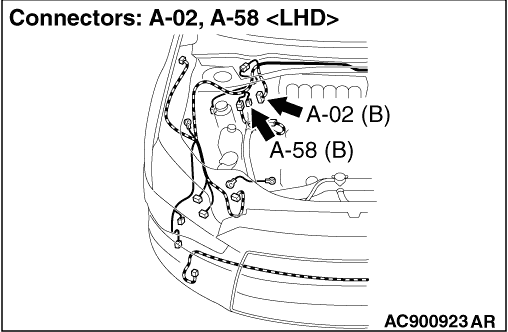
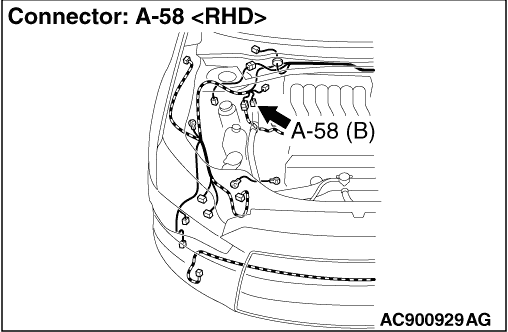
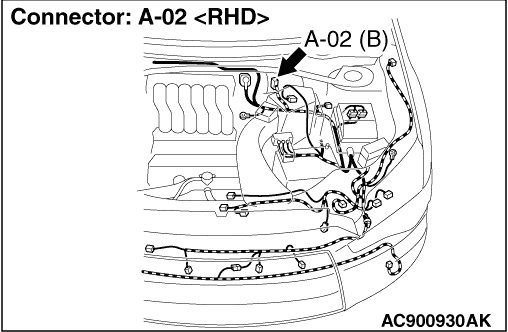
STEP 4. Connector check: A-02 ABS-ECU connector, A-58 front wheel
speed sensor <RH> connector
|
|
|
Q.
Is the check result normal?
|
|
|
Go to Step 5.
|
|
|
|
|
|
Repair the defective connector. Then go to Step 12.
|
|
|
|
|
|
STEP 5. Wiring harness check between A-02 ABS-ECU connector terminal
No.22 and A-58 front wheel speed sensor <RH> connector terminal No.1, and between
A-02 ABS-ECU connector terminal No.21 and A-58 front wheel speed sensor <RH> connector terminal
No.2
|
|
|
Q.
Is the check result normal?
|
|
|
Go to Step 6.
|
|
|
|
|
|
Repair the wiring harness. Then go to Step 12.
|
|
|
|
|
|
STEP 6. Check for wheel speed sensor <FR> installation
|
|
|
Check how the wheel speed sensor <FR> is installed (Disconnection of
wheel speed sensor <FR>, loose mounting bolt, etc.).
|
|
|
Q.
Is the check result normal?
|
|
|
Go to Step 7.
|
|
|
|
|
|
Reinstall the wheel speed sensor <FR> correctly (Refer to ).
Then go to Step 7.
|
|
|
|
|
|
STEP 7. Check for wheel speed sensor <FR> output
current
|
|
|
Refer to .
|
|
|
Q.
Is the check result normal?
|
|
|
Go to Step 8.
|
|
|
|
|
|
Replace the wheel speed sensor <FR> (Refer to ). Then
go to Step 11.
|
|
|
|
|
|
STEP 8. Check for wheel bearing looseness
|
|
|
| note |
Loose wheel bearing may increase the gap between the wheel speed sensor <FR> and
the wheel speed detection magnet encoder. Check the wheel bearing <FR> for
looseness. (Refer to GROUP 26 - Wheel Bearing Axial Play Check .)
|
|
|
|
Q.
Is the check result normal?
|
|
|
Go to Step 9.
|
|
|
|
|
|
Replace the wheel bearing <FR> (Refer to GROUP 26 - Front
Axle Hub Assembly ). Then go to Step 12.
|
|
|
|
|
|
STEP 9. Check of wheel speed detection encoder
|
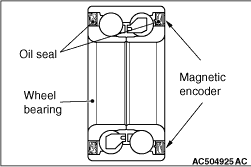
|
Check the encoder for adhesion of foreign materials or deformation.
Q.
Is the check result normal?
Go to Step 10.
NO (Adhesion of foreign materials) : Remove the foreign materials and clean the encoder so as not to disturb the magnetization
pattern on it while taking care of the magnet, magnetic substance, and magnetic attraction.
Then go to Step 12. : Remove the foreign materials and clean the encoder so as not to disturb the magnetization
pattern on it while taking care of the magnet, magnetic substance, and magnetic attraction.
Then go to Step 12.
NO (Deformation) : Replace the wheel bearing <FR> (Refer to GROUP 26 - Front
Axle Hub Assembly ). Then go to Step 12.
|
|
|
STEP 10. Check whether the diagnosis code is reset.
|
|
|
(1)Erase the diagnosis code.
|
|
|
(2)Drive the vehicle at 20 km/h or higher.
| note |
The ABS warning lamp does not turn OFF in some cases unless the vehicle runs at 20 km/h
or higher.
|
|
|
|
Q.
Is the diagnosis code No.C101C set?
|
|
|
Replace the wheel speed sensor <FR> (Refer to ).
Then go to Step 11.
|
|
|
|
|
|
Intermittent malfunction (Refer to GROUP 00 - How to Use Troubleshooting/How
to Cope with Intermittent Malfunctions ).
|
|
|
|
|
|
STEP 11. Check whether the diagnosis code is reset.
|
|
|
(1)Erase the diagnosis code.
|
|
|
(2)Drive the vehicle at 20 km/h or higher.
| note |
The ABS warning lamp does not turn OFF in some cases unless the vehicle runs at 20 km/h
or higher.
|
|
|
|
Q.
Is the diagnosis code No.C101C set?
|
|
|
Replace the hydraulic unit (integrated with ABS-ECU) (Refer to ).
Then go to Step 12.
|
|
|
|
|
|
This diagnosis is complete.
|
|
|
|
|
|
STEP 12. Check whether the diagnosis code is reset.
|
|
|
(1)Erase the diagnosis code.
|
|
|
(2)Drive the vehicle at 20 km/h or higher.
| note |
The ABS warning lamp does not turn OFF in some cases unless the vehicle runs at 20 km/h
or higher.
|
|
|
|
Q.
Is the diagnosis code No.C101C set?
|
|
|
Return to Step 1.
|
|
|
|
|
|
This diagnosis is complete.
|
|
|
|
)
)
)
)
)