DIAGNOSIS SYSTEM (LOW TIRE PRESSURE WARNING CONTROL UNIT)
Diagnosis Description
 Description
During driving, the transmitter installed at each road wheel transmits the tire pressure information signal to the receiver. The receiver receives the tire pressure signal and transmits it to the low tire pressure warning control unit. The low tire pressure warning control unit judges whether or not the tire pressure is OK based on the tire pressure information signal, and if it judges that the tire pressure is low, it transmits the information via CAN communication to the BCM.
After receiving the tire pressure malfunction information via CAN communication, the BCM transmits the tire pressure malfunction information via CAN communication to the combination meter.
After receiving the tire pressure information via CAN communication from the BCM, the combination meter illuminates the low tire pressure warning lamp and displays a message on the vehicle information display in order to warn the driver.
Self-diagnosis procedure- Initiate diagnosis mode by short-circuiting the low tire pressure warning check switch to the ground.
- The blinking pattern of the low tire pressure warning lamp indicates the conditions of the malfunction.
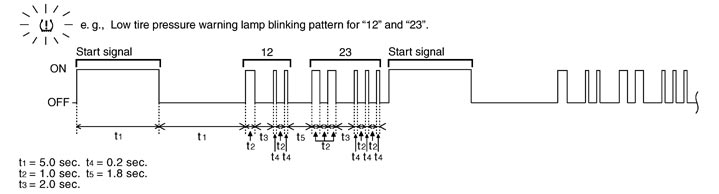
NOTE:
If the low tire pressure warning lamp is blinking repeatedly at 5 Hz, there is no malfunction occurring in the system.
|
ON Pattern |
Items |
Condition |
Check items |
|
6 |
Flat tire (Front LH) |
Front left wheel pressure is 70 kPa (0.7 kg/cm2, 10 psi) or less |
Diagnosis Procedure (GT-R certified NISSAN dealer)
|
|
7 |
Flat tire (Front RH) |
Front right wheel pressure is 70 kPa (0.7 kg/cm2, 10 psi) or less |
|
|
8 |
Flat tire (Rear RH) |
Rear right wheel pressure is 70 kPa (0.7 kg/cm2, 10 psi) or less |
|
|
9 |
Flat tire (Rear LH) |
Rear left wheel pressure is 70 kPa (0.7 kg/cm2, 10 psi) or less |
|
|
15 |
Low tire pressure (Front LH) |
Front left wheel pressure is or less 150 kPa (1.5 kg/cm2, 22 psi) |
Diagnosis Procedure (GT-R certified NISSAN dealer)
|
|
16 |
Low tire pressure (Front RH) |
Front right wheel pressure is or less 150 kPa (1.5 kg/cm2, 22 psi) |
|
|
17 |
Low tire pressure (Rear RH) |
Rear right wheel pressure is or less 150 kPa (1.5 kg/cm2, 22 psi) |
|
|
18 |
Low tire pressure (Rear LH) |
Rear left wheel pressure is or less 150 kPa (1.5 kg/cm2, 22 psi) |
|
|
21 |
Transmitter no data (Front LH) |
Tire pressure data signal from the front left wheel transmitter cannot be detected. |
Diagnosis Procedure (GT-R certified NISSAN dealer)
|
|
22 |
Transmitter no data (Front RH) |
Tire pressure data signal from the front right wheel transmitter cannot be detected. |
|
|
23 |
Transmitter no data (Rear RH) |
Tire pressure data signal from the rear right wheel transmitter cannot be detected. |
|
|
24 |
Transmitter no data (Rear LH) |
Tire pressure data signal from the rear left wheel transmitter cannot be detected. |
|
|
35 |
Transmitter pressure data error (Front left wheel) |
Malfunction in the tire pressure data from the front left wheel transmitter. |
Diagnosis Procedure (GT-R certified NISSAN dealer)
|
|
36 |
Transmitter pressure data error (Front right wheel) |
Malfunction in the tire pressure data from the front right wheel transmitter. |
|
|
37 |
Transmitter pressure data error (Rear right wheel) |
Malfunction in the tire pressure data from the rear right wheel transmitter. |
|
|
38 |
Transmitter pressure data error (Rear left wheel) |
Malfunction in the tire pressure data from the rear left wheel transmitter. |
|
|
41 |
Transmitter function code error (front left wheel) |
The function code data from the front left wheel transmitter is malfunction. |
Diagnosis Procedure (GT-R certified NISSAN dealer)
|
|
42 |
Transmitter function code error (front right wheel) |
The function code data from the front right wheel transmitter is malfunction. |
|
|
43 |
Transmitter function code error (rear right wheel) |
The function code data from the rear right wheel transmitter is malfunction. |
|
|
44 |
Transmitter function code error (rear left wheel) |
The function code data from the rear left wheel transmitter is malfunction. |
|
|
51 |
Receiver ID registration not completed. |
Receiver ID registration cannot be performed. |
Diagnosis Procedure (GT-R certified NISSAN dealer)
|
|
52 |
Vehicle speed signal malfunction |
Vehicle speed signal not detected. |
Diagnosis Procedure (GT-R certified NISSAN dealer)
|
|
54 |
EEPROM read error |
Tire Pressure Monitoring System (TPMS) malfunction in the low tire pressure warning control unit occurs |
Diagnosis Procedure (GT-R certified NISSAN dealer)
|
|
55 |
Low communication performance (front left wheel) |
The data signal from the front left wheel transmitter cannot be detected due to external electromagnetic interference. (DTC C1708 is displayed at the same time.) |
Diagnosis Procedure (GT-R certified NISSAN dealer)
|
|
56 |
Low communication performance (front right wheel) |
The data signal from the front right wheel transmitter cannot be detected due to external electromagnetic interference. (DTC C1709 is displayed at the same time.) |
|
|
57 |
Low communication performance (Rear right wheel) |
The data signal from the rear right wheel transmitter cannot be detected due to external electromagnetic interference. (DTC C1710 is displayed at the same time.) |
|
|
58 |
Low communication performance (rear left wheel) |
The data signal from the rear left wheel transmitter cannot be detected due to external electromagnetic interference. (DTC C1711 is displayed at the same time.) |
|
|
Off |
CAN communication circuit |
Malfunction in the CAN communication of the low tire pressure warning control unit. |
Diagnosis Procedure (GT-R certified NISSAN dealer), Diagnosis Procedure (GT-R certified NISSAN dealer) |
Erase the self-diagnosis history.After performing self-diagnosis by short-circuiting the tire pressure warning check switch to the body, turn the ignition switch OFF.
CONSULT-III Function
FUNCTIONThe diagnosis functions (main functions) include the following: “WORK SUPPORT”, “SELF DIAGNOSTIC RESULT”, “DATA MONITOR”, “ACTIVE TEST”, and “ECU IDENTIFICATION”.
| Diagnostic test mode | Function |
| Work support | In this mode, it is possible to make quick and accurate adjustments by following the instructions on the CONSULT-III display. |
| Self diagnostic result | Receives self-diagnosis results from the low tire pressure warning control unit, and indicates DTCs and the number of malfunctions. |
| Data monitor | Receives input/output signals from the low tire pressure warning control unit and indicates and stores them to facilitate locating the causes of malfunctions. |
| Active test | Transmits command to the low tire pressure warning control unit to change output signals and check operation of output system. |
| ECU Identification | Displays the part number of the low tire pressure warning control unit. |
WORK SUPPORT SELF-DIAGNOSTIC RESULTOperation Procedure
Before starting self-diagnosis, start the engine and drive the vehicle at the speed more than 40 km/h (25 MPH) or more.
Display Item List
Refer to DTC Index.
DATA MONITORDisplay Item List
| Monitor item (Unit) | Remarks |
| VHCL SPEED SE (km/h) or (MPH) | Vehicle speed |
| AIR PRESS FL (kPa) or (Psi) | Internal pressure of tires |
| AIR PRESS FR (kPa) or (Psi) | |
| AIR PRESS RR (kPa) or (Psi) | |
| AIR PRESS RL (kPa) or (Psi) | |
| ID REGIST FL1 | ID is registered: Done ID is not registered: Yet |
| ID REGIST FR1 | |
| ID REGIST RR1 | |
| ID REGIST RL1 | |
| WARNING LAMP | Low tire pressure warning lamp ON: On |
| Low tire pressure warning lamp OFF: Off | |
| BUZZER | Combination meter buzzer ON: On |
| Combination meter buzzer OFF: Off |
ACTIVE TESTAfter completing the work below, perform an active test.
- Before performing self-diagnosis, register the transmitter IDs.
- Erase the self-diagnosis result history.
Test item list
| Test item | Condition | Details |
| BUZZER | Vehicle stopped | Check that the buzzer operates correctly. |
| WARNING LAMP | The system is normal | Perform a test to check that the low tire pressure warning lamp illuminates correctly. |
ECU IDENTIFICATIONLow tire pressure warning control unit part number can be read.