REFRIGERATION SYSTEM
System Diagram
System Description
 REFRIGERANT CYCLE
 Refrigerant Flow
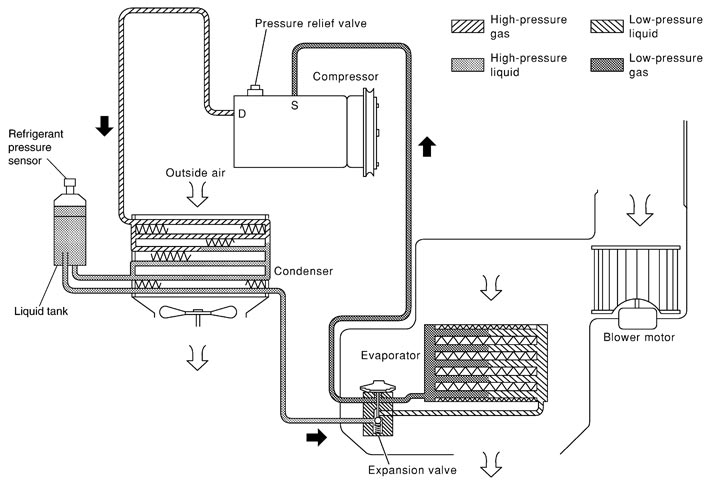
The refrigerant flows from the compressor, through the condenser with liquid tank, through the evaporator, and back to the compressor. The refrigerant evaporation in the evaporator is controlled by an externally equalized expansion valve, located inside the evaporator case.
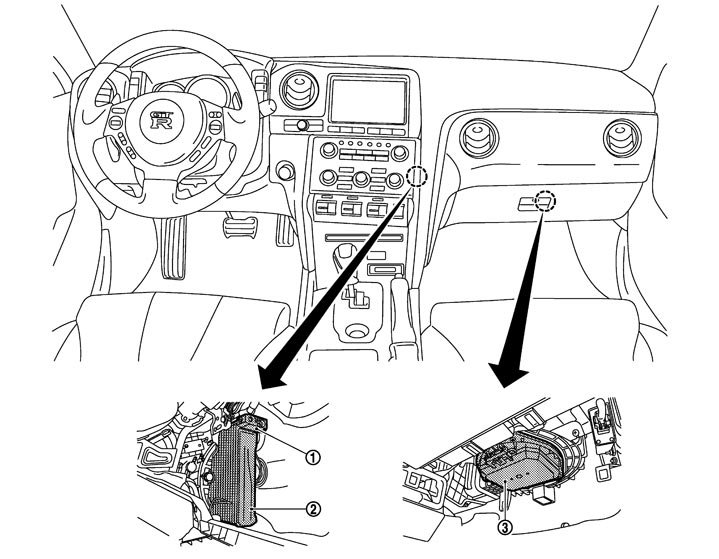
Freeze ProtectionTo prevent evaporator from freezing up, the evaporator air temperature is monitored, and the voltage signal to the A/C auto amp. makes the A/C relay go OFF and stop the compressor.
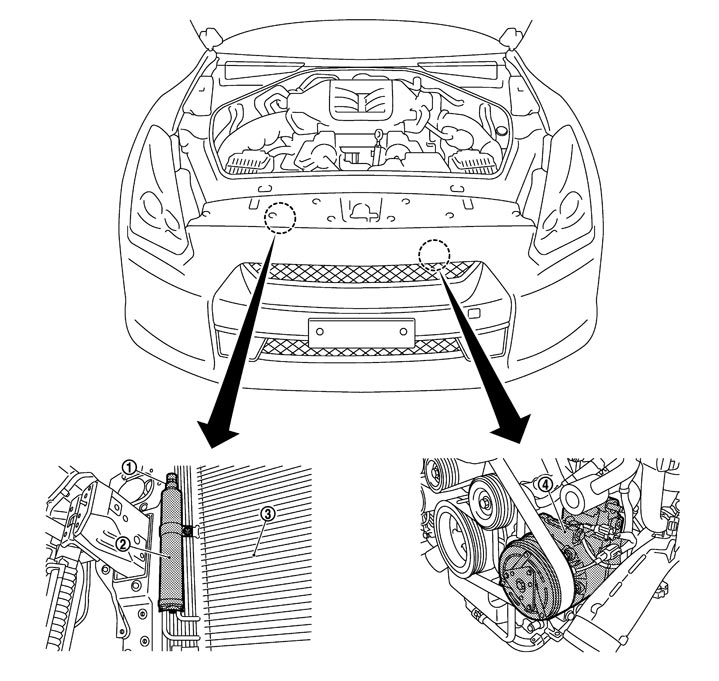
REFRIGERANT SYSTEM PROTECTION Refrigerant Pressure SensorThe refrigerant system is protected against excessively high‐ or low‐pressures by the refrigerant pressure sensor, located on the liquid tank. The refrigerant pressure sensor detects the pressure inside the refrigerant line and sends the voltage signal to the ECM if the system pressure rises above, or falls below the specifications.
The high‐pressure side detected by refrigerant pressure sensor is approximately 3,120 kPa (31.8 kg/cm2, 452 psi) or more when the engine speed is 1,500 rpm or more. It is approximately 2,740 kPa (27.9 kg/cm2, 397 psi) when the engine speed is less than 1,500 rpm. When it is approximately 120 kPa (1.2 kg/cm2, 17 psi) or less, ECM turns the A/C relay to OFF and stops the compressor.
Pressure Relief ValveThe refrigerant system is also protected by a pressure relief valve, located in the rear head of the compressor. The release port on the pressure relief valve automatically opens and releases refrigerant into the atmosphere when the pressure of refrigerant in the system increases to an unusual level [more than 3,628 kPa (37 kg/cm2, 526 psi)].
Component Parts Location
Component Description
|
Component |
Description |
|
Compressor |
Intakes, compresses, and discharges refrigerant, to circulate refrigerant inside the refrigerant cycle. |
|
Condenser |
Cools refrigerant discharged from compressor, and transforms it to liquid refrigerant. |
|
Liquid tank |
Eliminates foreign matter in refrigerant, and stores temporarily liquid refrigerant. |
|
Refrigerant pressure sensor |
Refer to Description (GT-R certified NISSAN dealer). |
|
Expansion valve |
Transforms high‐pressure liquid refrigerant to mist form low‐pressure liquid refrigerant by drawing function. |
|
Evaporator |
The mist form liquid refrigerant transforms to gas by evaporation by the air conveyed from blower motor. The air is cooled by the heat by evaporation. |
|
Blower motor |
Takes in air in the vehicle or fresh outside air, provides it forcedly to the air conditioner, and conveys it inside the vehicle. |