LUBRICANT
- Description
- Adjustment
- Lubricant Adjusting Procedure for Components Replacement Except Compressor
- Lubricant Adjusting Procedure for Compressor Replacement
Description
 MAINTENANCE OF LUBRICANT QUANTITY
The lubricant in the compressor circulates through the system with the refrigerant. Add lubricant to compressor when replacing any component or after a large refrigerant leakage occurred. It is important to maintain the specified amount.
The following malfunctions may result if lubricant quantity is not maintained normally:
- Lack of lubricant: May lead to a seized compressor.
- Excessive lubricant: Inadequate cooling (thermal exchange interference)
LUBRICANT|
Name |
: NISSAN A/C System Oil Type S |
Adjustment
 1.CHECK A/C SYSTEM
Lubricant Adjusting Procedure for Components Replacement Except Compressor
Add the correct amount of lubricant to the system after replacing any of the following major components.
Amount of lubricant to be added:
| Replaced part | Lubricant to be added to system | Remarks |
| Amount of lubricant m  (US fl oz., Imp fl oz.) (US fl oz., Imp fl oz.) | ||
| Evaporator | 75 (2.5, 2.6) | — |
| Condenser | 35 (1.2, 1.2) | — |
| Liquid tank | 10 (0.3, 0.4) | — |
| In case of refrigerant leakage | 30 (1.0, 1.1) | Large leakage |
| — | Small leakage *1 |
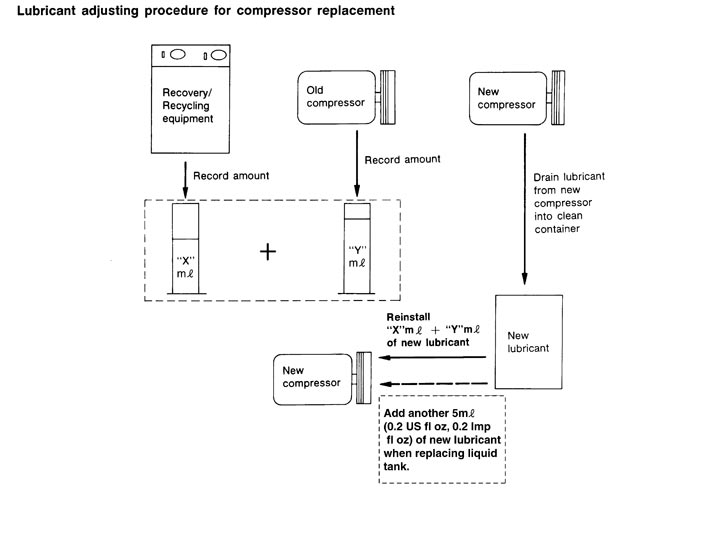
Lubricant Adjusting Procedure for Compressor Replacement
- 1.Check recovery/recycling recharging equipment gauges before connecting recovery/recycling recharging equipment to vehicle. No refrigerant pressure should be displayed. Recover refrigerant from equipment lines if NG.
- 2.Connect recovery/recycling recharging equipment to vehicle. Confirm refrigerant purity in supply tank using recovery/recycling recharging equipment and refrigerant identifier. Refer to Working with HFC-134a (R-134a) if NG.
- 3.Confirm refrigerant purity in vehicle A/C system using recovery/recycling recharging equipment and refrigerant identifier. If NG, refer to Working with HFC-134a (R-134a).
- 4.Discharge refrigerant into the recovery/recycling recharging equipment. Measure lubricant discharged into the recovery/recycling recharging equipment.
- 5.Drain the lubricant from the old (removed) compressor into a graduated container and recover the amount of lubricant drained.
- 6.Drain the lubricant from the new compressor into a separate. Then clean container.
- 7.Measure an amount of new lubricant installed equal to amount drained from old compressor. Add this lubricant to new compressor through the suction port opening.
- 8.Measure an amount of new lubricant equal to the amount recovered during discharging. Add this lubricant to new compressor through the suction port opening.
- 9.Add another 5 m
(0.2 US fl oz., 0.2 Imp fl oz.) of lubricant at this time if the liquid tank also needs to be replaced.Do not add this 5 m (0.2 US fl oz., 0.2 Imp fl oz.) of lubricant when replacing the compressor only.