PRECAUTIONS
- Precaution for Supplemental Restraint System (SRS) "AIR BAG" and "SEAT BELT PRE-TENSIONER"
- Precaution Necessary for Steering Wheel Rotation after Battery Disconnect
- Precaution for Procedure without Cowl Top Cover
- General Precautions
- Precaution for Brake System
Precaution for Supplemental Restraint System (SRS) "AIR BAG" and "SEAT BELT PRE-TENSIONER"
The Supplemental Restraint System such as “AIR BAG” and “SEAT BELT PRE-TENSIONER”, used along with a front seat belt, helps to reduce the risk or severity of injury to the driver and front passenger for certain types of collision. This system includes seat belt switch inputs and dual stage front air bag modules. The SRS system uses the seat belt switches to determine the front air bag deployment, and may only deploy one front air bag, depending on the severity of a collision and whether the front occupants are belted or unbelted.
Information necessary to service the system safely is included in the “SRS AIRBAG” and “SEAT BELT” of this Service Manual.
■ WARNING ■
- To avoid rendering the SRS inoperative, which could increase the risk of personal injury or death in the event of a collision which would result in air bag inflation, all maintenance must be performed by an authorized NISSAN/INFINITI dealer.
- Improper maintenance, including incorrect removal and installation of the SRS, can lead to personal injury caused by unintentional activation of the system. For removal of Spiral Cable and Air Bag Module, see the “SRS AIRBAG”.
- Never use electrical test equipment on any circuit related to the SRS unless instructed to in this Service Manual. SRS wiring harnesses can be identified by yellow and/or orange harnesses or harness connectors.
Precaution Necessary for Steering Wheel Rotation after Battery Disconnect
NOTE:
- Before removing and installing any control units, first turn the push-button ignition switch to the LOCK position, then disconnect both battery cables.
- After finishing work, confirm that all control unit connectors are connected properly, then re-connect both battery cables.
- Always use CONSULT-III to perform self-diagnosis as a part of each function inspection after finishing work. If a DTC is detected, perform trouble diagnosis according to self-diagnosis results.
This vehicle is equipped with a push-button ignition switch and a steering lock unit.
If the battery is disconnected or discharged, the steering wheel will lock and cannot be turned.
If turning the steering wheel is required with the battery disconnected or discharged, follow the procedure below before starting the repair operation.
 OPERATION PROCEDURE
- 1.Connect both battery cables.
NOTE:
Supply power using jumper cables if battery is discharged.- 2.Turn the push-button ignition switch to ACC position.(At this time, the steering lock will be released.)
- 3.Disconnect both battery cables. The steering lock will remain released with both battery cables disconnected and the steering wheel can be turned.
- 4.Perform the necessary repair operation.
- 5.When the repair work is completed, re-connect both battery cables. With the brake pedal released, turn the push-button ignition switch from ACC position to ON position, then to LOCK position. (The steering wheel will lock when the push-button ignition switch is turned to LOCK position.)
- 6.Perform self-diagnosis check of all control units using CONSULT-III.
Precaution for Procedure without Cowl Top Cover
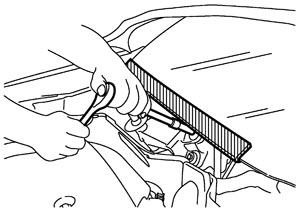
When performing the procedure after removing cowl top cover, cover the lower end of windshield with urethane, etc.
General Precautions
■ CAUTION ■
After finishing servicing, check that all the tools and waste are stored in a customary place.
Precaution for Brake System
■ WARNING ■
Clean any dust from the front brake and rear brake with a vacuum dust collector. Never blow with compressed air.
- Brake fluid use refer to Fluids and Lubricants.
- Never reuse drained brake fluid.
- Never spill or splash brake fluid on painted surfaces. Brake fluid may seriously damage paint. Wipe it out immediately and wash with water if it gets on a painted surface.
- Never scratch the flare nut and the brake caliper.
- After pressing the brake pedal more deeply or harder than normal driving, such as when air bleeding, check each item of brake pedal. Adjust brake pedal if it is outside the standard condition.
- Always clean with new brake fluid when cleaning the master cylinder, brake caliper and other components.
- Never use mineral oils such as gasoline or light oil to clean. They may damage rubber parts and cause a malfunction.
- Always loosen the brake tube flare nut with a flare nut wrench.
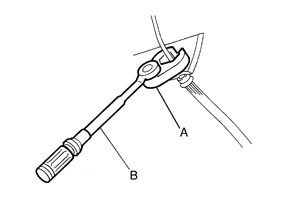
- Tighten the brake tube flare nut to the specified torque with a crowfoot (A) and torque wrench (B).
- Always confirm the specified tightening torque when installing the brake pipes.
- Turn the ignition switch OFF and disconnect the ABS actuator and electric unit (control unit) connector or the battery negative terminal before performing the work.
- Check that no brake fluid leakage is present after replacing the parts.
- Burnish the brake contact surfaces after refinishing or replacing rotors, after replacing pads, or if a soft pedal occurs at very low mileage.
- Front brake pad: refer to Inspection and Adjustment.
- Front disc rotor: refer to Inspection and Adjustment.
- Rear brake pad: refer to Inspection and Adjustment.
- Rear disc rotor: refer to Inspection and Adjustment.