The chemical reaction in a battery produces explosive hydrogen gas. This is
the safe way to jump start a dead battery, reducing the chances of an accidental
spark that could cause an explosion.
- Be sure both batteries are of the same voltage.
- Be sure both batteries are of the same polarity (have the same grounded
terminal, in most cases negative).
- Be sure the vehicles are not touching.
- Be sure that the vent cap holes are not obstructed.
- Do not smoke or allow sparks around the battery.
- In cold weather, check for frozen electrolyte in the battery.
- Do not allow electrolyte on your skin or clothing.
- Be sure the electrolyte is not frozen.
WARNING
Make sure that the ignition key, in the vehicle with the dead battery, is in
the OFF position. Connecting cables to vehicles with on-board computers may
result in computer destruction if the key is not in the OFF position.
- Determine voltage ratings of the two batteries; they must be the same.
- Bring the starting vehicle close (they must not touch) so that the batteries
can be reached easily.
- Turn OFF all accessories and both engines. Put both cars
in NEUTRAL or PARK and set the parking brake.
- Cover the cell caps with a rag — do not cover terminals.
- If the terminals on the run-down battery are heavily corroded, clean them.
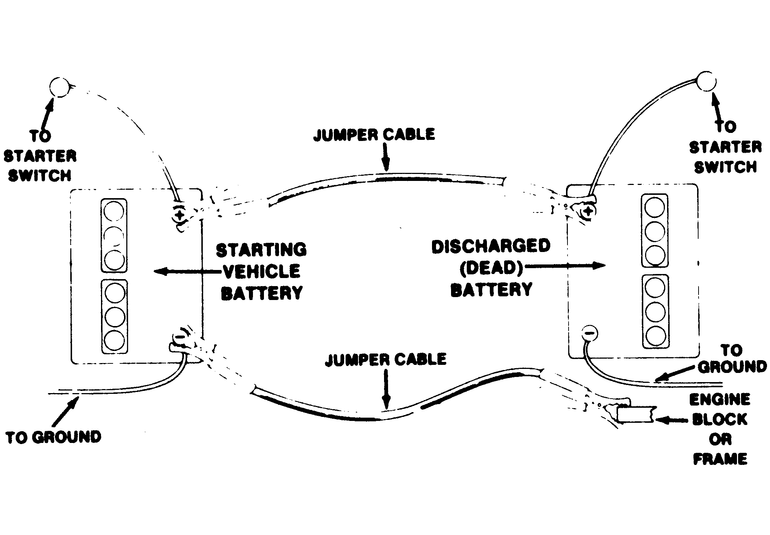
- Identify the positive and negative posts on both batteries and connect the
cables in the order shown.
- Start the engine of the starting vehicle and run it at fast idle. Try to
start the car with the dead battery. Crank it for no more than 10 seconds
at a time and let it cool off for 20 seconds in between tries.
- If it doesn't start in 3 tries, it is likely that something else is wrong.
- Disconnect the cables in the reverse order.
- Install the cell covers and dispose of the rags.
| Fig. 1: Connect the battery cables as shown
|