CAUTION
Never add coolant to a hot engine. Stop the engine and allow it to cool. Then,
start it to circulate coolant uniformly through the block and add coolant slowly
as the engine idles. Otherwise you risk cracking the block. Coolant can be added
to the radiator. NEVER REMOVE THE RADIATOR CAP UNTIL THE ENGINE HAS HAD AMPLE
TIME TO COOL TO BELOW OPERATING TEMPERATURE.
These models have a sealed cooling system with two radiators and separate thermal expansion tank.
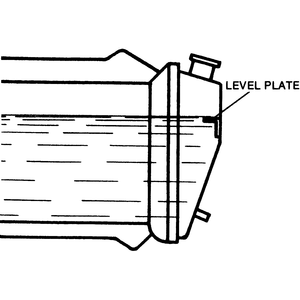
On 1300G models, it is not necessary to remove the cap to check the coolant level, because the expansion tank is translucent plastic. The coolant should be replenished if its level falls 3⁄8 in. (9.5mm) below the line molded in the side of the tank.
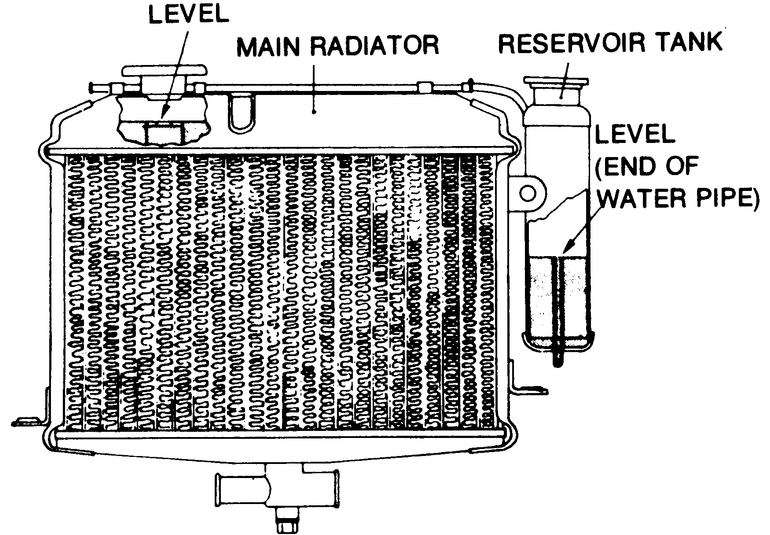
On ff-1 models, the cap must be removed from the expansion tank in order to check the coolant level which should be flush with the top of the pipe inside of the tank.
| Fig. 1: Checking the coolant level — ff-1
and 1300G models
|
If, on either model, the level in the expansion tank is lower than it should be, check the coolant level in the main radiator, as well.
CAUTION
The cap on the main radiator is not a pressure/vacuum safety cap. Never remove
it when the engine is hot. Always remove the cap on the expansion tank first,
after depressing the black button on it to release the pressure in the cooling
system.
On both models, fill the main radiator to the bottom of the filler port. On the ff-1 models, fill the expansion tank so that the water just covers the pipe inside it. On 1300G models, fill the expansion tank up to the mark on its side. Add a good brand of an anti-corrosive ethylene glycol coolant, and water, in a 50/50 mixture.
WARNING
Never add cold coolant to an engine which has overheated because of a low coolant
level. First allow the engine to cool, and then idle it while adding the fresh
coolant slowly.
These models use a conventional crossflow radiator. Check the coolant level with the engine cold. To check the coolant level:
| Fig. 2: Checking the coolant level — except
ff-1 and 1300G models
|