- Loosen, but do not remove, the brass exhaust manifold-to-cylinder head retaining
nuts.
- Remove the exhaust pipe from the manifold flange.
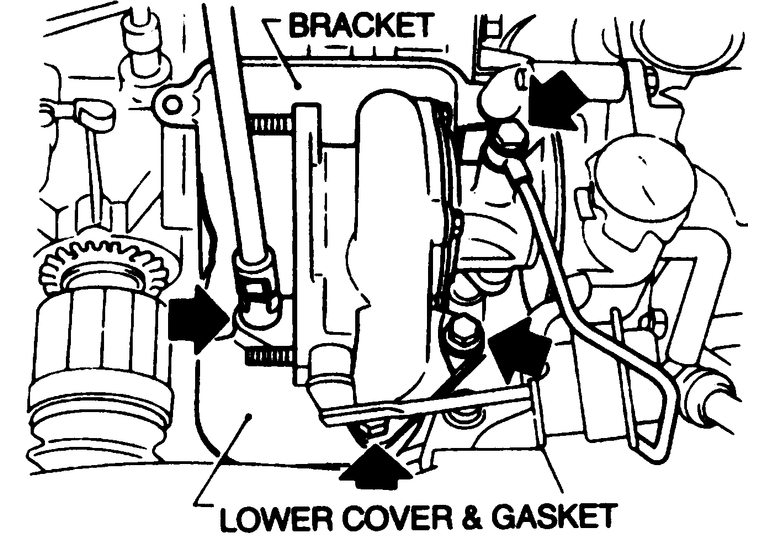
| Fig. 1: Manifold-to-cylinder head flange assembly
found on ff-1 and 1300G models
|
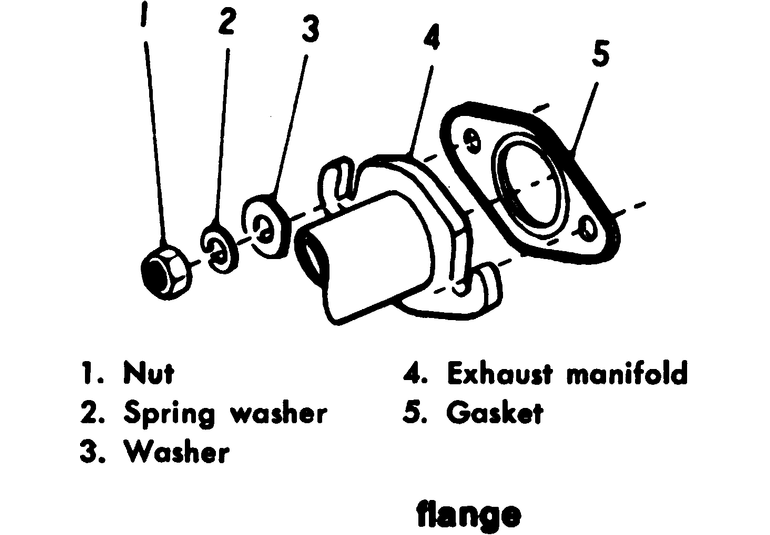
| Fig. 2: Manifold-to-exhaust pipe flange components
found on ff-1 and 1300G models
|
- Remove the band which secures the exhaust pipe to the left side of the transaxle.
- Move the manifold around until the mounting slots permit its removal.
- Pull the manifold downward, in order to remove it.
CAUTION
If the car must be raised to remove the manifolds, be sure that it is securely
supported on jackstands.
- Repeat for the other side.
To install:
- Install the exhaust manifold onto the engine block and tighten the nuts
evenly and in stages, to the figure given in the Torque Specifications chart.
Use a new insulator in the exhaust pipe–to–transaxle securing
band. Replace any damaged gaskets.
- Separate the exhaust pipe from the exhaust manifold by unfastening the flange
nuts.
- Loosen, but do not remove, the nuts which secure the exhaust manifold to
the cylinder head.
- Then do one of the following, whichever is most convenient. Loosen the front
engine mounting bolt and raise the engine slightly or remove the valve cover.
- Remove the exhaust manifold by lifting it upward, after working it off the
mounting studs.
- Repeat the procedure for the other side.
To install:
- Install the exhaust manifold onto the engine block. Tighten the cylinder
head–to–exhaust manifold nuts, evenly and in stages, to the figure
given in the Torque Specifications chart, above, Tighten the exhaust pipe–to–manifold
flange nuts to 12–15 ft. lbs. (16–20 Nm) replace any damaged gaskets
with new ones. Check for exhaust leaks.
An exhaust manifold, as a separate item, is not found on these models. Instead,
the Y–shaped exhaust pipe bolts directly to a flange on each cylinder
head.
- Raise and support the vehicle on jackstands.
- Disengage the electrical connector from the O2sensor.
- From the upper shell cover, remove the air duct.
- Loosen the front exhaust pipe–to–cylinder head nuts.
- Remove the front exhaust pipe–to–rear exhaust pipe nuts, then
separate the pipes; discard the gasket.
- Remove the front exhaust pipe–to–bracket bolt. While supporting
the front exhaust pipe, unfasten the pipe–to–cylinder head nuts
and front exhaust pipe from the vehicle; discard the gaskets.
- Using a putty knife, clean the gasket mounting surfaces.
To install:
- Install new gaskets and reverse the removal procedures. Tighten the front
exhaust pipe–to–cylinder head nuts to 19–22 ft. lbs. (25–29
Nm), the front exhaust pipe-to-rear exhaust pipe nuts to 9–17 ft. lbs.
(12–23 Nm) and the front exhaust pipe–to–bracket to 18–25
ft. lbs. (24–33 Nm) Start the engine and check for exhaust leaks.
This model is unique in having a crossover pipe that links both exhaust ports
at the cylinder heads and the exhaust inlet at the turbocharger so as to feed
all the exhaust through the turbocharger.
- Disengage the connection at the turbocharger by removing the two nuts and
accompanying washers from the top of the turbocharger exhaust inlet flange.
- From under the car, remove the two nuts at either cylinder head exhaust
port and then pull the crossover pipe off the cylinder head studs while guiding
the studs integral with the pipe out of the base of the turbocharger. Be careful
to pull all three gaskets off.
- To install, reverse the removal procedure, using new gaskets.