The purpose of bleeding the brakes is to expel air trapped in the hydraulic
system. The system must be bled whenever the pedal feels spongy, indicating
that compressible air has entered the system. It must also be bled whenever
the system has been opened or repaired. You will need a helper for this job.
CAUTION
Never reuse brake fluid which has been bled from the system.
Start with the longest brake line (usually the wheel furthest from the master
cylinder):
- Clean all dirt from around the master cylinder reservoir caps.
- Remove the caps and fill the master cylinder to the proper level with clean,
fresh brake fluid meeting DOT 3 specifications.
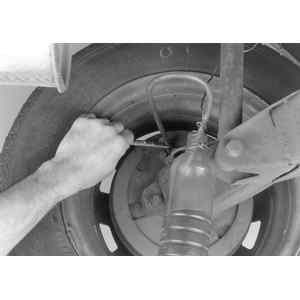
| Fig. 1: When bleeding the brake system use a clear
container and fresh clean brake fluid — watch the
hose for bubble-free fluid
|
WARNING
Brake fluid picks up moisture from the air, which reduces its effectiveness
and causes brake line corrosion. Don't leave the master cylinder or the
fluid container open any long than necessary. Be careful not to spill brake
fluid on painted surfaces. Wipe up any spilled fluid immediately and rinse
the area with clear water.
- Clean all the bleeder screws. You may want to give each one a shot of penetrating
solvent to loosen it up. Seizure is a common problem with bleeder screws,
which then break off, requiring replacement.
- Attach a length of clear vinyl tubing to the bleeder screw on the wheel
cylinder (or master cylinder). Insert the other end of the tube into a clear,
clean plastic bottle half filled with brake fluid.
- Have your helper slowly depress the brake pedal.
- As this is being done, open the bleeder screw 1⁄3 – 1⁄2 of
a turn, and allow the fluid to run through the tube.
- Close the bleeder screw before the pedal reaches the end of its travel.
- Have your assistant slowly release the pedal.
- Repeat this process until no air bubbles appear in the expelled fluid.
- Repeat the procedure on the other three brakes, checking the fluid level
in the master cylinder reservoirs often.
- Do not allow the reservoirs to run dry, or the bleeding process will have
to be repeated.
- Upon completion of bleeding all four wheels, check the level of the brake
fluid in the master cylinder reservoir and add fluid to the level line, if
necessary.

