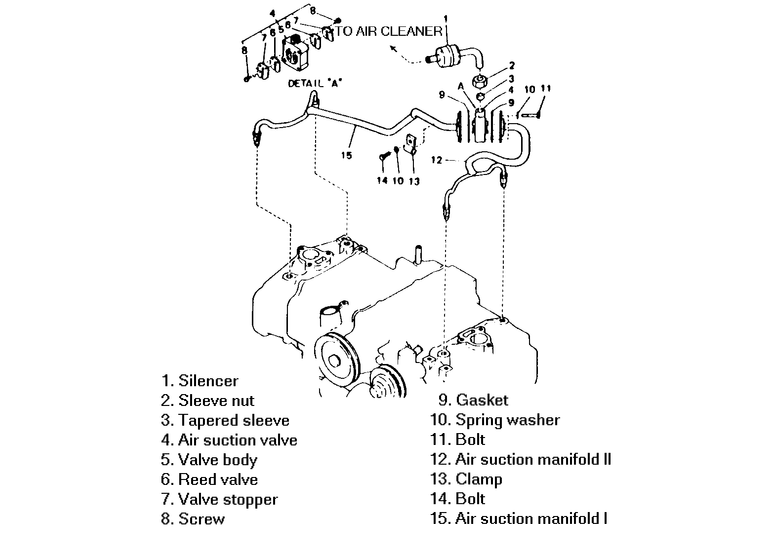
| Fig. 1: Air injection system components
|
The Air Injection (AI) system utilizes the vacuum created by exhaust gas pulsation and normal intake manifold vacuum. Each exhaust port is connected to the air suction valve by air suction manifolds. When a vacuum is created in the exhaust ports, a reed in the suction valve opens allowing fresh air to be sucked into the exhaust ports. When there is pressure rather than vacuum in the exhaust ports, the reed in the air suction valve closes, preventing the flow of exhaust gases.
The fresh air sucked through the air suction valve is used for oxidation of HC and CO in the exhaust passages and partly for combustion in the cylinders
The system incorporates an electronically controlled solenoid that either deactivates this system entirely, or partially a short time after the engine is started cold. The only way to determine that there is a problem with this system is to remove the solenoid and test it electrically.
Models equipped with an AI system incorporate an Air Suction Valve (ASV), which can be disassembled and serviced.
Various models have an exhaust port liner made from stainless steel plate built into the cylinder head as one unit. The port liner has a built in air layer which decreases heat transfer to the cylinder head while keeping the exhaust port at a higher temperature. The insulation of the exhaust port helps oxidation of residual HC and CO with the help of the remaining air in the exhaust gases.
The anti-afterburn valve prevents afterburning that occurs on cold starts. Below 122°F (50°C), the temperature valve has an open passage connecting the afterburning valve with the intake manifold via a vacuum line. The vacuum line remains opened, and the afterburning valve in operation until the coolant temperature becomes hot enough to shut off the vacuum and override the afterburning system.