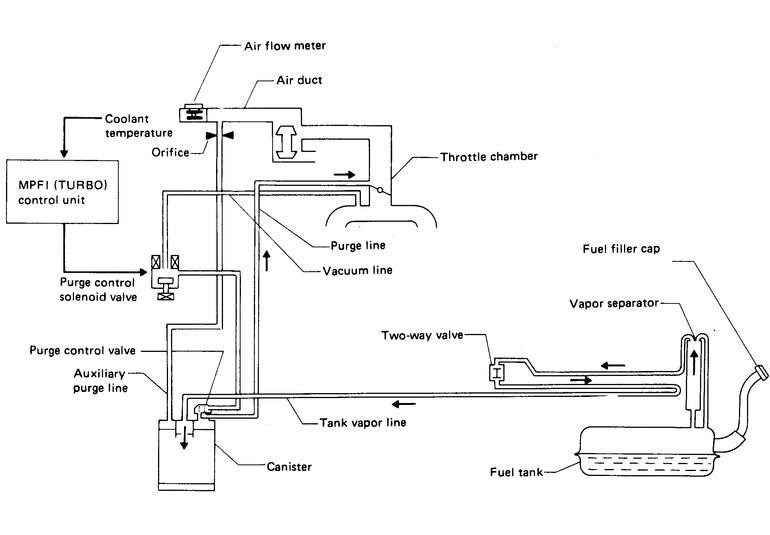
| Fig. 1: Evaporative emission for a typical MPFI engine
|
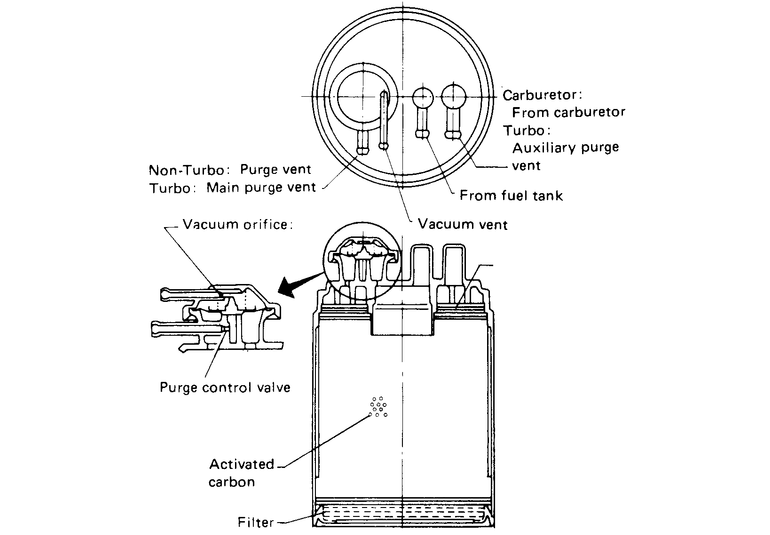
| Fig. 2: Cutaway view of an evaporative emission canister
|
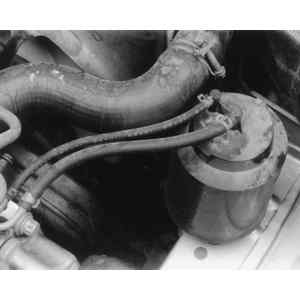
| Fig. 3: Evaporative emission canister in the engine compartment — Legacy
|
The evaporative emission control system is employed to prevent evaporated fuel in the fuel tank or carburetor bowl (carbureted engines only) from being discharged into the atmosphere. System components differ slightly according to the model of the vehicle and the type of fuel system, but all systems function in the same manner.
Gasoline vapor from the fuel tank (and carburetor bowl) is introduced into a canister mounted in the engine compartment. This canister is filled with activated charcoal which absorbs the vapors and stores them. This function of the canister is continuous and is performed whether the engine is running or stopped; the function of the float chamber ventilation valve is only performed when the engine is stopped.
In order to clear the charcoal canister of vapors, the system purges the canister while the engine is running. When predetermined engine conditions are met, usually when the engine is at normal operating temperature and running at a speed greater than idle, a purge control valve opens to allow the stored vapors to enter the intake tract. The purge control valve can be vacuum or electrically controlled.
Once the purge control valve is open, the stored vapors in the canister are drawn, along with the incoming air/fuel charge, into the combustion chamber and burned. Fresh air is allowed to enter the canister through a filter in the bottom to fully purge the system.
Most models use a fuel separator, mounted on the fuel tank, to prevent liquid fuel from being transferred to the charcoal canister in the event of severe cornering or abrupt stops. Liquid fuel in the separator is returned to the fuel tank through a hose at the rear of the tank. On some models, a fuel cut valve is used to control liquid fuel from entering the vapor pipe. The rising level of the fuel from the tank causes a float to move up and close the cap hole to prevent fuel from entering the pipe.
A two-way valve is used on all vehicles to allow the fuel tank to breathe. When a vacuum is created in the fuel tank due to the fuel pump suck fuel, the two-way valve opens to allow a flow of air from the vapor canister to the tank. When pressure is built up in the tank, the valve opens in the opposite direction to allow the pressure to be vented into the charcoal canister. In the event of a two-way valve failure, the fuel cap is fitted with a valve to allow the tank to ingest air. This will prevent a collapse of the tank.